Chapter 5
Physics for Aviation
Anti-Torque Systems
Any time a force is applied to make an object rotate; there will be equal force acting in the opposite direction. If the helicopter’s main rotor system rotates clockwise when viewed from the top, the helicopter will try to rotate counterclockwise. Earlier in this chapter, it was discovered that torque is what tries to make something rotate. For this reason, a helicopter uses what is called an anti-torque system to counteract the force trying to make it rotate.
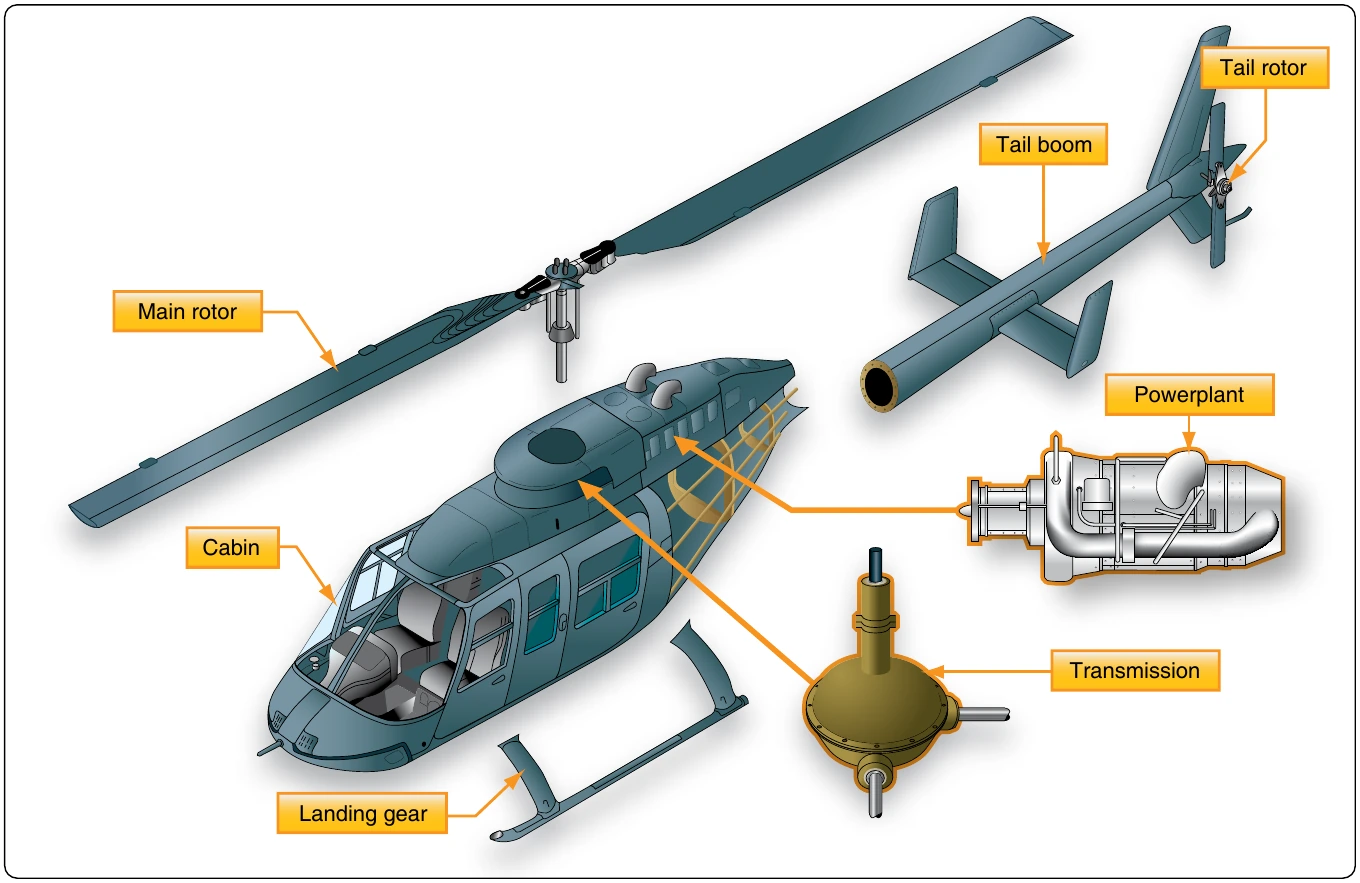
One method that is used on a helicopter to counteract torque is to place a spinning set of blades at the end of the tail boom. These blades are called a tail rotor or anti-torque rotor, and their purpose is to create a force, or thrust that acts in the opposite direction of the way the helicopter is trying to rotate. The tail rotor force, in pounds, multiplied by the distance from the tail rotor to the main rotor, in feet, creates a torque in pound-feet that counteracts the main rotor torque.
Figure 5-86 shows a three-bladed tail rotor on an Aerospatiale AS-315B helicopter. This tail rotor has open tipped blades that are variable pitch, and the helicopter’s anti-torque pedals that are positioned like rudder pedals on an airplane, control the amount of thrust they create. Some potential problems with this tail rotor system are as follows:
- The spinning blades are deadly if someone walks into them.
- When the helicopter is in forward flight and a vertical fin may be in use to counteract torque, the tail rotor robs engine power and creates drag.
An alternative to the tail rotor seen in Figure 5-86 is a type of anti-torque rotor known as a fenestron, or “fan-in-tail” design as seen in Figure 5-87. The rotating blades present less of a hazard to personnel on the ground and they create less drag in flight, because they are enclosed in a shroud.
A third method of counteracting the torque of the helicopter’s main rotor is a technique called the “no tail rotor” system, or NOTAR. This system uses a high volume of air at low pressure, which comes from a fan driven by the helicopter’s engine. The fan forces air into the tail boom, where a portion of it exits out of slots on the right side of the boom and, in conjunction with the main rotor downwash, creates a phenomenon called the “Coanda effect.” The air coming out of the slots on the right side of the boom causes a higher velocity, and therefore lower pressure, on that side of the boom. The higher pressure on the left side of the boom creates the primary force that counteracts the torque of the main rotor.
The remainder of the air travels back to a controllable rotating nozzle in the helicopter’s tail. The air exits the nozzle at a high velocity, and creates an additional force, or thrust, that helps counteracts the torque of the main rotor. A NOTAR system is shown in Figures 5-88 and 5-89.
For helicopters with two main rotors, such as the Chinook that has a main rotor at each end, no anti-torque rotor is needed. For this type of helicopter, the two main rotors turn in opposite directions, and each one cancels out the torque of the other.
Helicopter Axes of Flight
Helicopters, like airplanes, have a vertical, lateral, and longitudinal axis that passes through the helicopter’s center of gravity. Helicopters yaw around the vertical axis, pitch around the lateral axis, and rotate around the longitudinal axis. Figure 5-90 shows the three axes of a helicopter and how they relate to the helicopter’s movement. All three axes will intersect at the helicopter’s center of gravity, and the helicopter pivots around this point. Notice in the figure that the vertical axis passes almost through the center of the main rotor, because the helicopter’s center of gravity needs to be very close to this point.
Control Around the Vertical Axis
For a single main rotor helicopter, control around the vertical axis is handled by the anti-torque rotor, or tail rotor, or from the fan’s airflow on a NOTAR type helicopter. Like in an airplane, rotation around this axis is known as yaw. The pilot controls yaw by pushing on the anti-torque pedals located on the cockpit floor, in the same way the airplane pilot controls yaw by pushing on the rudder pedals. To make the nose of tries to spin in a counterclockwise direction because of the torque of the main rotor, the pilot will also push on the right anti-torque pedal to counteract the main rotor torque. By using the anti-torque pedals, the pilot can intentionally make the helicopter rotate in either direction around the vertical axis. The anti-torque pedals can be seen in Figure 5-91.