
Chapter 6
Aircraft Weight & Balance
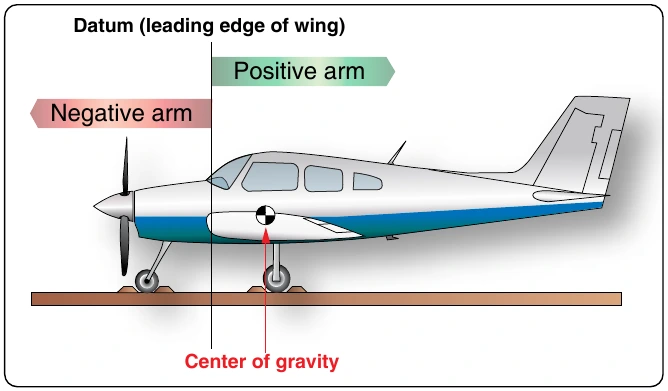
The arm of each item is usually included in parentheses immediately after the item’s name or weight in the Aircraft Specifications, TCDS, or equipment list for the aircraft. For example, in a TCDS, the fuel quantity might be identified as 98 gallons (gal) (+93.6) and the forward baggage limit as 100 pounds (lb) (–22.5). These numbers indicate that the fuel is located 93.6" aft of the datum and the nose baggage is located 22.6" forward of the datum. If the arm for a piece of equipment is not known, its exact location must be accurately measured. When the arm for a piece of equipment is being determined, the measurement is taken from the datum to the piece of equipment’s own CG.
Moment
To understand balance, it is necessary to have a working knowledge of the principle of moments. For those unfamiliar with weight and balance terms, the word moment is the product of a force or weight times a distance. The distance used in calculating a moment is referred to as the arm or moment arm and is usually expressed in inches. To calculate a moment, a force (or weight) and a distance must be known. The weight is multiplied by the distance from the datum and the result is the moment, which is expressed in inch-pounds (in-lb), a point through which the force acts. For the purpose of illustration, compare an aircraft to a seesaw. Like the seesaw, for an aircraft to be in balance, or equilibrium, the (in inches) from the datum have greater moments.
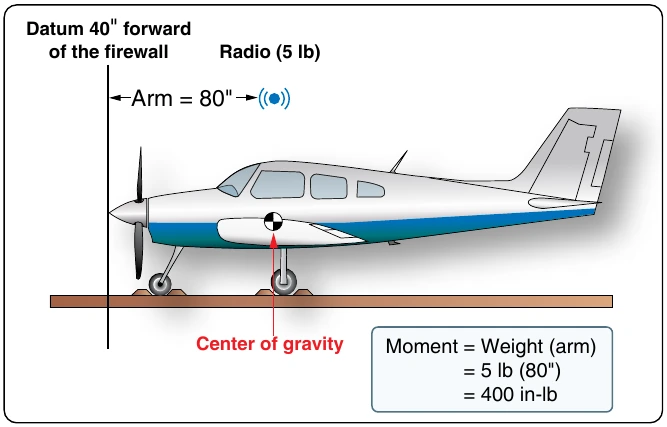
A 5 lb radio located 80" from the datum would have a moment of 400 in-lb (5 lb × 80"). A 10-pound radio located 12" from the datum would have a moment of 120 in-lb. Whether the moment is preceded by a positive (+) or negative (−) sign depends on its location in relation to the datum. Figure 6-2 shows where the moment ends up being a positive number because the weight and arm are both positive.
The algebraic sign of the moment, based on the datum location and whether weight is being installed or removed [Figure 6-3], would be as follows:
- Weight being added aft of the datum produces a positive moment (+weight, +arm).
- Weight being added forward of the datum produces a negative moment (+weight, −arm).
- Weight being removed aft of the datum produces a negative moment (−weight, +arm).
- Weight being removed forward of the datum produces a positive moment (−weight, −arm).
When dealing with positive and negative numbers, remember that the product of like signs produces a positive answer, and the product of unlike signs produces a negative answer.
Center of Gravity (CG)
The CG is the point at which all the weight of the aircraft is concentrated and balanced; therefore, the aircraft can be supported at that point (the CG). The magnitude of the nose-heavy and tail-heavy moments are exactly equal. It is the balance point for the aircraft and, if suspended from this point, there would be no tendency to rotate in a noseup or nosedown attitude.
Figure 6-4 shows a lever with the pivot point (called a fulcrum) located at the CG for the lever. Even though the weights on either side of the fulcrum are not equal, and the distances from each weight to the fulcrum are not equal, the product of the weights and arms (moments) are equal, and that is what produces a balanced condition. Therefore, the lever would be balanced much like two persons sitting on a seesaw who are differing weights and located at different distances from the fulcrum.
Maximum Weight
The maximum weight is the maximum authorized weight of the aircraft and its contents, and is indicated in the Aircraft Specifications or TCDS. For many aircraft, there are variations to the maximum allowable weight depending on the purpose and conditions under which the aircraft is to be flown. For example, a certain aircraft may be allowed a maximum gross weight of 2,750 lb when flown in the normal category, but when flown in the utility category, which allows for limited aerobatics, the same aircraft’s maximum allowable gross weight might only be 2,175 lb. There are other variations when dealing with the concept of maximum weight, as follows:
- Maximum Ramp Weight—the heaviest weight to which an aircraft can be loaded while it is sitting on the ground. This is sometimes referred to as the maximum taxi weight.
- Maximum Takeoff Weight—the heaviest weight an aircraft can be when it starts the takeoff roll. The difference between this weight and the maximum ramp weight would equal the weight of the fuel that would be consumed prior to takeoff.
- Maximum Landing Weight—the heaviest weight an aircraft can be when it lands. For large, wide body commercial airplanes, it can be 100,000 lb less than maximum takeoff weight, or even more.
- Maximum Zero Fuel Weight—the heaviest weight an aircraft can be loaded to without having any usable fuel in the fuel tanks. Any weight loaded above this value must be in the form of fuel.
Empty Weight
The empty weight of an aircraft includes all operating equipment that has a fixed location and is actually installed in the aircraft. It includes the weight of the airframe, powerplant, required equipment, optional or special equipment, fixed ballast, hydraulic fluid, and residual fuel and oil. Residual fuel and oil are the fluids that do not normally drain out because they are trapped in the fuel lines, oil lines, and tanks. They must be included in the aircraft’s empty weight. For most aircraft certified after 1978, the full capacity of the engine oil system is also included in the empty weight. Information regarding residual fluids in aircraft systems that must be included in the empty weight, and whether or not full oil is included, will be indicated in the Aircraft Specifications or TCDS.
Other terms that are used when describing empty weight include basic empty weight, licensed empty weight, and standard empty weight. The term “basic empty weight” applies when the full capacity of the engine oil system is included in the value. The term “licensed empty weight” applies when only the weight of residual oil is included in the value, so it generally involves only aircraft certified prior to 1978. Standard empty weight would be a value supplied by the aircraft manufacturer, and it would not include any optional equipment that might be installed in an aircraft. For most people working in the aviation maintenance field, the basic empty weight of the aircraft is the most important one.
Empty Weight Center of Gravity (EWCG)
The EWCG for an aircraft is the point at which it balances when it is in an empty weight condition. The concepts of empty weight and CG were discussed earlier in this chapter, and now they are being combined into a single concept.