
Chapter 7
Aircraft Materials, Hardware, & Processes
Identification & Coding
Part numbers designate the type of nut. The common types and their respective part numbers are:
- Plain, AN315 and AN335
- Castle, AN310
- Plain check, AN316
- Light hex, AN340 and AN345
- Castellated shear, AN320
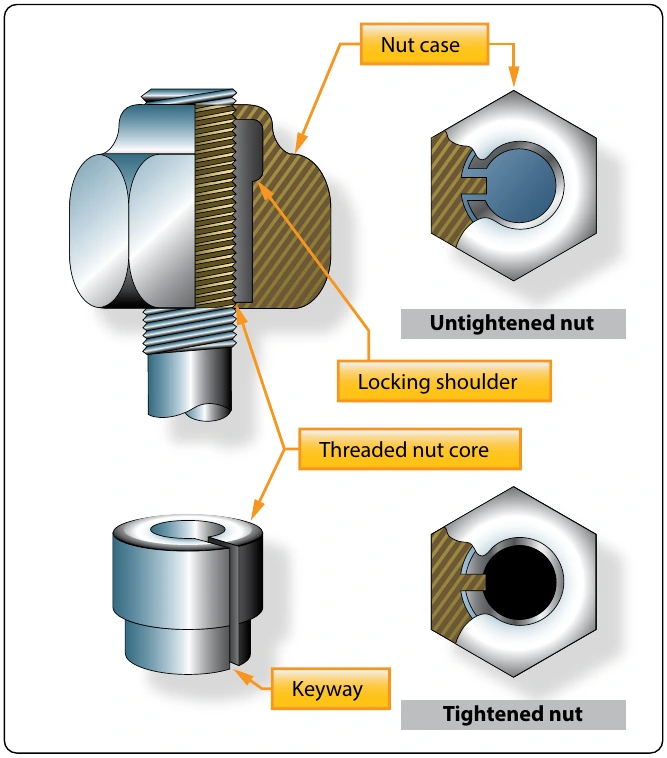
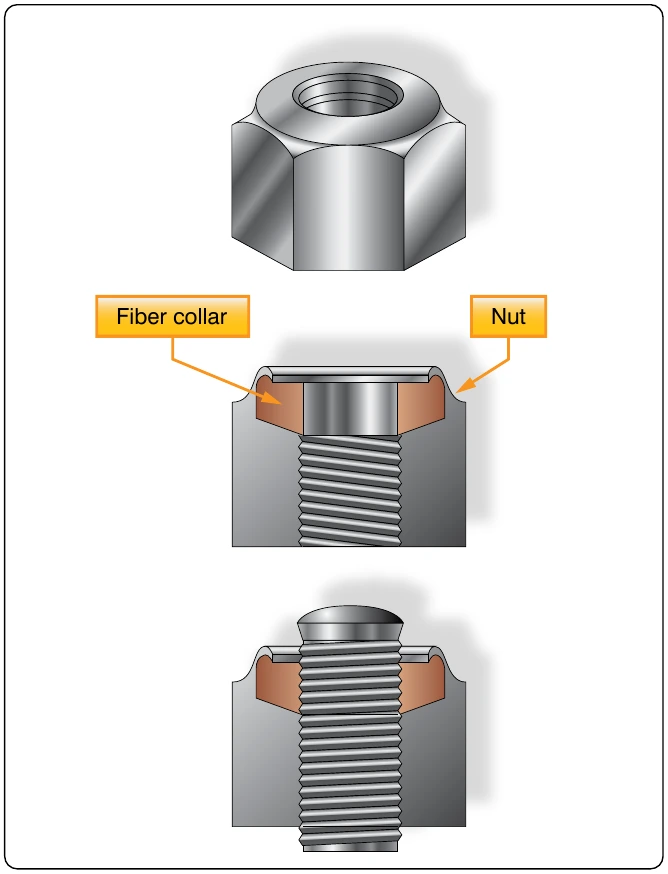
The patented self-locking types are assigned part numbers ranging from MS20363 through MS20367. The Boots, the Flexloc, the fiber locknut, the elastic stop nut, and the self-locking nut belong to this group. Part number AN350 is assigned to the wing nut.
Letters and digits following the part number indicate such items as material, size, threads per inch, and whether the thread is right or left hand. The letter “B” following the part number indicates the nut material to be brass, a “D” indicates 2017-T aluminum alloy, a “DD” indicates 2024-T aluminum alloy, a “C” indicates stainless steel, and a dash in place of a letter indicates cadmium-plated carbon steel.
The digit (or two digits) following the dash or the material code letter is the dash number of the nut, and it indicates the size of the shank and threads per inch of the bolt on which the nut fits. The dash number corresponds to the first figure appearing in the part number coding of general purpose bolts. A dash and the number 3, for example, indicate that the nut fits an AN3 bolt (10-32); a dash and the number 4 means it fits an AN4 bolt (1⁄4-28); a dash and the number 5, an AN5 bolt (5⁄16-24); and so on.
The code numbers for self-locking nuts end in three or four digit numbers. The last two digits refer to threads per inch, and the one or two preceding digits stand for the nut size in 16ths of an inch.
Some other common nuts and their code numbers are:
Aircraft Washers
Aircraft washers used in airframe repair are either plain, lock, or special type washers.
Plain Washers
Plain washers, both the AN960 and AN970, are used under hex nuts. [Figure 7-30] They provide a smooth bearing surface and act as a shim in obtaining correct grip length for a bolt and nut assembly. They are used to adjust the position of castellated nuts in respect to drilled cotter pin holes in bolts. Use plain washers under lock washers to prevent damage to the surface material.
Aluminum and aluminum-alloy washers may be used under bolt heads or nuts on aluminum alloy or magnesium structures where corrosion caused by dissimilar metals is a factor. When used in this manner, any electric current flow is between the washer and the steel bolt. However, it is common practice to use a cadmium-plated steel washer under a nut bearing directly against a structure as this washer resists the cutting action of a nut better than an aluminum-alloy washer.
The AN970 steel washer provides a greater bearing area than the AN960 washer and is used on wooden structures under both the head and the nut of a bolt to prevent crushing the surface.
Lock Washers
Lock washers, both the AN935 and AN936, are used with machine screws or bolts where the self-locking or castellated-type nut is not appropriate. The spring action of the washer (AN935) provides enough friction to prevent loosening of the nut from vibration. [Figure 7-30]