
Chapter 7
Aircraft Materials, Hardware, & Processes
Boots self-locking nuts are made with three different spring styles and in various shapes and sizes. The wing type that is the most common ranges in size for No. 6 up to 1⁄4 inch, the Rol-top ranges from 1⁄4 inch to 1⁄6 inch, and the bellows type ranges in size from No. 8 up to 3⁄8 inch. Wing-type nuts are made of anodized aluminum alloy, cadmium-plated carbon steel, or stainless steel. The Rol-top nut is cadmium-plated steel, and the bellows type is made of aluminum alloy only..
Stainless Steel Self-Locking Nut
The stainless steel self-locking nut may be spun on and off by hand as its locking action takes places only when the nut is seated against a solid surface and tightened. The nut consists of two parts: a case with a beveled locking shoulder and key and a thread insert with a locking shoulder and slotted keyway. Until the nut is tightened, it spins on the bolt easily, because the threaded insert is the proper size for the bolt. However, when the nut is seated against a solid surface and tightened, the locking shoulder of the insert is pulled downward and wedged against the locking shoulder of the case. This action compresses the threaded insert and causes it to clench the bolt tightly. The cross-sectional view in Figure 7-27 shows how the key of the case fits into the slotted keyway of the insert so that when the case is turned, the threaded insert is turned with it. Note that the slot is wider than the key. This permits the slot to be narrowed and the insert to be compressed when the nut is tightened.
Elastic Stop Nut
The elastic stop nut is a standard nut with the height increased to accommodate a fiber locking collar. This fiber collar is very tough and durable and is unaffected by immersion in hot or cold water or ordinary solvents, such as ether, carbon tetrachloride, oils, and gasoline. It will not damage bolt threads or plating.
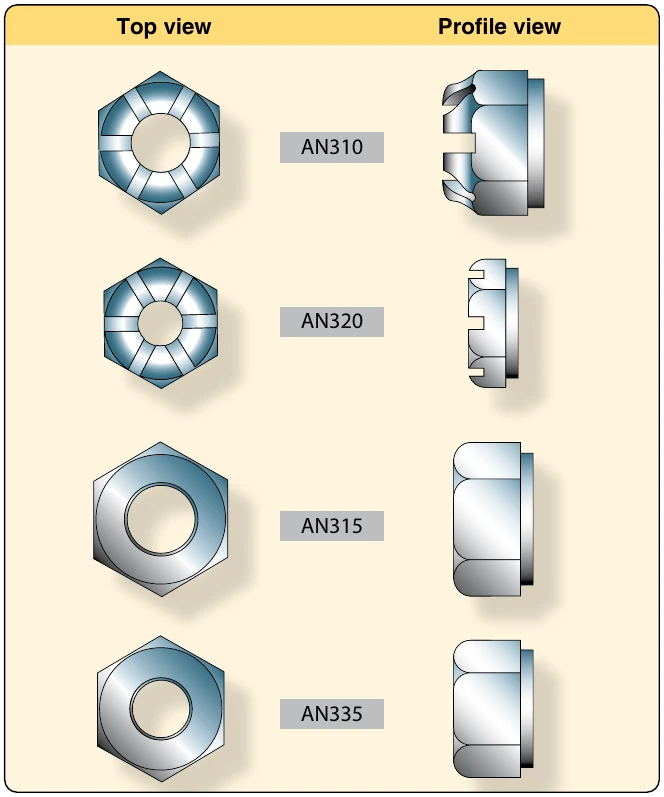
As shown in Figure 7-28, the fiber locking collar is not threaded, and its inside diameter is smaller than the largest diameter of the threaded portion or the outside diameter of a corresponding bolt. When the nut is screwed onto a bolt, it acts as an ordinary nut until the bolt reaches the fiber collar. When the bolt is screwed into the fiber collar, however, friction (or drag) causes the fiber to be pushed upward. This creates a heavy downward pressure on the load carrying part and automatically throws the load carrying sides of the nut and bolt threads into positive contact. After the bolt has been forced all the way through the fiber collar, the downward pressure remains constant. This pressure locks and holds the nut securely in place even under severe vibration.
Nearly all elastic stop nuts are steel or aluminum alloy. However, such nuts are available in practically any kind of metal. Aluminum-alloy elastic stop nuts are supplied with an anodized finish. Steel nuts are cadmium plated.
Normally, elastic stop nuts can be used many times with complete safety and without detriment to their locking efficiency. When reusing elastic stop nuts, be sure the fiber has not lost its locking friction or become brittle. If a nut can be turned with the fingers, replace it.
After the nut has been tightened, make sure the rounded or
TToopp vviieeww PPrrooffiillee vviieeww - - - ~-chamfered end of the bolts, studs, or screws extends at least the full round or chamfer through the nut. Flat end bolts, studs, or screws should extend at least 1⁄32 inch through the nut. Bolts of 5⁄16-inch diameter and over with cotter pin holes may be used with self-locking nuts, but only if free from burrs around the holes. Bolts with damaged threads and rough ends are not acceptable. Do not tap the fiber locking insert. The self-locking action of the elastic stop nut is the result of having the bolt threads impress themselves into the untapped fiber.
Do not install elastic stop nuts in places where the temperature is higher than 250 °F, because the effectiveness of the self-locking action is reduced beyond this point. Self-locking nuts may be used on aircraft engines and accessories when the engine manufacturer specifies their use.
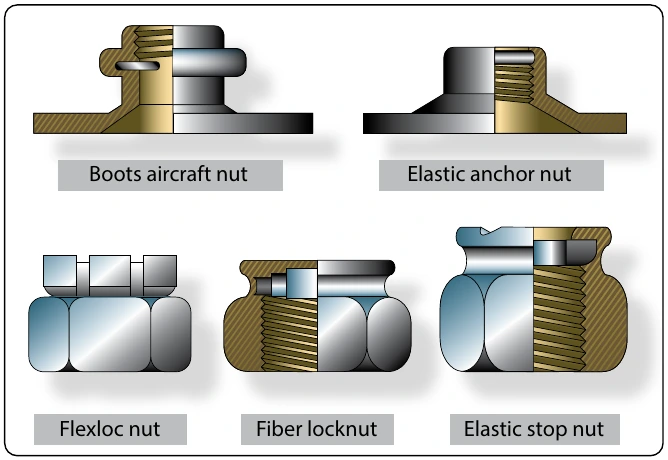
Self-locking nut bases are made in several forms and materials for riveting and welding to aircraft structure or parts. [Figure 7-29] Certain applications require the installation of self-locking nuts in channels, an arrangement that permits the attachment of many nuts with only a few rivets. These channels are track-like bases with regularly spaced nuts, which are either removable or non-removable. The removable type carries a floating nut that can be snapped in or out of the channel, thus making possible the easy removal of damaged nuts. Nuts, such as the clinch-type and spline-type, depend on friction for their anchorage and are not acceptable for use in aircraft structures.
Sheet Spring Nuts
Sheet spring nuts, such as speed nuts, are used with standard and sheet metal self-tapping screws in non-structural locations. They find various uses in supporting line clamps, conduit clamps, electrical equipment, access doors, and the like and are available in several types. Speed nuts are made from spring steel and are arched prior to tightening. This arched spring lock prevents the screw from working loose.
These nuts should be used only where originally used in the fabrication of the aircraft.
Internal & External Wrenching Nuts
Two commercial types of high-strength internal or external wrenching nuts are available; they are the internal and external wrenching elastic stop nut and the Unbrako internal and external wrenching nut. Both are of the self-locking type, are heat-treated, and can carry high-strength bolt tension loads.