
Chapter 7
Aircraft Materials, Hardware, & Processes
- The stem is pulled through the rivet shank.
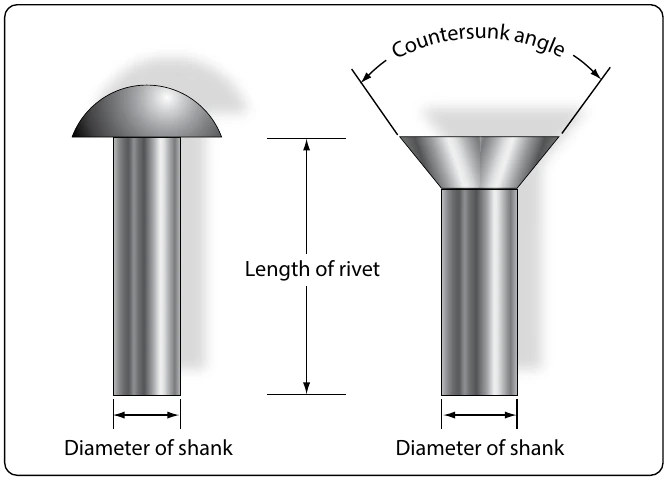
Pull-thru rivets are fabricated in two common head styles: protruding head like the MS20470 or universal head and a 100° countersunk head. Other head styles are available from some manufacturers.
Pull-thru rivets are fabricated from several materials. The most commonly used are 2117-T4 aluminum alloy, 5056 aluminum alloy, Monel. Pull-thru rivets are designed so that installation requires only one person; it is not necessary to have the work accessible from both sides.
Factors to consider in the selection of the correct rivet for installation are: installation location, composition of the material being riveted, thickness of the material being riveted, and strength desired.
The thickness of the material being riveted determines the overall length of the shank of the rivet. As a general rule, the shank of the rivet should extend beyond the material thickness approximately 3⁄64 inch to 1⁄8 inch before the stem is pulled. [Figure 7-42] Each company that manufactures pull-thru rivets has a code number to help users obtain correct rivet for the grip range of a particular installation. In addition, MS numbers are used for identification purposes. Numbers are similar to those shown on the preceding pages.
Self-Plugging Rivets (Mechanical Lock)
Self-plugging (mechanical lock) rivets are like self-plugging (friction lock) rivets, except for the way the stem is retained in the rivet sleeve. This type of rivet has a positive mechanical locking collar to resist vibrations that cause the friction lock rivets to loosen and possibly fall out. [Figure 7-43] Also, the mechanical locking-type rivet stem breaks off flush with the head and usually does not require further stem trimming when properly installed. Self-plugging (mechanical lock) r_iv_ets_ di_sp_lay all the strength characteristics of solid shank rivets and, in most cases, can be substituted rivet for rivet.
Bulbed CherryLOCK® Rivets
The large blind head of this fastener introduced the word “bulb” to blind rivet terminology. In conjunction with the unique residual preload developed by the high stem break load, its proven fatigue strength makes it the only blind rivet interchangeable structurally with solid rivets. [Figure 7-44]
Wiredraw CherryLOCK® Rivets
There is a wide range of sizes, materials, and strength levels from which to select. This fastener is especially suited for sealing applications and joints requiring an excessive amount of sheet take-up. [Figure 7-45]
Huck® Mechanical Locked Rivets
Self-plugging (mechanical lock) rivets are fabricated in two sections: a head and shank (including a conical recess and locking collar in the head) and a serrated stem that extends through the shank. Unlike the friction lock rivet, the Huck® mechanical lock rivet has a locking collar that forms a positive lock for retention of the stem in the shank of the rivet. This collar is seated in position during the installation of the rivet.
Material
Self-plugging (mechanical lock) rivets are fabricated with sleeves (rivet shanks) of 2017 and 5056 aluminum alloys, Monel, or stainless steel.
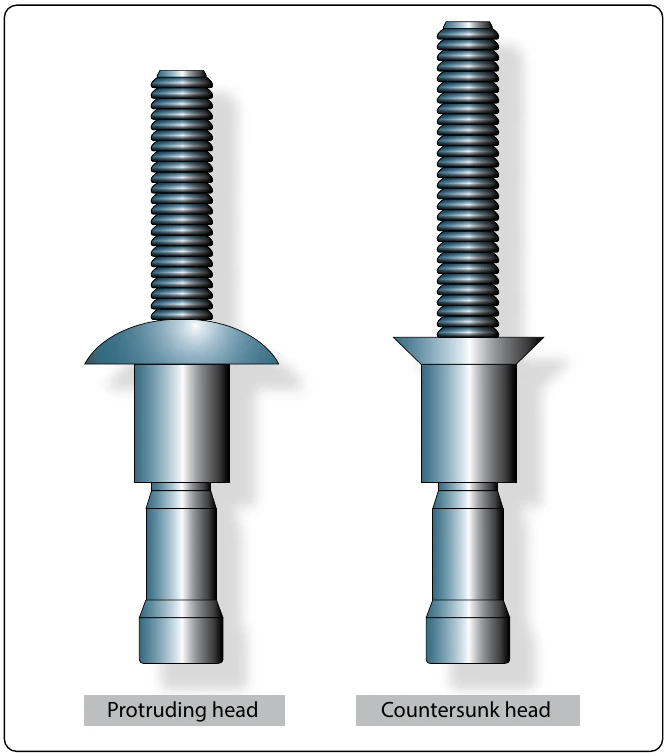
The mechanical lock type of self-plugging rivet can be used in the same applications as the friction lock type of rivet. In addition, because of its greater stem retention characteristic, installation in areas subject to considerable vibration is recommended.
The same general requirements must be met in the selection of the mechanical lock rivet as for the friction lock rivet. Composition of the material being joined together determines the composition of the rivet sleeve. For example, 2017 aluminum alloy rivets for most aluminum alloys and 5056 aluminum rivets for magnesium.
Figure 7-46 depicts the sequences of a typical mechanically-locked blind rivet. The form and function may vary slightly between blind rivet styles and specifics should be obtained from manufacturers.