Chapter 1
Aircraft Engines
Example
Indicated horsepower worked example
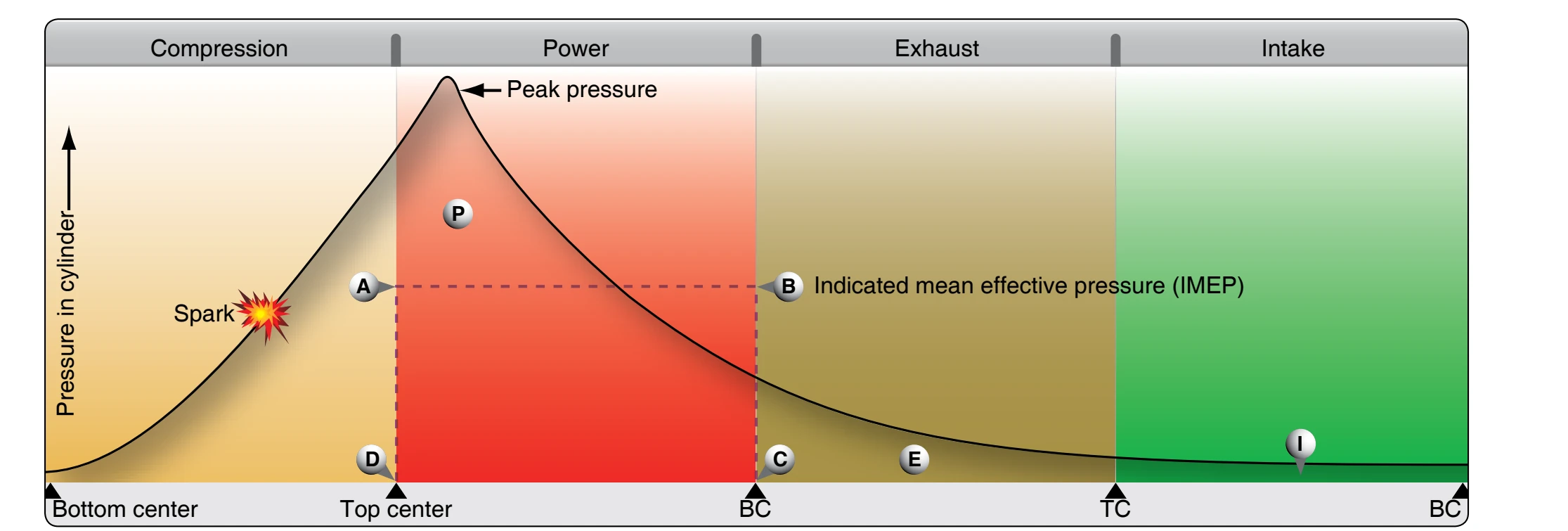
Linear form: Given: P = 1.65 lb/in²; L = 0.5 ft; A = 5.5 inches; N = 1,500; K = 12. Indicated hp = PLANK / 33,000 ft-lb/min. A = ¼πD² = ¼ × 3.1416 × 5.5 in × 5.5 in = 23.76 in². N = ½ × 3,000 = 1,500 rpm. Indicated hp = (1.65 lb/in² × 0.5 in × 23.76 in² × 1,500 rpm × 12) / 33,000 ft-lb/min = 1,069.123.
Source note: The printed example shows P = 1.65 lb/in², but the printed result 1,069.123 is consistent with P = 165 lb/in². It lists A = 5.5 inches, then calculates A as area from D = 5.5 inches, and it gives L = 0.5 ft before printing 0.5 in in the substitution. The printed labels, values, units, and result are preserved here without correction.
Brake Horsepower
The indicated horsepower calculation discussed in the preceding paragraph is the theoretical power of a frictionless engine. The total horsepower lost in overcoming friction must be subtracted from the indicated horsepower to arrive at the actual horsepower delivered to the propeller. The power delivered to the propeller for useful work is known as brake horsepower (bhp). The difference between indicated and brake horsepower is known as friction horsepower, which is the horsepower required to overcome mechanical losses, such as the pumping action of the pistons, the friction of the pistons, and the friction of all other moving parts.
The measurement of an engine’s bhp involves the measurement of a quantity known as torque or twisting moment. Torque is the product of a force and the distance of the force from the axis about which it acts, or
Torque
Linear form: Torque = force × distance (at right angles to the force)
Torque is a measure of load and is properly expressed in pound-inches (lb-in) or pound-feet (lb-ft). Torque should not be confused with work, which is expressed in inch-pounds (in-lb) or foot-pounds (ft-lb).
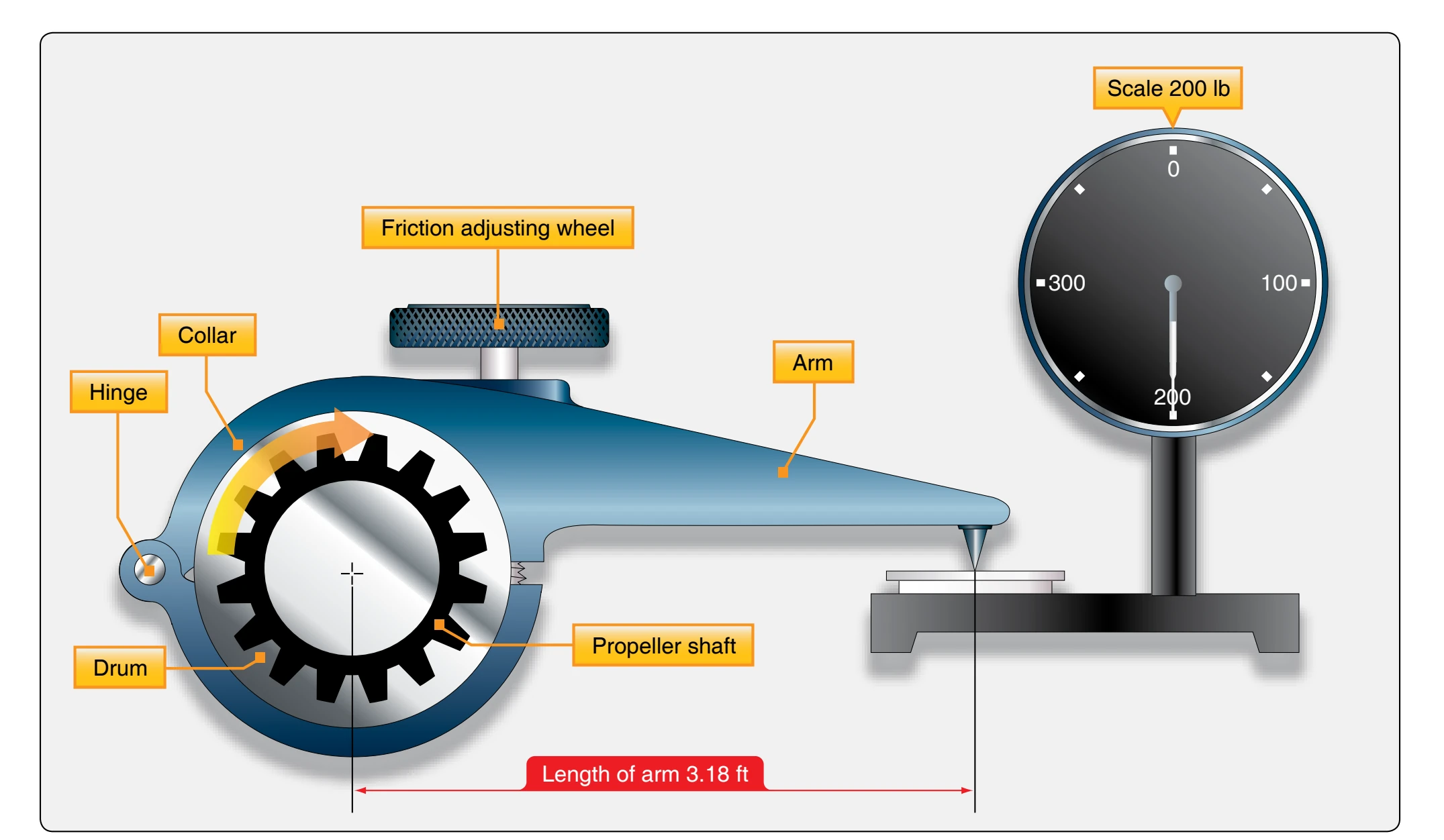
There are numerous devices for measuring torque, such as a dynamometer or a torque meter. One very simple type of device that can be used to demonstrate torque calculations is the Prony brake. [Figure 1-40] All of these torquemeasuring devices are usable to calculate power output of an engine on a test stand. It consists essentially of a hinged collar, or brake, which can be clamped to a drum splined to the propeller shaft. The collar and drum form a friction brake, which can be adjusted by a wheel. An arm of a known length is rigidly attached to or is a part of the hinged collar and terminates at a point that rests on a set of scales. As the propeller shaft rotates, it tends to carry the hinged collar of the brake with it and is prevented from doing so only by the arm that rests on the scale. The scale indicates the force necessary to arrest the motion of the arm. If the resulting force registered on the scale is multiplied by the length of the arm, the resulting product is the torque exerted by the rotating shaft. For example, if the scale registers 200 pounds and the length of the arm is 3.18 feet, the torque exerted by the shaft is:
Torque worked example
Linear form: 200 lb × 3.18 ft = 636 lb-ft
Once the torque is known, the work done per revolution of the propeller shaft can be computed without difficulty by the equation:
Work per revolution
Linear form: Work per revolution = 2π × torque
If work per revolution is multiplied by the rpm, the result is work per minute, or power. If the work is expressed in ft-lb per minute, this quantity is divided by 33,000. The result is the brake horsepower of the shaft.
Brake horsepower
Linear form: Power = work per revolution × rpm; bhp = (work per revolution × rpm) / 33,000; bhp = (2πr × force on scales (lb) × length of arm (ft) × rpm) / 33,000
Example
Brake horsepower worked example
Linear form: Given: force on scales = 200 lb; length of arm = 3.18 ft; rpm = 3,000; π = 3.1416. bhp = (6.2832 × 200 × 3.18 × 3,000) / 33,000 = 363.2 = 363.
As long as the friction between the brake collar and propeller shaft drum is great enough to impose an appreciable load on the engine, but is not great enough to stop the engine, it is not necessary to know the amount of friction between the collar and drum to compute the bhp. If there were no load imposed, there would be no torque to measure, and the engine would “run away.” If the imposed load is so great that the engine stalls, there may be considerable torque to measure, but there is no rpm. In either case, it is impossible to measure the bhp of the engine. However, if a reasonable amount of friction exists between the brake drum and the collar and the load is then increased, the tendency of the propeller shaft to carry the collar and arm about with it becomes greater, thus imposing a greater force upon the scales. As long as the torque increase is proportional to the rpm decrease, the horsepower delivered at the shaft remains unchanged. This can be seen from the equation in which 2πr and 33,000 are constants and torque and rpm are variables. If the change in rpm is inversely proportional to the change in torque, their product remains unchanged, and bhp remains unchanged. This is important. It shows that horsepower is the function of both torque and rpm, and can be changed by changing either torque, rpm, or both.
Friction Horsepower
Friction horsepower is the indicated horsepower minus brake horsepower. It is the horsepower used by an engine in overcoming the friction of moving parts, drawing in fuel, expelling exhaust, driving oil and fuel pumps, and other engine accessories. On modern aircraft engines, this power loss through friction may be as high as 10 to 15 percent of