
Chapter 1
Aircraft Engines
the indicated horsepower.
Friction & Brake Mean Effective Pressures
The indicated mean effective pressure (IMEP), discussed previously, is the average pressure produced in the combustion chamber during the operating cycle and is an expression of the theoretical, frictionless power known as indicated horsepower. In addition to completely disregarding power lost to friction, indicated horsepower gives no indication of how much actual power is delivered to the propeller shaft for doing useful work. However, it is related to actual pressures that occur in the cylinder and can be used as a measure of these pressures.
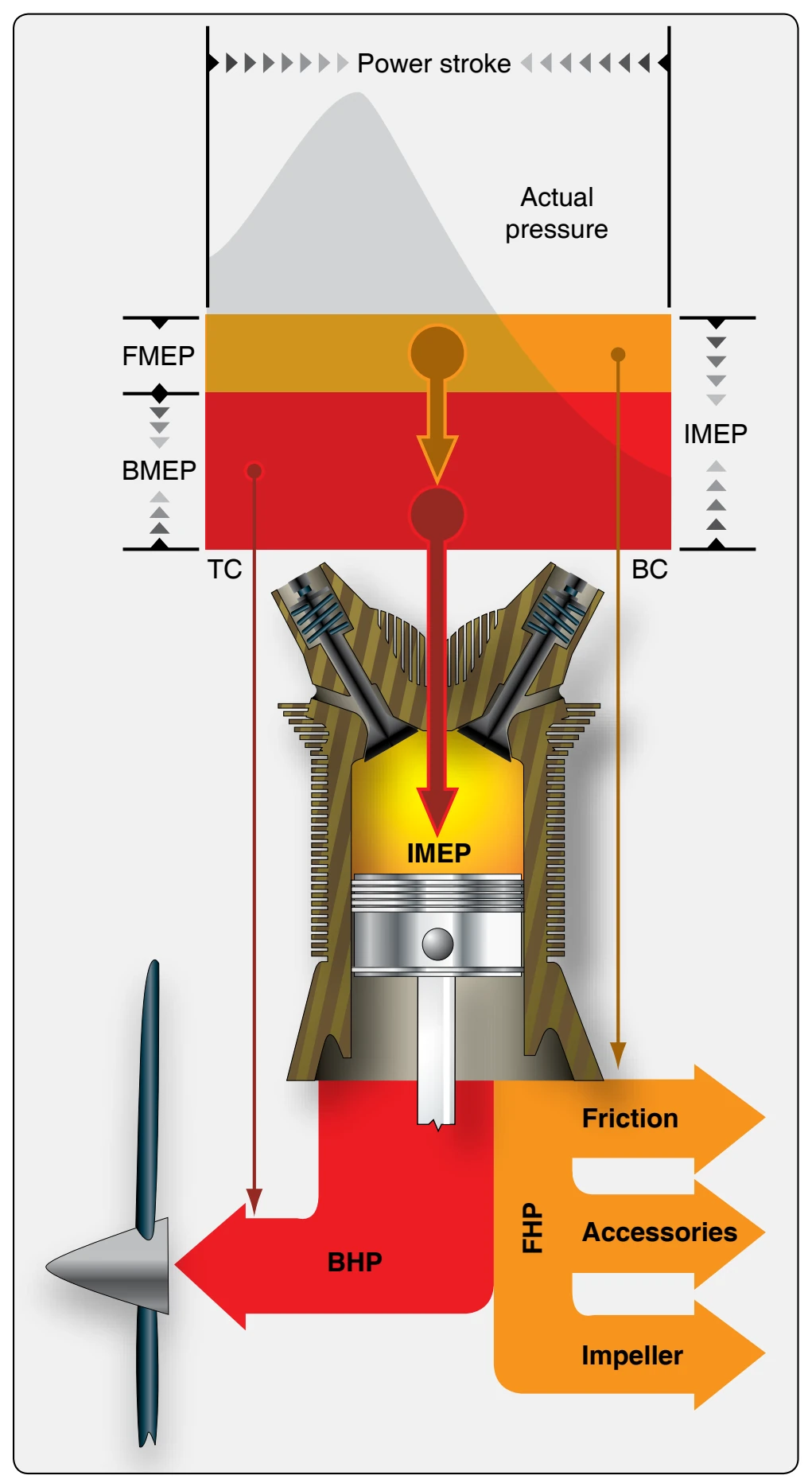
To compute the friction loss and net power output, the indicated horsepower of a cylinder may be thought of as two separate powers, each producing a different effect. The first power overcomes internal friction, and the horsepower thus consumed is known as friction horsepower. The second power, known as brake horsepower, produces useful work at the propeller. That portion of IMEP that produces brake horsepower is called brake mean effective pressure (BMEP). The remaining pressure used to overcome internal friction is called friction mean effective pressure (FMEP). [Figure 1-41] IMEP is a useful expression of total cylinder power output, but is not a real physical quantity; likewise, FMEP and BMEP are theoretical but useful expressions of friction losses and net power output.
Although BMEP and FMEP have no real existence in the cylinder, they provide a convenient means of representing pressure limits or rating engine performance throughout its entire operating range. There is an operating relationship between IMEP, BMEP, and FMEP.
One of the basic limitations placed on engine operation is the pressure developed in the cylinder during combustion. In the discussion of compression ratios and indicated mean effective pressure, it was found that, within limits, increased pressure resulted in increased power. It was also noted that if the cylinder pressure were not controlled within close limits, it would impose dangerous internal loads that might result in engine failure. Therefore, it is important to have a means of determining these cylinder pressures as a protective measure and for efficient application of power.
If the bhp is known, the BMEP can be computed by means of the following equation:
Brake mean effective pressure
Linear form: BMEP = (bhp × 33,000) / LANK. Given: bhp = 1,000; stroke = 6 in; bore = 5.5 in; rpm = 3,000; number of cycles = 12. L = 6 in = 0.5 ft. A = ¼ × 3.1416 × 5.5 in × 5.5 in = 23.76 in². N = ½ × rpm = ½ × 3,000 = 1,500. BMEP = (1,000 bhp × 33,000 ft-lb/min) / (0.5 ft × 23.76 in² × 1,500 strokes/min × 12) = 154.32 lb/in².
Thrust Horsepower
Thrust horsepower can be considered the result of the engine and the propeller working together. If a propeller could be designed to be 100 percent efficient, the thrust and the bph would be the same. However, the efficiency of the propeller varies with the engine speed, attitude, altitude, temperature, and airspeed. Thus, the ratio of the thrust horsepower and the bhp delivered to the propeller shaft will never be equal. For example, if an engine develops 1,000 bhp, and it is used with a propeller having 85 percent efficiency, the thrust horsepower of that engine-propeller combination is 85 percent of 1,000 or 850 thrust hp. Of the four types of horsepower discussed, it is the thrust horsepower that determines the performance of the engine-propeller combination.
Efficiencies
Thermal Efficiency
Any study of engines and power involves consideration of heat as the source of power. The heat produced by the burning of gasoline in the cylinders causes a rapid expansion of the gases in the cylinder, and this, in turn, moves the pistons
and creates mechanical energy. It has long been known that mechanical work can be converted into heat and that a given amount of heat contains the energy equivalent of a certain amount of mechanical work. Heat and work are theoretically interchangeable and bear a fixed relation to each other. Heat can therefore be measured in work units (for example, ft-lb) as well as in heat units. The British thermal unit (BTU) of heat is the quantity of heat required to raise the temperature of 1 pound of water by 1 °F. It is equivalent to 778 ft-lb of mechanical work. A pound of petroleum fuel, when burned with enough air to consume it completely, gives up about 20,000 BTU, the equivalent of 15,560,000 ft-lb of mechanical work. These quantities express the heat energy of the fuel in heat and work units, respectively.
The ratio of useful work done by an engine to the heat energy of the fuel it uses, expressed in work or heat units, is called the thermal efficiency of the engine. If two similar engines use equal amounts of fuel, the engine that converts into work the greater part of the energy in the fuel (higher thermal efficiency) delivers the greater amount of power. Furthermore, the engine that has the higher thermal efficiency has less waste heat to dispose of to the valves, cylinders, pistons, and cooling system of the engine. A high thermal efficiency also means low specific fuel consumption and, therefore, less fuel for a flight of a given distance at a given power. Thus, the practical importance of a high thermal efficiency is threefold, and it constitutes one of the most desirable features in the performance of an aircraft engine.
Of the total heat produced, 25 to 30 percent is utilized for power output, 15 to 20 percent is lost in cooling (heat radiated from cylinder head fins), 5 to 10 percent is lost in overcoming friction of moving parts; and 40 to 45 percent is lost through the exhaust. Anything that increases the heat content going into mechanical work on the piston, which reduces the friction and pumping losses, or which reduces the quantity of unburned fuel or the heat lost to the engine parts, increases the thermal efficiency.
The portion of the total heat of combustion that is turned into mechanical work depends to a great extent upon the compression ratio. The compression ratio is the ratio of the piston displacement plus combustion chamber space to the combustion chamber space, as mentioned earlier. Other things being equal, the higher the compression ratio is, the larger is the proportion of the heat energy of combustion turned into useful work at the crankshaft. On the other hand, increasing the compression ratio increases the cylinder head temperature. This is a limiting factor because the extremely high temperature created by high compression ratios causes the material in the cylinder to deteriorate rapidly and the fuel to detonate instead of burning at a controlled rate.
The thermal efficiency of an engine may be based on either bhp or indicated horsepower (ihp) and is represented by the following formula:
Indicated thermal efficiency
Linear form: Indicated thermal efficiency = (ihp × 33,000) / (weight of fuel burned/min × heat value × 778)