
Chapter 1
Aircraft Engines
The formula for brake thermal efficiency is the same as shown above, except the value for bhp is inserted instead of the value for ihp.
Example
An engine delivers 85 bhp for a period of 1 hour and during that time consumes 50 pounds of fuel. Assuming the fuel has a heat content of 18,800 BTU per pound, find the thermal efficiency of the engine:
Brake thermal efficiency worked example
Linear form: (8.5 ihp × 33,000) / (0.833 × 18,800 BTU × 778) = 2,805,000 / 12,184,569. Brake thermal efficiency = 0.23 or 23 percent.
Source note: The printed formula shows 8.5 ihp, but the displayed numerator 2,805,000 requires 85 hp, which also matches the preceding prose. The printed formula and result are preserved here without correction.
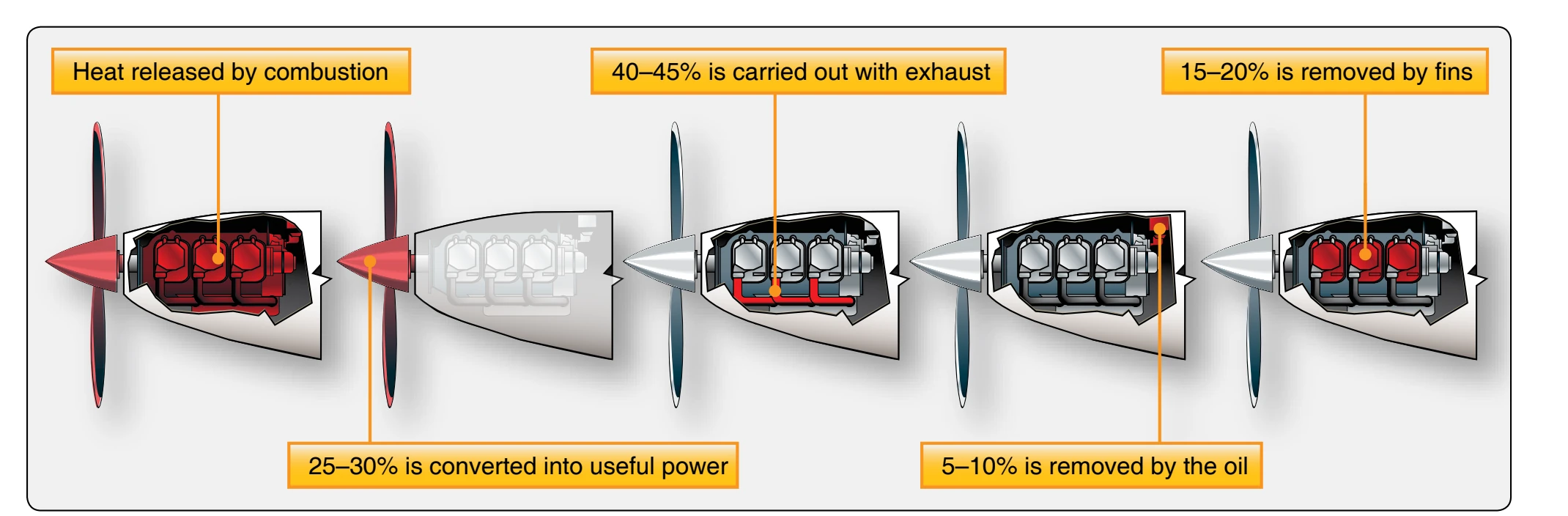
Reciprocating engines are only about 34 percent thermally efficient; that is, they transform only about 34 percent of the total heat potential of the burning fuel into mechanical energy. The remainder of the heat is lost through the exhaust gases, the cooling system, and the friction within the engine. Thermal distribution in a reciprocating engine is illustrated in Figure 1-42.
Mechanical Efficiency
Mechanical efficiency is the ratio that shows how much of the power developed by the expanding gases in the cylinder is actually delivered to the output shaft. It is a comparison between the bhp and the ihp. It can be expressed by the following formula:
Mechanical efficiency
Linear form: Mechanical efficiency = bhp / ihp
Brake horsepower is the useful power delivered to the propeller shaft. Indicated horsepower is the total hp developed in the cylinders. The difference between the two is friction horsepower (fhp), the power lost in overcoming friction. The factor that has the greatest effect on mechanical efficiency is the friction within the engine itself. The friction between moving parts in an engine remains practically constant throughout an engine’s speed range. Therefore, the mechanical efficiency of an engine is highest when the engine is running at the rpm at which maximum bhp is developed. Mechanical efficiency of the average aircraft reciprocating engine approaches 90 percent.
Volumetric Efficiency
Volumetric efficiency is a ratio expressed in terms of percentages. It is a comparison of the volume of air-fuel charge (corrected for temperature and pressure) inducted into the cylinders to the total piston displacement of the engine. Various factors cause departure from a 100 percent volumetric efficiency. The pistons of a naturally aspirated engine displace the same volume each time they travel from top center to bottom center of the cylinders. The amount of charge that fills this volume on the intake stroke depends on the existing pressure and temperature of the surrounding atmosphere. Therefore, to find the volumetric efficiency of an engine, standards for atmospheric pressure and temperature had to be established. The U.S. standard atmosphere was established in 1958, and provides the necessary pressure and temperature values to calculate volumetric efficiency.
The standard sea level temperature is 59 °F, or 15 °C. At this temperature, the pressure of one atmosphere is 14.69 lb/in2, and this pressure supports a column of mercury (Hg) 29.92 inches high, or 29.92 "Hg. These standard sea level conditions determine a standard density, and if the engine draws in a volume of charge of this density exactly equal to its piston displacement, it is said to be operating at 100 percent volumetric efficiency. An engine drawing in less volume than this has a volumetric efficiency lower than 100 percent. An engine equipped with true supercharging (boost above 30.00 "Hg) may have a volumetric efficiency greater than 100 percent. The equation for volumetric efficiency is as follows:
Volumetric efficiency
Linear form: Volumetric efficiency = volume of charge (corrected for temperature and pressure) / piston displacement
Many factors decrease volumetric efficiency, including:
- Part-throttle operation;
- Long intake pipes of small diameter;
- Sharp bends in the induction system;
- Carburetor air temperature too high;
- Cylinder-head temperature too high;
- Incomplete scavenging; and
- Improper valve timing.
Propulsive Efficiency
A propeller is used with an engine to provide thrust. The engine supplies bhp through a rotating shaft, and the propeller absorbs the bhp and converts it into thrust hp. In this conversion, some power is wasted. Since the efficiency of any machine is the ratio of useful power output to the power input, propulsive efficiency (in this case, propeller efficiency) is the ratio of thrust hp to bhp. On the average, thrust hp constitutes approximately 80 percent of the bhp. The other 20 percent is lost in friction and slippage. Controlling the blade angle of the propeller is the best method of obtaining maximum propulsive efficiency for all conditions encountered in flight.
During takeoff, when the aircraft is moving at low speeds and when maximum power and thrust are required, a low propeller blade angle gives maximum thrust. For highspeed flying or diving, the blade angle is increased to obtain maximum thrust and efficiency. The constant-speed propeller is used to give required thrust at maximum efficiency for all flight conditions.