
Chapter 10
Engine Maintenance & Operation
- Close throttle.
- Move the mixture control to the idle cutoff position and observe the change in rpm. Return the mixture control back to the rich position before engine cutoff.
As the mixture control lever is moved into idle cutoff, and before normal dropoff, one of two things may occur momentarily:
- The engine speed may increase. An increase in rpm, but less than that recommended by the manufacturer (usually 20 rpm), indicates proper mixture strength. A greater increase indicates that the mixture is too rich.
- The engine speed may not increase or may drop immediately. This indicates that the idle mixture is too lean. The idle mixture should be set to give a mixture slightly richer than best power, resulting in a 10- to 20-rpm rise after idle cutoff.
Engine Stopping
With each type of engine installation, specific procedures are used in stopping the engine. The general procedure, outlined in the following paragraphs, reduces the time required for stopping, minimizes backfiring tendencies, and prevents overheating of tightly baffled air-cooled engine during operation on the ground.
In stopping any aircraft engine, the controls are set as follows, irrespective of the type or fuel system installation.
- Cowl flaps and any other shutters or doors are always placed in the full open position to avoid overheating the engine and are left in that position after the engine is stopped to prevent engine residual heat from deteriorating the ignition system.
- Carburetor air-heater control is left in the cold position to prevent damage that may occur from backfire.
- Constant speed propeller is usually stopped with the control set in the high pitch (decrease rpm) position to prevent exposure and corrosion of the pitch changing mechanism.
No mention is made of the throttle, mixture control, fuel selector valve, and ignition switches in the preceding set of directions because the operation of these controls varies with the type of carburetor used with the engine. An engine equipped with a carburetor incorporating an idle cutoff mixture control is stopped as follows:
- Idle the engine by setting the throttle for 800 to 1,000 rpm.
- Move the mixture control to the idle cutoff position. In a float-type carburetor, it equalizes the pressure in the float chamber and at the discharge nozzle.
- After the propeller has stopped rotating, place the ignition switch in the off position.
In addition to the operations outlined previously, check the functioning of various items of aircraft equipment, such as generator systems, hydraulic systems, etc.
Basic Engine Operating Principles
Combustion Process
Normal combustion occurs when the air-fuel mixture ignites in the cylinder and burns progressively at a fairly uniform rate across the combustion chamber. When ignition is properly timed, maximum pressure is built up just after the piston has passed top dead center at the end of the compression stroke.
The flame fronts start at each spark plug and burn in more or less wavelike forms. [Figure 10-42] The velocity of the flame travel is influenced by the type of fuel, the ratio of the air-fuel mixture, and the pressure and temperature of the fuel mixture. With normal combustion, the flame travel is about 100 feet/second. The temperature and pressure within the cylinder rises at a normal rate as the air-fuel mixture burns.
Detonation
There is a limit, however, to the amount of compression and the degree of temperature rise that can be tolerated within an engine cylinder and still permit normal combustion. All fuels
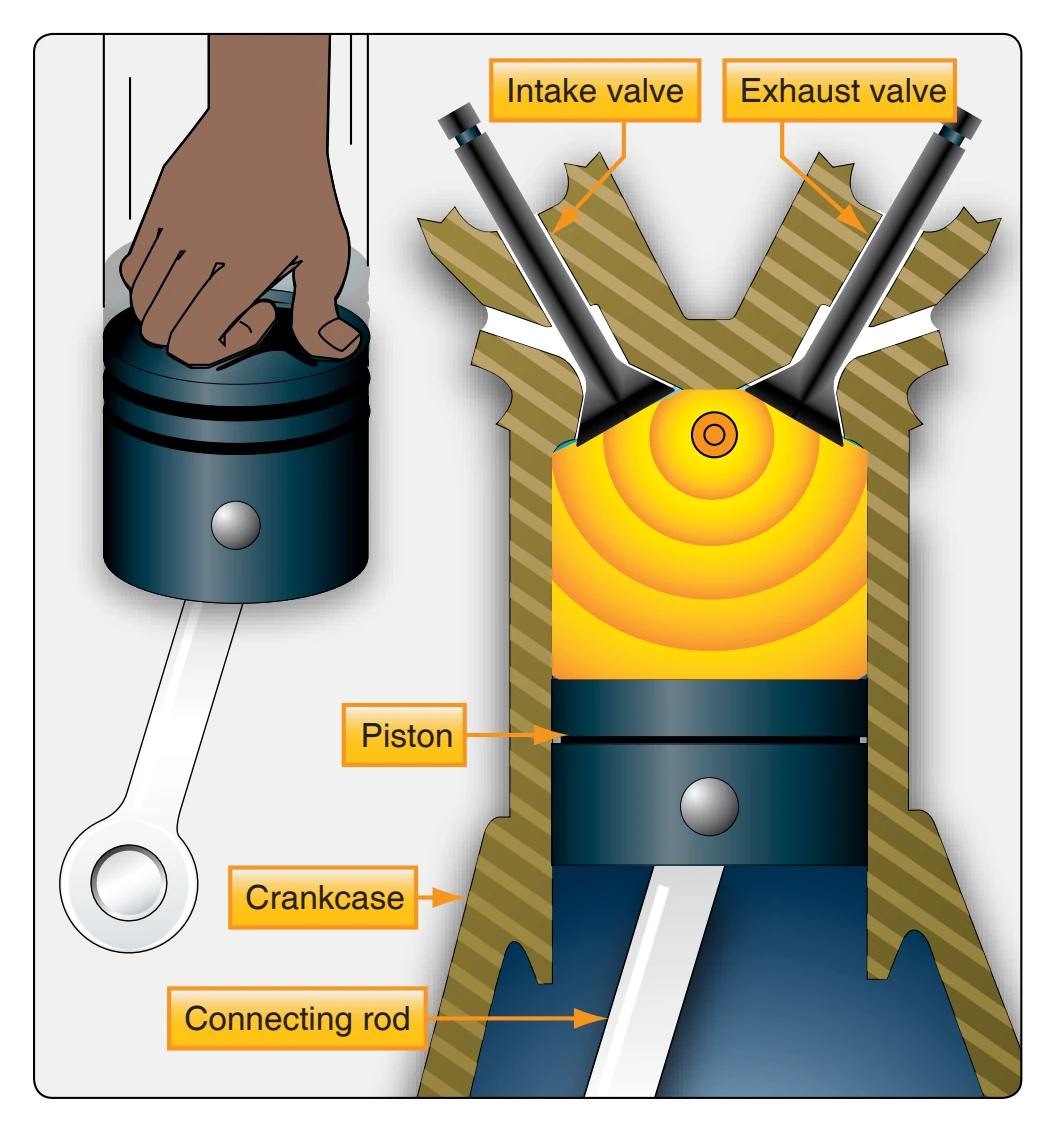
have critical limits of temperature and compression. Beyond this limit, they ignite spontaneously and burn with explosive violence. This instantaneous and explosive burning of the air-fuel mixture or, more accurately, of the latter portion of the charge is called detonation.
Detonation is the spontaneous combustion of the unburned charge ahead of the flame fronts after ignition of the charge. [Figure 10-43] During normal combustion, the flame fronts progress from the point of ignition across the cylinder. These flame fronts compress the gases ahead of them. At the same time, the gases are being compressed by the upward movement of the piston. If the total compression on the remaining unburned gases exceeds the critical point, detonation occurs.
The explosive burning during detonation results in an extremely rapid pressure rise. This rapid pressure rise and the high instantaneous temperature, combined with the high turbulence generated, cause a scrubbing action on the cylinder and the piston. This can burn a hole completely through the piston.