
Chapter 10
Engine Maintenance & Operation
Hydraulic Lock
Whenever a radial engine remains shut down for any length of time beyond a few minutes, oil or fuel may drain into the combustion chambers of the lower cylinders or accumulate in the lower intake pipes ready to be drawn into the cylinders when the engine starts. [Figure 10-41] As the piston approaches top center of the compression stroke (both valves closed), this liquid being incompressible, stops piston movement. If the crankshaft continues to rotate, something
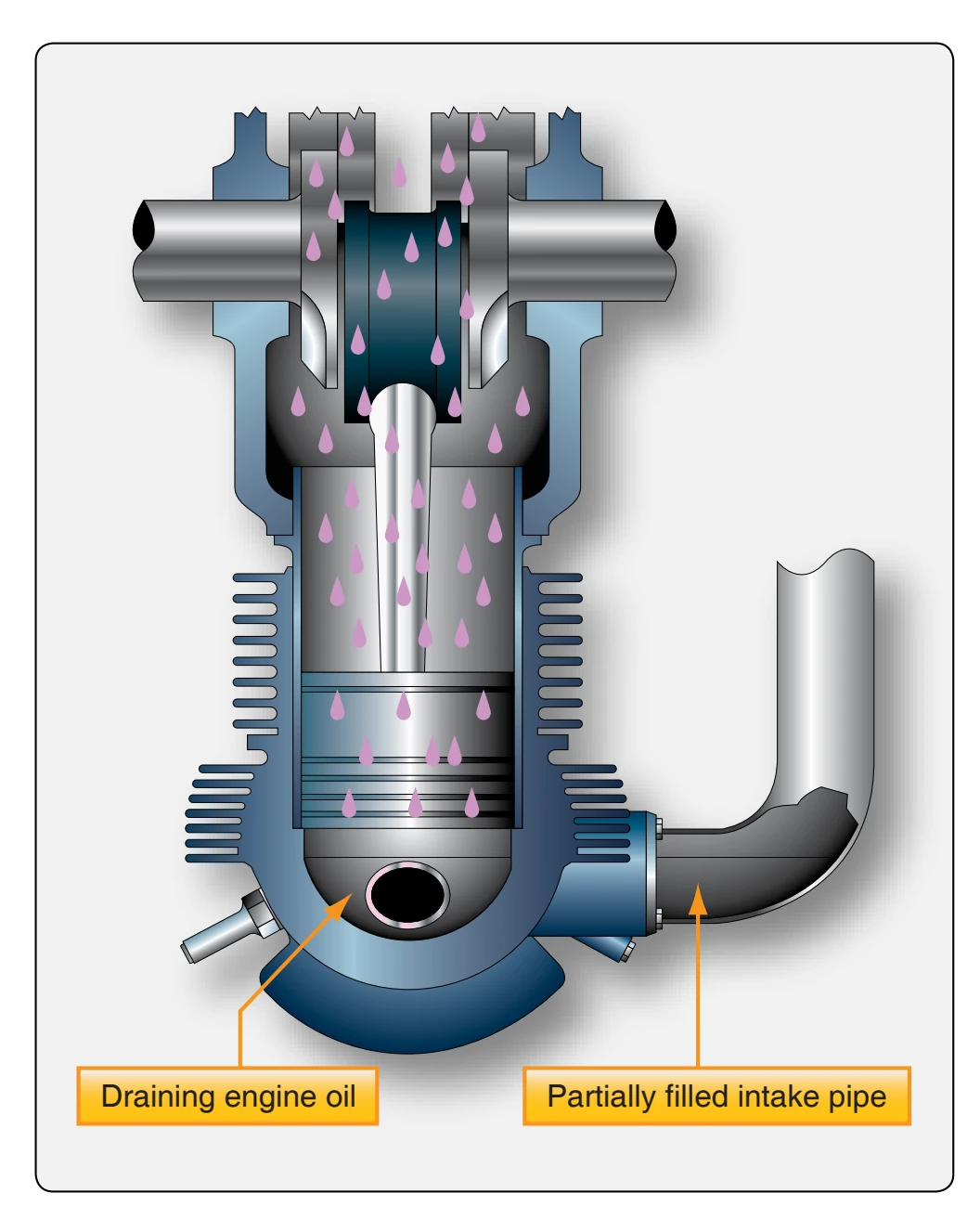
must give. Therefore, starting or attempting to start an engine with a hydraulic lock of this nature may cause the affected cylinder to blow out or, more likely, may result in a bent or broken connecting rod.
To eliminate a lock, remove either the front or rear spark plug of the lower cylinders and pull the propeller through in the direction of rotation. The piston expels any liquid that may be present. If the hydraulic lock occurs as a result of overpriming prior to initial engine start, eliminate the lock in the same manner (i.e., remove one of the spark plugs from the cylinder and rotate the crankshaft through two turns). Never attempt to clear the hydraulic lock by pulling the propeller through in the direction opposite to normal rotation. This tends to inject the liquid from the cylinder into the intake pipe with the possibility of a complete or partial lock occurring on the subsequent start.
Engine Warm-Up
Proper engine warm-up is important, particularly when the condition of the engine is unknown. Improperly adjusted idle mixture, intermittently firing spark plugs, and improperly adjusted engine valves all have an overlapping effect on engine stability. Therefore, the warm-up should be made at the engine speed where maximum engine stability is obtained. Experience has shown that the optimum warm-up speed is from 1,000 to 1,600 rpm. The actual speed selected should be the speed at which engine operation is the smoothest, since the smoothest operation is an indication that all phases of engine operation are the most stable.
Some engines incorporate temperature-compensated oil pressure relief valves. This type of relief valve results in high engine oil pressures immediately after the engine starts, if oil temperatures are very low. Consequently, start the warmup of these engines at approximately 1,000 rpm and then move to the higher, more stable engine speed as soon as oil temperature reaches a warmer level.
During warm-up, watch the instruments associated with engine operation. This aids in making sure that all phases of engine operation are normal. For example, engine oil pressure should be indicated within 30 seconds after the start. Furthermore, if the oil pressure is not up to or above normal within 1 minute after the engine starts, the engine should be shut down. Cylinder head or coolant temperatures should be observed continually to see that they do not exceed the maximum allowable limit.
A lean mixture should not be used to hasten the warm-up. Actually, at the warm-up rpm, there is very little difference in the mixture supplied to the engine, whether the mixture is in a rich or lean position, since metering in this power range is governed by throttle position.
Carburetor heat can be used as required under conditions leading to ice formation. For engines equipped with a float-type carburetor, it is desirable to raise the CAT during warm-up to prevent ice formation and to ensure smooth operation.
The magneto safety check can be performed during warmup. Its purpose is to ensure that all ignition connections are secure, and that the ignition system permits operation at the higher power settings used during later phases of the ground check. The time required for proper warm-up gives ample opportunity to perform this simple check, which may disclose a condition that would make it inadvisable to continue operation until after corrections have been made.
The magneto safety check is conducted with the propeller in the high rpm (low pitch) position, at approximately 1,000 rpm. Move the ignition switch from “both” to “right” and return to “both;” from “both” to “left” and return to “both;” from “both” to “off” momentarily and return to “both.”
While switching from “both” to a single magneto position, a slight but noticeable drop in rpm should occur. This indicates that the opposite magneto has been properly grounded out. Complete cutting out of the engine when switching from “both” to “off” indicates that both magnetos are grounded properly. While in the single magneto position, failure to obtain any rpm drop, or failure of the engine to cut out while switching to off, indicates that one or both ground connections are faulty. This indicates a safety problem; the magnetos are not secured at shut down and may fire if the propeller is turned.
Ground Check
The ground check is performed to evaluate the functioning of the engine by comparing power input, as measured by manifold pressure, with power output, as measured by rpm or torque.
The engine may be capable of producing a prescribed power, even rated takeoff, and not be functioning properly. Only by comparing the manifold pressure required during the check against a known standard is an unsuitable condition disclosed. The magneto check can also fail to show shortcomings, since the allowable rpm dropoff is only a measure of an improperly functioning ignition system and is not necessarily affected by other factors. Conversely, it is possible for the magneto check to prove satisfactory when an unsatisfactory condition is present elsewhere in the engine.
The ground check is made after the engine is thoroughly warm. It consists of checking the operation of the powerplant and accessory equipment by ear, by visual inspection, and by proper interpretation of instrument readings, control movements, and switch reactions. During the ground check, the aircraft should be headed into the wind, if possible, to take advantage of the cooling airflow. A ground check procedure is outlined below:
- Control position check.
- Cowl flaps (if equipped)—open.
- Mixture—rich.
- Propeller—high rpm.
- Carburetor heat—cold.
- Check propeller according to propeller manufacturer’s instruction.
- Open throttle to the run-up rpm setting as per manufacturer’s instructions (specified RPM and manifold pressure).
- Ignition system operational check.
In performing the ignition system operational check (magneto check), the power-absorbing characteristics of the propeller in the low fixed-pitch position are utilized. In switching to individual magnetos, cutting out the opposite plugs results in a slower rate of combustion, which gives the same effect as retarding the spark advance. The drop in engine speed is a measure of the power loss at this slower combustion rate.