
Chapter 10
Engine Maintenance & Operation
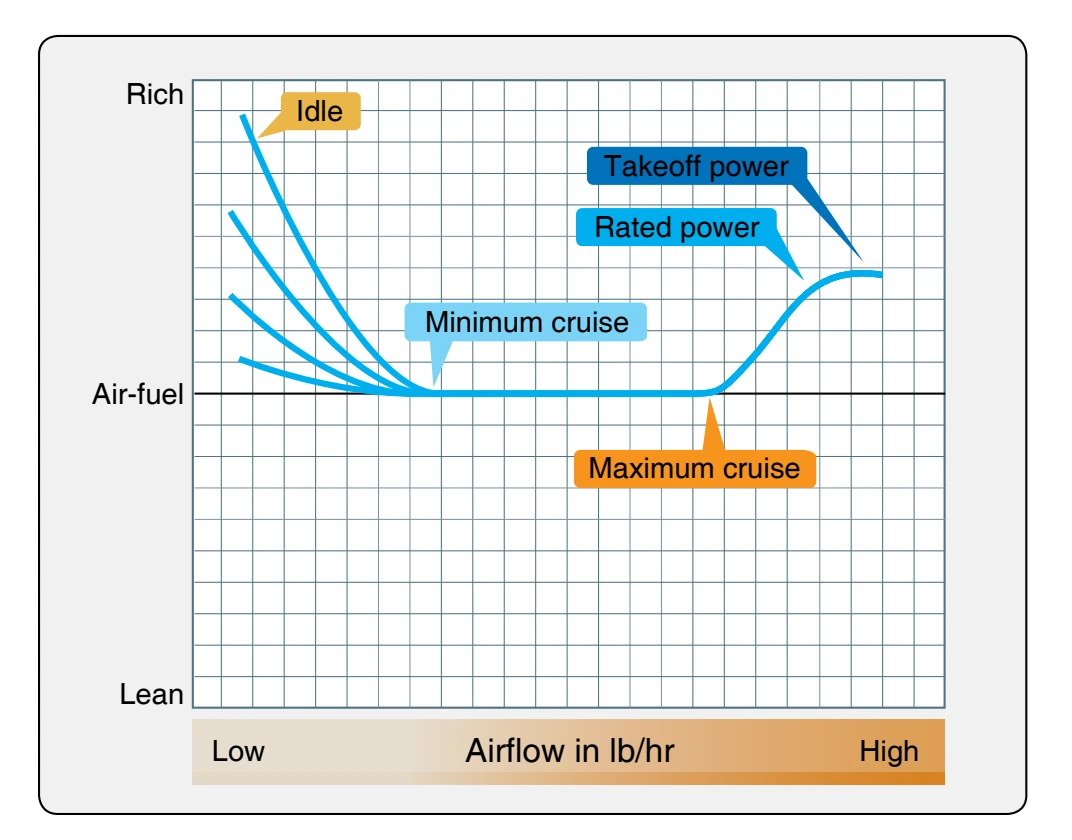
The idle mixture curve shows how the mixture changes when the idle mixture adjustment is changed. [Figure 10-48] Note that the greatest effect is at idling speeds. However, there is some effect on the mixture at airflows above idling. The airflow at which the idle adjustment effect cancels out varies from minimum cruise to maximum cruise. The exact point depends on the type of carburetor and the carburetor setting. In general, the idle adjustment affects the air-fuel mixture up to low cruise on engines equipped with float-type carburetors. This means that incorrect idle mixture adjustments can easily give faulty cruise performance, as well as poor idling.
There are variations in mixture requirements between one engine and another because of the fuel distribution within the engine and the ability of the engine to cool. Remember, a carburetor setting must be rich enough to supply a combustible mixture for the leanest cylinder. If fuel distribution is poor, the overall mixture must be richer than would be required for the same engine if distribution were good. The engine’s ability to cool depends on such factors as cylinder design (including the design of the cooling fins), compression ratio, accessories on the front of the engine that cause individual cylinders to run hot, and the design of the baffling used to deflect airflow around the cylinder. At takeoff power, the mixture must be rich enough to supply sufficient fuel to keep the hottest cylinder cool.
Induction Manifold
The induction manifold provides the means of distributing air, or the air-fuel mixture, to the cylinders. Whether the manifold handles an air-fuel mixture or air alone depends on the type of fuel metering system used. On an engine equipped with
a carburetor, the induction manifold distributes an air-fuel mixture from the carburetor to the cylinders. On a fuelinjection engine, the fuel is delivered to injection nozzles, one in each cylinder, that provide the proper spray pattern for efficient burning. Thus, the mixing of fuel and air takes place at the inlet port to the cylinder. On a fuel-injection engine the induction manifold handles only air.
The induction manifold is an important item because of the effect it can have on the air-fuel mixture that finally reaches the cylinder. Fuel is introduced into the airstream by the carburetor in a liquid form. To become combustible, the fuel must be vaporized in the air. This vaporization takes place in the induction manifold, which includes the internal supercharger, if one is used. Any fuel that does not vaporize clings to the walls of the intake pipes. Obviously, this affects the effective air-fuel ratio of the mixture that finally reaches the cylinder in vapor form. This explains the reason for the apparently rich mixture required to start a cold engine. In a cold engine, some of the fuel in the airstream condenses out and clings to the walls of the manifold. This is in addition to that fuel that never vaporized in the first place. As the engine warms up, less fuel is required because less fuel is condensed out of the airstream and more of the fuel is vaporized, thus giving the cylinder the required air-fuel mixture for normal combustion.
Any leak in the induction system has an effect on the mixture reaching the cylinders. This is particularly true of a leak at the cylinder end of an intake pipe. At manifold pressures below atmospheric pressure, such a leak leans out the mixture. This occurs because additional air is drawn in from the atmosphere at the leaky point. The affected cylinder may overheat, fire intermittently, or even cut out altogether.
Operational Effect of Valve Clearance
While considering the operational effect of valve clearance, keep in mind that all aircraft reciprocating engines of current design use valve overlap. Valve overlap is when the intake and exhaust valves are open at the same time. This takes advantage of the momentum of the entering and exiting gases to improve the efficiency of getting air-fuel in and exhaust gases out. Figure 10-49 shows the pressures at the intake and exhaust ports under two different sets of operating conditions. In one case, the engine is operating at a manifold pressure of 35 "Hg. Barometric pressure (exhaust back pressure) is 29 "Hg. This gives a pressure acting in the direction indicated by the arrow of differential of 6 "Hg (3 psi).
During the valve overlap period, this pressure differential forces the air-fuel mixture across the combustion chamber toward the open exhaust. This flow of air-fuel mixture forces ahead of it the exhaust gases remaining in the cylinder, resulting in complete scavenging of the combustion chamber.
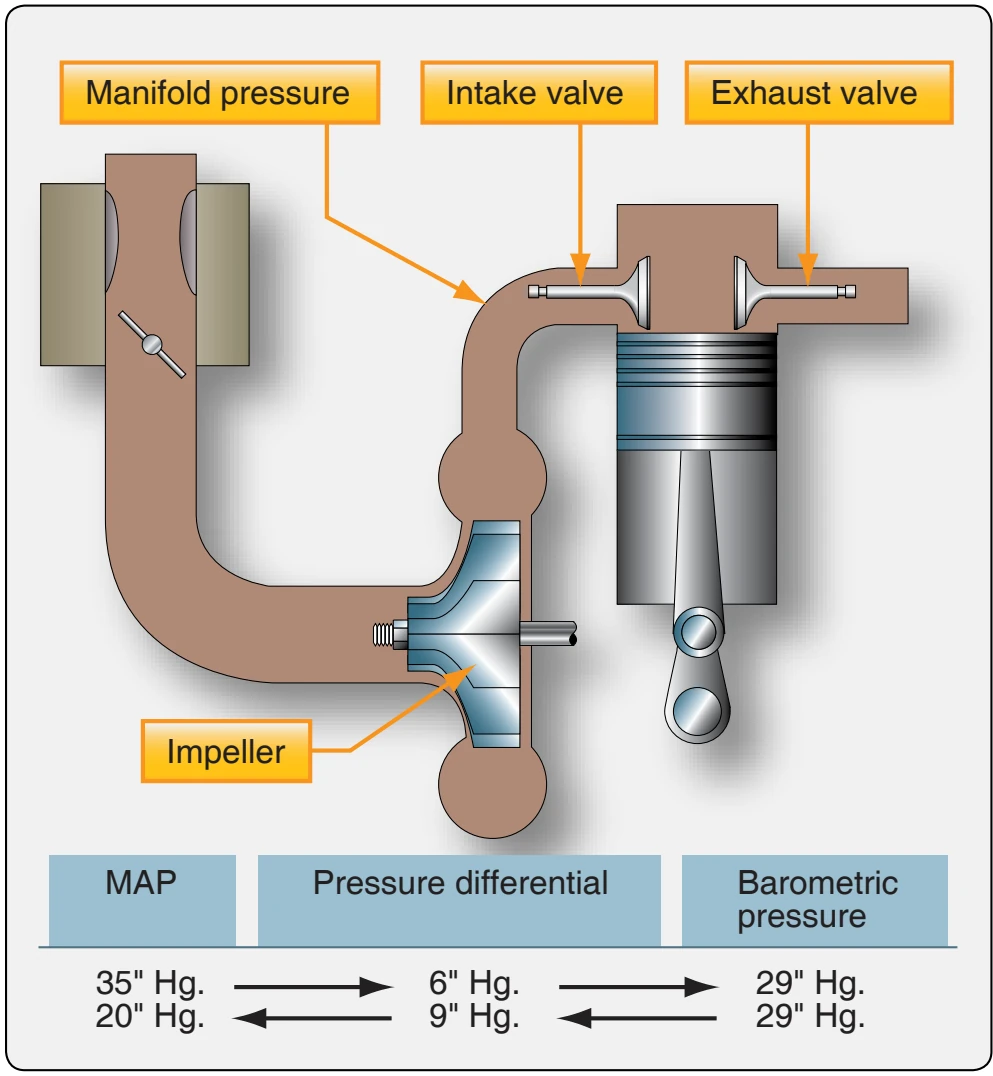
This, in turn, permits complete filling of the cylinder with a fresh charge on the following intake event. This is the situation in which valve overlap gives increased power.
There is a pressure differential in the opposite direction of 9 "Hg (4.5 psi) when the manifold pressure is below atmospheric pressure, for example, 20 "Hg. These cause air or exhaust gases to be drawn into the cylinder through the exhaust port during valve overlap.
In engines with collector rings, this inflow through the exhaust port at low power settings consists of burned exhaust gases. These gases are pulled back into the cylinder and mix with the incoming air-fuel mixture. However, these exhaust gases are inert; they do not contain oxygen. Therefore, the air-fuel mixture ratio is not affected much. With open exhaust stacks, the situation is entirely different. Here, fresh air containing oxygen is pulled into the cylinders through the exhaust. This leans out the mixture. Therefore, the carburetor must be set to deliver an excessively rich idle mixture so that, when this mixture is combined with the fresh air drawn in through the exhaust port, the effective mixture in the cylinder will be at the desired ratio.
At first thought, it does not appear possible that the effect of valve overlap on air-fuel mixture is sufficient to cause concern. However, the effect of valve overlap becomes apparent when considering idle air-fuel mixtures. These mixtures must be enriched 20 to 30 percent when open stacks, instead of collector rings (radial engines) are used on the same engine. [Figure 10-50] Note the spread at idle between an open stack and an exhaust collector ring installation for engines that are otherwise identical. The mixture variation decreases as the engine speed or airflow is increased from idle into the cruise range.
Engine, airplane, and equipment manufacturers provide a powerplant installation that gives satisfactory performance. Cams are designed to give best valve operation and correct overlap. But valve operation is correct only if valve clearances are set and remain at the value recommended by the engine manufacturer. If valve clearances are set wrong, the valve overlap period is longer or shorter than the manufacturer intended. The same is true if clearances get out of adjustment during operation.
Where there is too much valve clearance, the valves do not open as wide or remain open as long as they should. This reduces the overlap period. At idling speed, it affects the air-fuel mixture, since a less-than-normal amount of air or exhaust gases is drawn back into the cylinder during the shortened overlap period. As a result, the idle mixture tends to be too rich.
When valve clearance is less than it should be, the valve overlap period is lengthened. A greater than normal amount of air, or exhaust gases, is drawn back into the cylinder at idling speeds. As a result, the idle mixture is leaned out at the cylinder. The carburetor is adjusted with the expectation that a certain amount of air or exhaust gases is drawn back into the cylinder at idling. If more or less air, or exhaust gases, are drawn into the cylinder during the valve overlap period, the mixture is too lean or too rich.
When valve clearances are wrong, it is unlikely that they are all wrong in the same direction. Instead, there is too much clearance on some cylinders and too little on others. Naturally,