
Chapter 10
Engine Maintenance & Operation
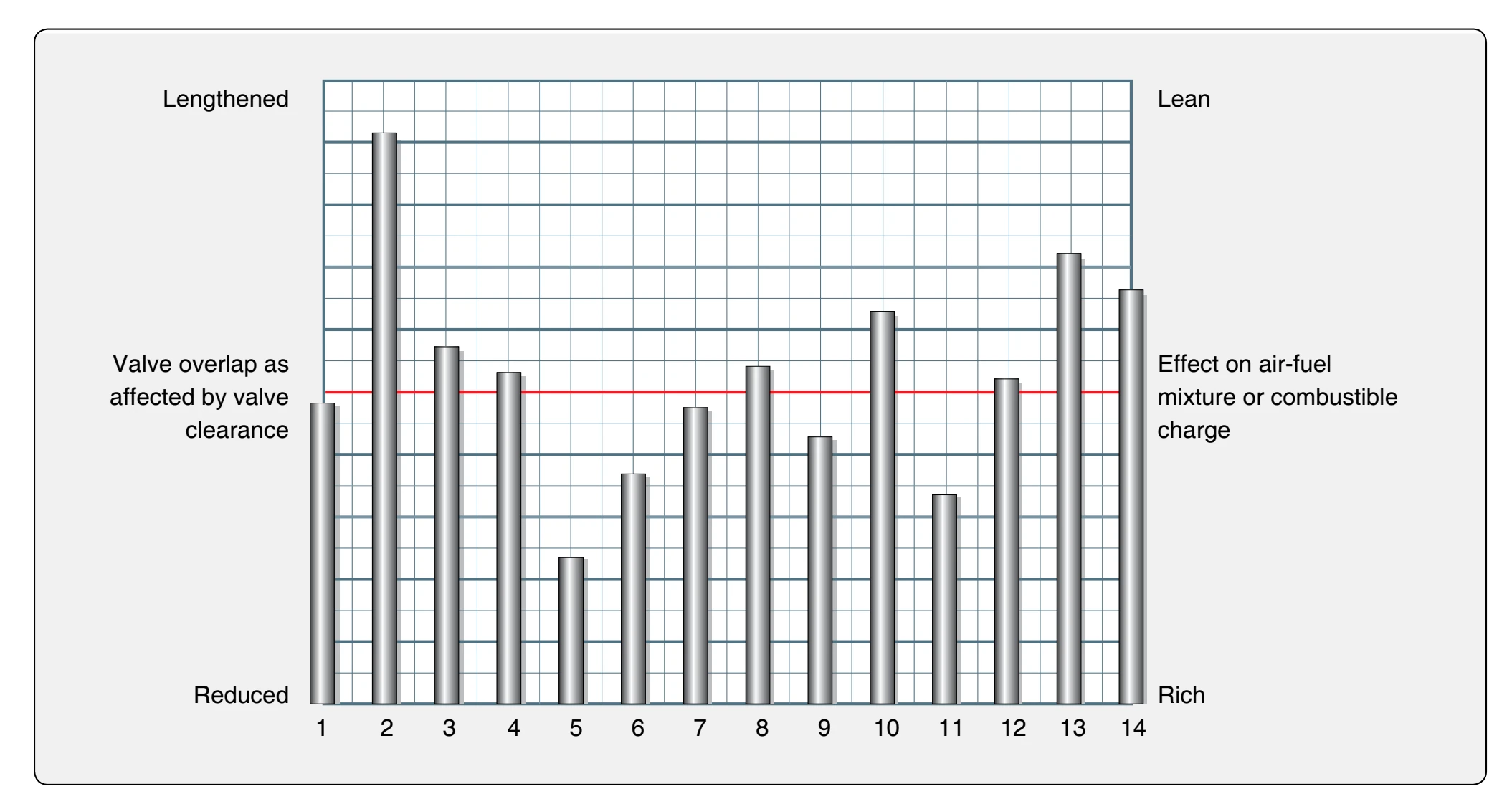
this gives a variation in valve overlap between cylinders. This results in a variation in air-fuel ratio at idling and lowerpower settings, since the carburetor delivers the same mixture to all cylinders. The carburetor cannot tailor the mixture to each cylinder to compensate for variation in valve overlap. The effect of variation in valve clearance and valve overlap on the air-fuel mixture between cylinders is illustrated in Figure 10-51. Note how the cylinders with too little clearance run rich, and those with too much clearance run lean. Note also the extreme mixture variation between cylinders.
Valve clearance also effects volumetric efficiency. Any variations in air-fuel into, and exhaust gases out of, the cylinder affects the volumetric efficiency of the cylinder. With the use of hydraulic valve lifters that set the valve clearance automatically, engine operation has been greatly improved. Hydraulic lifters do have a limited range in which they can control the valve clearance, or they can become stuck in one position that can cause them to be a source of engine trouble. Normally engines equipped with hydraulic lifters require little to no maintenance.
Engine Troubleshooting
Troubleshooting is a systematic analysis of the symptoms that indicate engine malfunction. It would be impractical to list all the malfunctions that could occur in a reciprocating engine, so only the most common malfunctions are discussed. A thorough knowledge of the engine systems, applied with logical reasoning, solves most problems that may occur.
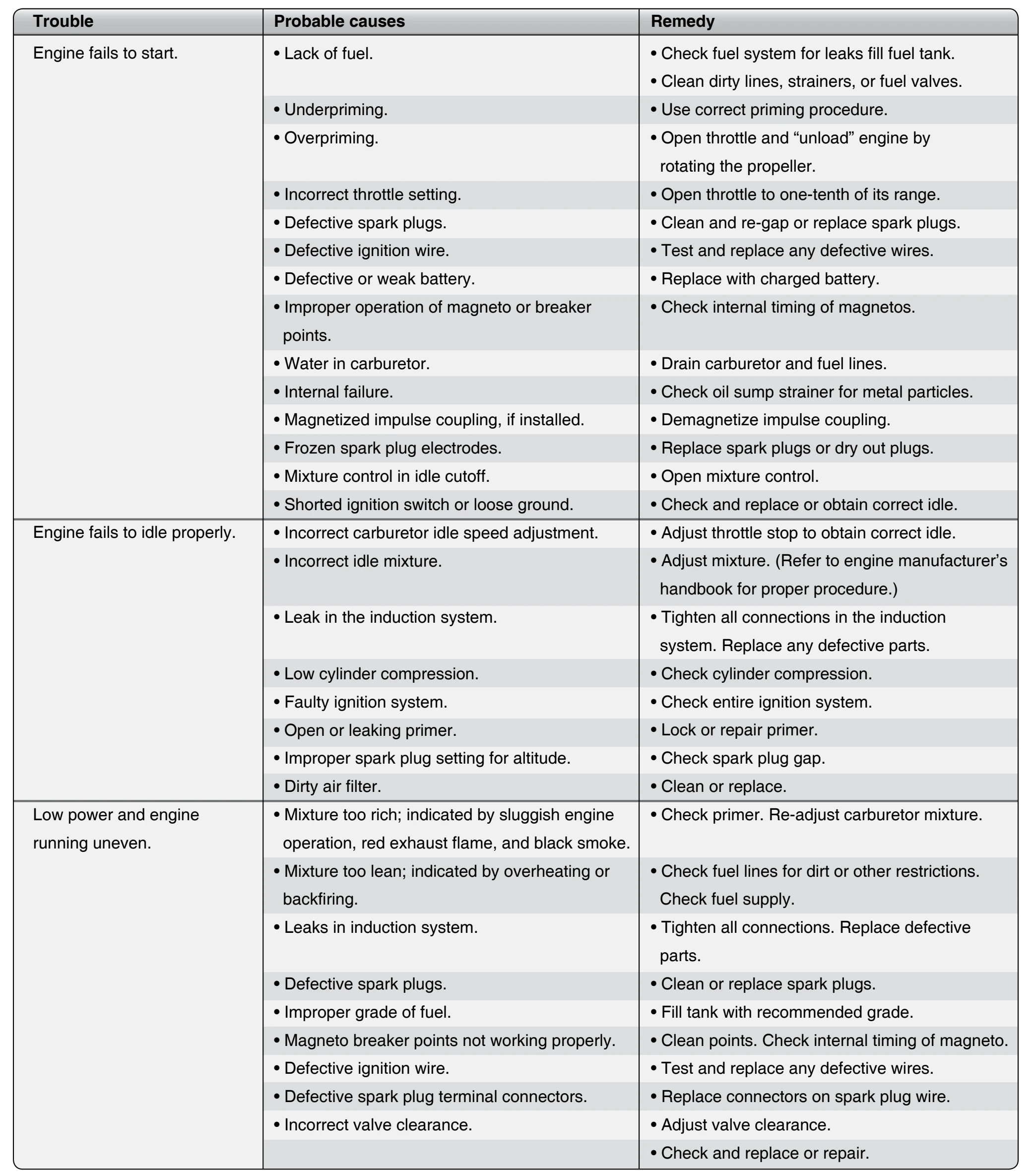
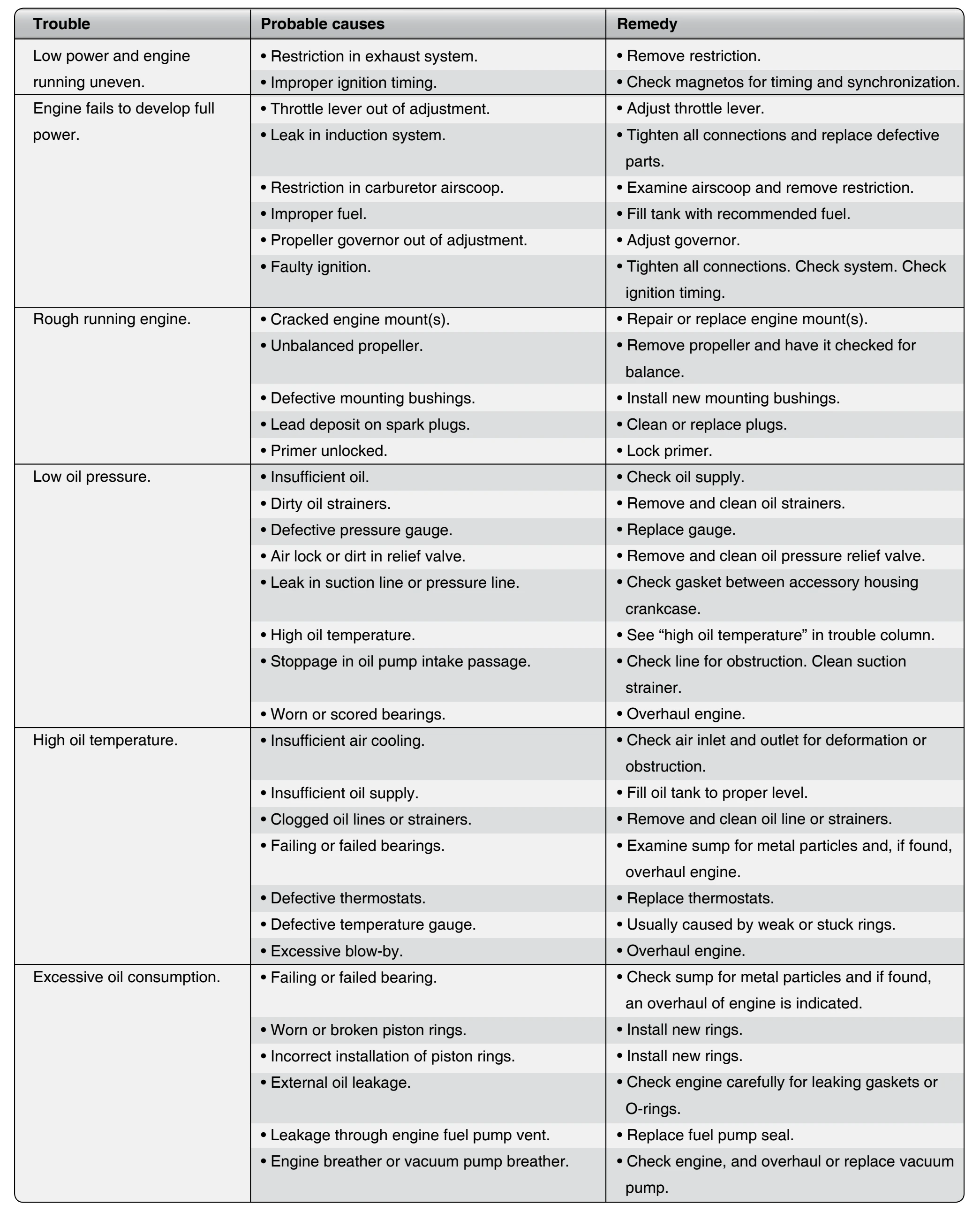
Figure 10-52 lists general conditions or troubles that may be encountered on reciprocating engines, such as engine fails to start. They are further divided into the probable causes contributing to such conditions. Corrective actions are indicated in the remedy column. The items are presented with consideration given to frequency of occurrence, ease of accessibility, and complexity of the corrective action indicated.
The need for troubleshooting normally is dictated by poor operation of the complete powerplant. Power settings for the type of operation at which any difficulty is encountered, in many cases, indicate that part of the powerplant that is the basic cause of difficulty.
The cylinders of an engine, along with any type of supercharging, form an air pump. Furthermore, the power developed in the cylinders varies directly with the rate that air can be consumed by the engine. Therefore, a measure of air consumption or airflow into the engine is a measure of power input. Ignoring for the moment such factors as humidity and exhaust back pressure, the manifold pressure gauge and the engine tachometer provide a measure of engine air consumption. Thus, for a given rpm, any change in power input is reflected by a corresponding change in manifold pressure.
The power output of an engine is the power absorbed by the propeller. Therefore, propeller load is a measure of power output. Propeller load, in turn, depends on the propeller rpm, blade angle, and air density. For a given angle and air
density, propeller load (power output) is directly proportional to engine speed. The basic power of an engine is related to manifold pressure, fuel flow, and rpm. Because the rpm of the engine and the throttle opening directly control manifold pressure, the primary engine power controls are the throttle and the rpm control. An engine equipped with a fixed-pitch propeller has only a throttle control. In this case, the throttle setting controls both manifold pressure and engine rpm.
With proper precautions, manifold pressure can be taken as a measure of power input, and rpm can be taken as a measure of power output. However, the following factors must be
considered:
- Atmospheric pressure and air temperature must be considered, since they affect air density.
- These measures of power input and power output should be used only for comparing the performance of an engine with its previous performance, or for comparing identical powerplants.
- With a controllable propeller, the blades must be against their low-pitch stops, since this is the only blade position in which the blade angle is known and does not vary. Once the blades are off their low-pitch stops, the propeller governor takes over and maintains a constant rpm, regardless of power input or engine condition. This precaution means that the propeller control must be set to maximum or takeoff rpm, and the checks made at engine speeds below this setting.
Having relative measures of power input and power output, the condition of an engine can be determined by comparing input and output. This is done by comparing the manifold pressure required to produce a given rpm with the manifold pressure required to produce the same rpm at a time when the engine (or an identical powerplant) was known to be in top operating condition.
An example shows the practical application of this method of determining engine condition. With the propeller control set for takeoff rpm (full low blade angle), an engine may require 32 inches of manifold pressure to turn 2,200 rpm for the ignition check. On previous checks, this engine required only 30 inches of manifold pressure to turn 2,200 rpm at the same station (altitude) and under similar atmospheric conditions. Obviously, something is wrong; a higher power input (manifold pressure) is now required for the same power output (rpm). There is a good chance that one cylinder has a malfunction.
There are several standards against which engine performance can be compared. The performance of a particular engine can be compared with its past performance, provided adequate records are kept. Engine performance can be compared with that of other engines on the same aircraft or aircraft having identical installations.
If a fault does exist, it may be assumed that the trouble lies in one of the following systems: