
Chapter 10
Engine Maintenance & Operation
While the degreasing solution removes dirt, grease, and soft carbon, deposits of hard carbon almost invariably remain on many interior surfaces. To remove these deposits, they must first be loosened by immersion in a tank containing a decarbonizing solution (usually heated). A great variety of commercial decarbonizing agents are available. Decarbonizers, like the degreasing solutions previously mentioned, fall generally into two categories, water-soluble and hydrocarbons. The same caution concerning the use of water-soluble degreasers is applicable to water-soluble decarbonizers.
Decarbonizing will usually loosen most of the hard carbon deposits remaining after degreasing. However, the complete removal of all hard carbon generally requires brushing, scraping, or grit-blasting. In all of these operations, be careful to avoid damaging the machined surfaces. In particular, wire brushes and metal scrapers must never be used on any bearing or contact surface.
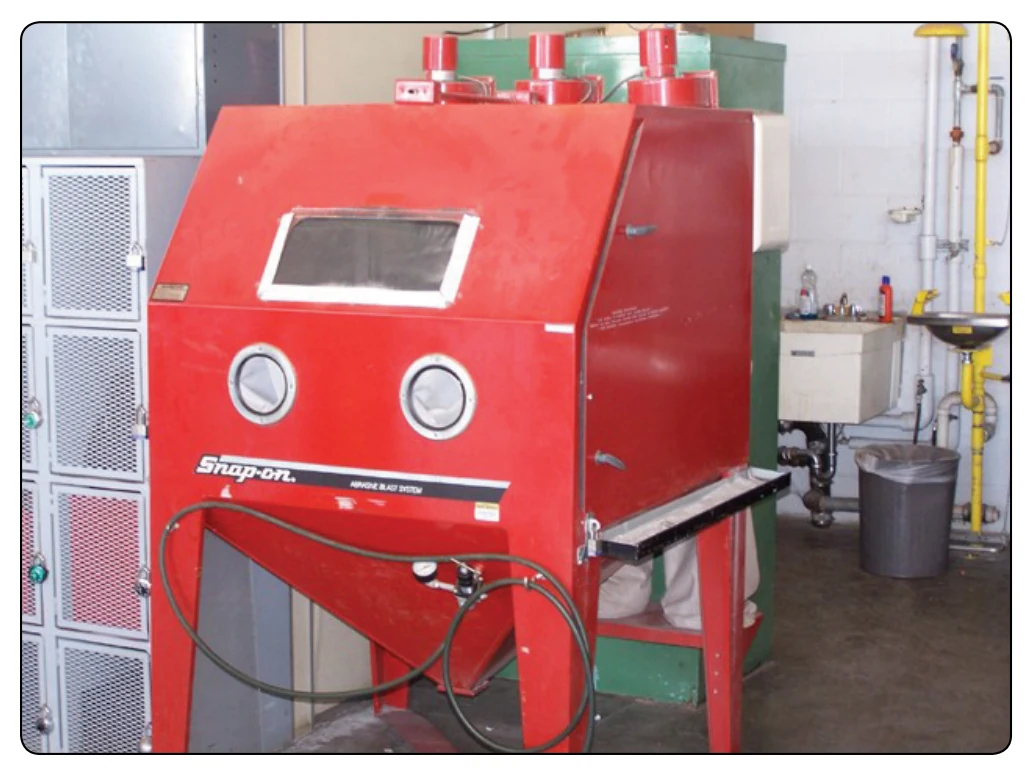
Follow the manufacturer's recommendations when grit-
blasting parts for the abrasive material being used. Sand, rice, baked wheat, plastic pellets, glass beads, or crushed walnut shells are examples of abrasive substances that are used for grit-blasting parts. A grit-blasting machine is shown in Figure 10-4.
All machined surfaces must be masked properly and adequately, and all openings tightly plugged before blasting. The one exception to this is the valve seats, which may be left unprotected when blasting the cylinder head combustion chamber. It is often advantageous to grit-blast the seats, since this will cut the glaze which tends to form (particularly on the exhaust valve seat), thus facilitating subsequent valve seat reconditioning. Piston ring grooves may be grit-blasted if necessary; however, extreme caution must be used to avoid the removal of metal from the bottom and sides of the grooves. When grit-blasting housings, plug all drilled oil passages with rubber plugs or other suitable material to prevent the entrance of foreign matter.
The decarbonizing solution will generally remove most of the enamel on exterior surfaces. All remaining enamel should be removed by grit-blasting, particularly in the crevices between cylinder cooling fins.
At the conclusion of cleaning operations, rinse the part in petroleum solvent, dry and remove any loose particles of carbon or other foreign matter by air-blasting, and apply a liberal coating of preservative oil to all surfaces.
Magnesium parts should be cleaned thoroughly with a dichromate treatment prior to painting. This treatment consists of cleaning all traces of grease and oil from the part by using a neutral, noncorrosive degreasing medium followed by a rinse, after which the part is immersed for at least 45 minutes in a hot dichromate solution (three-fourths of a pound of sodium dichromate to 1 gallon of water at 180 °F
to 200 °F). Then the part should be washed thoroughly in cold running water, dipped in hot water, and dried in an air blast. Immediately thereafter, the part should be painted with a prime coat and engine enamel in the same manner as that suggested for aluminum parts.
Some older engines used sludge chambers in the crankshafts, which were manufactured with hollow crankpins that serve as sludge removers. The sludge chambers require inspection and cleaning at overhaul. Sludge chambers are formed by means of spool-shaped tubes pressed into the hollow crankpins, or by plugs pressed into each end of the crankpin. If an engine has a sludge chamber or tubes, they must be removed for cleaning at overhaul. If these are not removed, accumulated sludge loosened during cleaning may clog the crankshaft oil passages and cause subsequent bearing failures. If the sludge chambers are formed by means of tubes pressed into the hollow crankpins, make certain they are re-installed correctly to avoid covering the ends of the oil passages. Due to improved oils, sludge chambers are no longer used with modern engines.
Structural Inspection
One of the best methods to double check your visual inspection findings is to supplement them with one of the forms of nondestructive testing, such as magnetic particle, dye penetrate, eddy current, ultrasound, and x-ray inspections. Defects in nonmagnetic parts (aluminum parts) can be found by all these methods except for magnetic particle inspection, which is used for magnetic or ferrous materials (steel).
Dye Penetrant Inspection
Dye penetrant inspection is a nondestructive test for defects open to the surface in parts made of any nonporous material. It is used with equal success on such metals as aluminum, magnesium, brass, copper, cast iron, stainless steel, and titanium. Dye penetrant inspection uses a penetrating liquid that enters a surface opening and remains there, making it clearly visible to the inspector. It calls for visual examination of the part after it has been processed, increasing the visibility of the defect so that it can be detected. Visibility of the penetrating material is increased by the addition of one of two types of dye: visible or fluorescent. When using a fluorescent dye, the inspection is accomplished using an ultraviolet (UV) light source (black light).
The steps for performing a dye penetrant inspection are:
- Thorough cleaning of the metal surface.
- Applying penetrant.
- Removing penetrant with remover emulsifier or cleaner.
- Drying the part.
- Applying the developer.
- Inspecting and interpreting results.