Chapter 11
Light-Sport Aircraft Engines
Light-Sport Aircraf
Engine General Requirements
Engines used for light-sport aircraft and other types of aircraft, such as some experimental aircraft, ultralight aircraft, and powered parachutes, must be very light for the power they develop. Each aircraft requires thrust to provide enough forward speed for the wings to provide lift to overcome the weight of the aircraft. An aircraft that meets the requirements of the light-sport categories must meet the following requirements.
A light-sport aircraft means an aircraft, other than a rotorcraft or powered-lift, since its original certification, has continued to meet the following:
- A maximum takeoff weight of not more than 1,320 pounds (lb) (600 kilograms (kg)) for aircraft not intended for operation on water; or 1,430 lb (650 kg) for an aircraft intended for operation on water.
- A maximum airspeed in level flight with maximum continuous power (V ) of not more than 120 knots H calibrated airspeed (CAS) under standard atmospheric conditions at sea level.
- A maximum never-exceed speed (V ) of not more NE than 120 knots CAS for a glider.
- A maximum stalling speed or minimum steady flight speed without the use of lift-enhancing devices (V ) of not more than 45 knots CAS at the aircraft’s S1 maximum certificated takeoff weight and most critical center of gravity.
- A maximum seating capacity of no more than two persons, including the pilot.
- A single, reciprocating engine, if powered.
- A fixed or ground-adjustable propeller, if a powered aircraft other than a powered glider.
- A fixed or auto-feathering propeller system, if a powered glider.
- A fixed-pitch, semirigid, teetering, two-blade rotor system, if a gyroplane.
- A non-pressurized cabin, if equipped with a cabin.
- Fixed landing gear, except for an aircraft intended for
ft Engines
operation on water or a glider.
- Fixed or retractable landing gear, or a hull, for an aircraft intended for operation on water.
- Fixed or retractable landing gear for a glider.
Powered parachute means a powered aircraft comprised of a flexible or semirigid wing connected to a fuselage so that the wing is not in position for flight until the aircraft is in motion. The fuselage of a powered parachute contains the aircraft engine, a seat for each occupant, and is attached to the aircraft’s landing gear.
Weight shift control aircraft means a powered aircraft with a framed pivoting wing and a fuselage controllable only in pitch and roll by the pilot’s ability to change the aircraft’s center of gravity with respect to the wing. Flight control of the aircraft depends on the wing’s ability to flexibly deform rather than the use of control surfaces.
As the weight of an engine is decreased, the useful load that an aircraft can carry and the performance of the aircraft are obviously increased. Every excess pound of weight carried by an aircraft engine reduces its performance. Since lightsport aircraft have a narrow margin of useful load, engine weight is a very important concern with all of the light, low airspeed aircraft. Tremendous gains in reducing the weight of the aircraft engine through improvements in design, operating cycles, and metallurgy have resulted in engines with a much improved power to weight ratio.
A light-sport aircraft engine is reliable when it can perform at the specified ratings in widely varying flight attitudes and in extreme weather conditions. The engine manufacturer ensures the reliability and durability of the product by design, research, and testing. Although most of these engines are not certificated by the Federal Aviation Administration (FAA), close control of manufacturing and assembly procedures is generally maintained, and normally each engine is tested before it leaves the factory and meets certain American Society for Testing and Materials (ASTM) standards. Some engines used on light-sport aircraft are certificated by the FAA and these engines are maintained as per the manufacturer’s instructions and Title 14 of the Code of Federal Regulations (14 CFR).
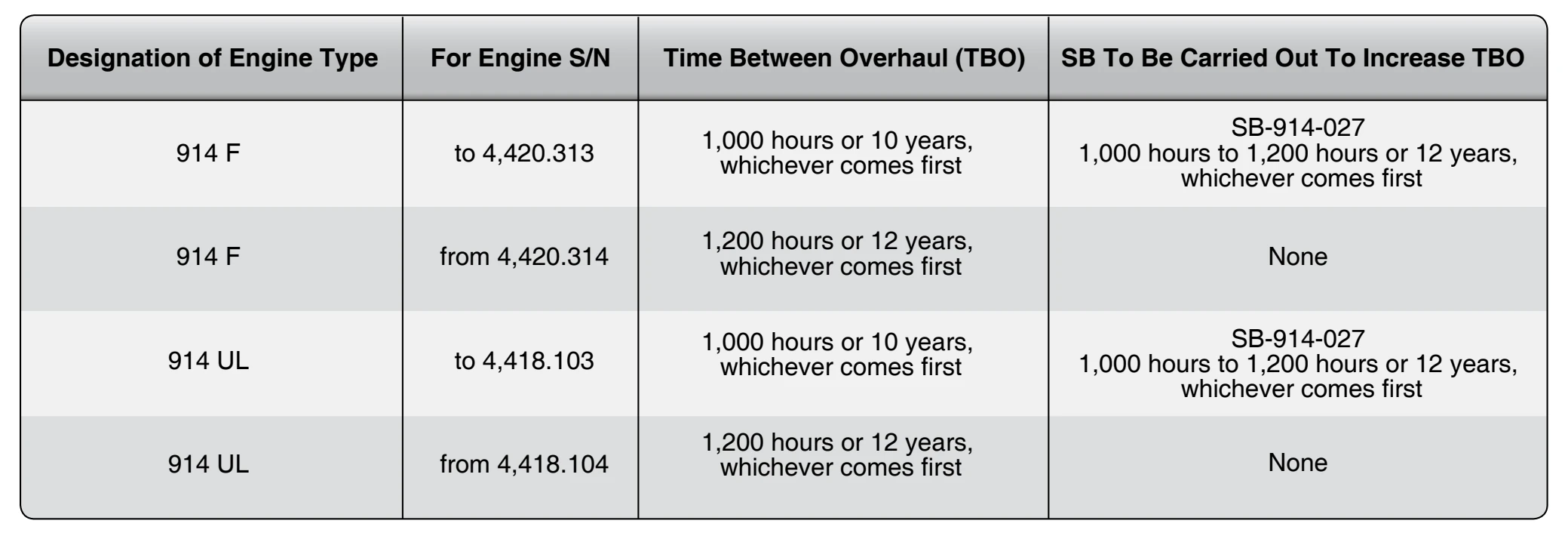
Most light-sport engines require a definite time interval between overhauls. This is specified or implied by the engine manufacturer. The time between overhauls (TBO) varies with the type of engine (cycle), operating conditions, such as engine temperatures, amount of time the engine is operated at high-power settings, and the maintenance received. After reaching the time limit, the engine has to be overhauled. Sometimes this requires the engine to be shipped to an authorized manufacturer’s overhaul facility. [Figure 11-1]
One consideration when selecting a light-sport engine is the shape, size, and number of cylinders of the engine. Since these engines range from single cylinder to multicylinder engines, the mounting in the airframe is important to maintain the view of the pilot, aircraft center of gravity, and to reduce aircraft drag.
Personnel Authorized to Perform Inspection & Maintenance on Light-Sport Engines
Given they meet all applicable regulations, the holder of a powerplant certificate can perform maintenance and inspections on light-sport engines. The holder of a sport pilot certificate may perform preventive maintenance on an aircraft owned or operated by that pilot and issued a special airworthiness certificate in the light-sport category under the provisions of 14 CFR part 43, section 43.3 (g). All maintenance must be performed in accordance with 14 CFR part 65, section 65.81, which describes specific experience requirements and current instructions for performing maintenance.
The following is used to determine eligibility for a repairman certificate (light-sport aircraft) and appropriate rating. To be eligible for a repairman certificate (light-sport aircraft), you must:
- Be at least 18 years old.
- Be able to read, speak, write, and understand English. If for medical reasons you cannot meet one of these requirements, the FAA may place limits on the repairman certificate necessary to safely perform the actions authorized by the certificate and rating.
- Demonstrate the requisite skill to determine whether a light-sport aircraft is in a condition for safe operation.
- Be a citizen of the United States, or a citizen of a foreign country who has been lawfully admitted for permanent residence in the United States.
- To be eligible for a repairman certificate (light-sport aircraft) with an inspection rating, the applicant must: o Meet the requirements stated above for a repairman’s certificate. o Complete a 16-hour training course acceptable to the FAA on inspecting the particular class of experimental light-sport aircraft for which these privileges are intended to be exercised.
- To be eligible for a repairman certificate (light-sport aircraft) with a maintenance rating, the applicant must: o Meet the requirements stated above for a repairman’s certificate. o Complete a training course acceptable to the FAA on maintaining the particular class of light-sport aircraft upon which the privileges are intended to be exercised. The training course must, at a minimum provide the following number of hours of instruction:
- For airplane class privileges: 120 hours.
- Weight-shift control aircraft class privileges: 104 hours.
- Powered parachute class privileges: 104 hours.
- Lighter-than-air class privileges: 80 hours.
- Glider class privileges: 80 hours.
- For airplane class privileges: 120 hours.