
Chapter 11
Light-Sport Aircraft Engines
Cooling System of Rotax 447 UL SCDI & Rotax 503 UL DCDI
Two versions of air-cooling are available for these engines. The first method is free air-cooling, which is a process of engine cooling by an air-stream generated by aircraft speed
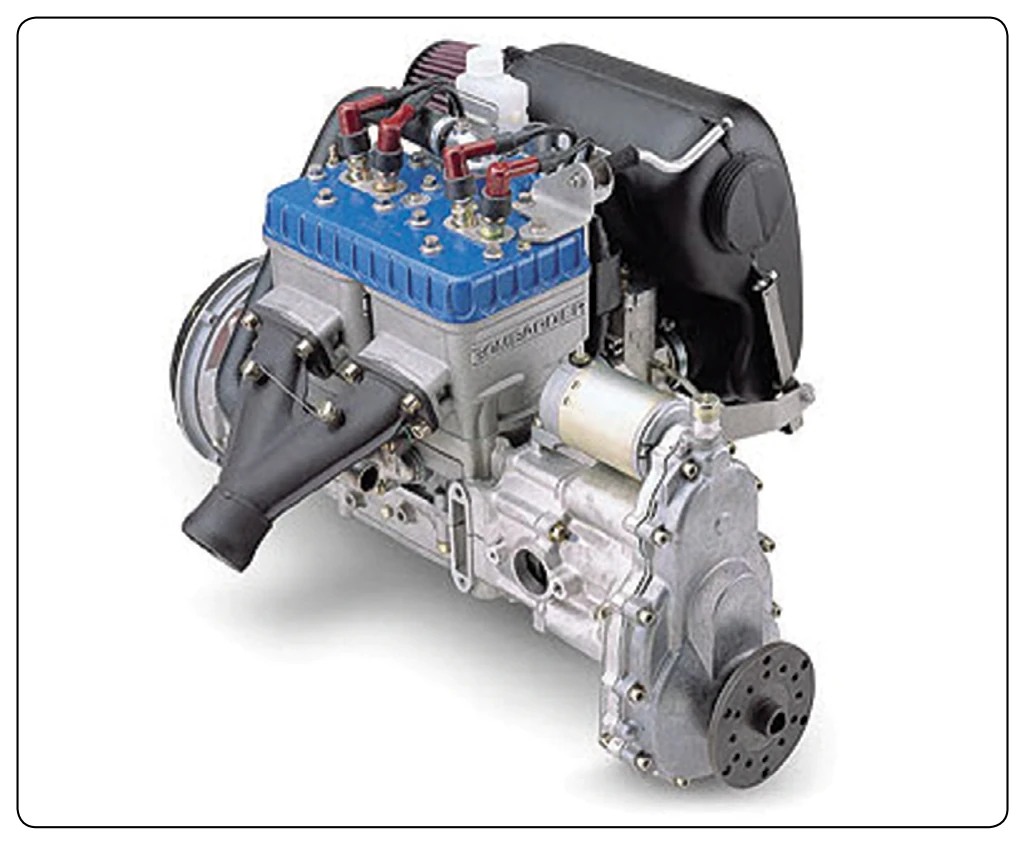
and propeller. The second is fan cooling, which is cooling by an air-stream generated by a fan permanently driven from the crankshaft via a V-belt.
Cooling System of the Rotax 582 UL DCDI
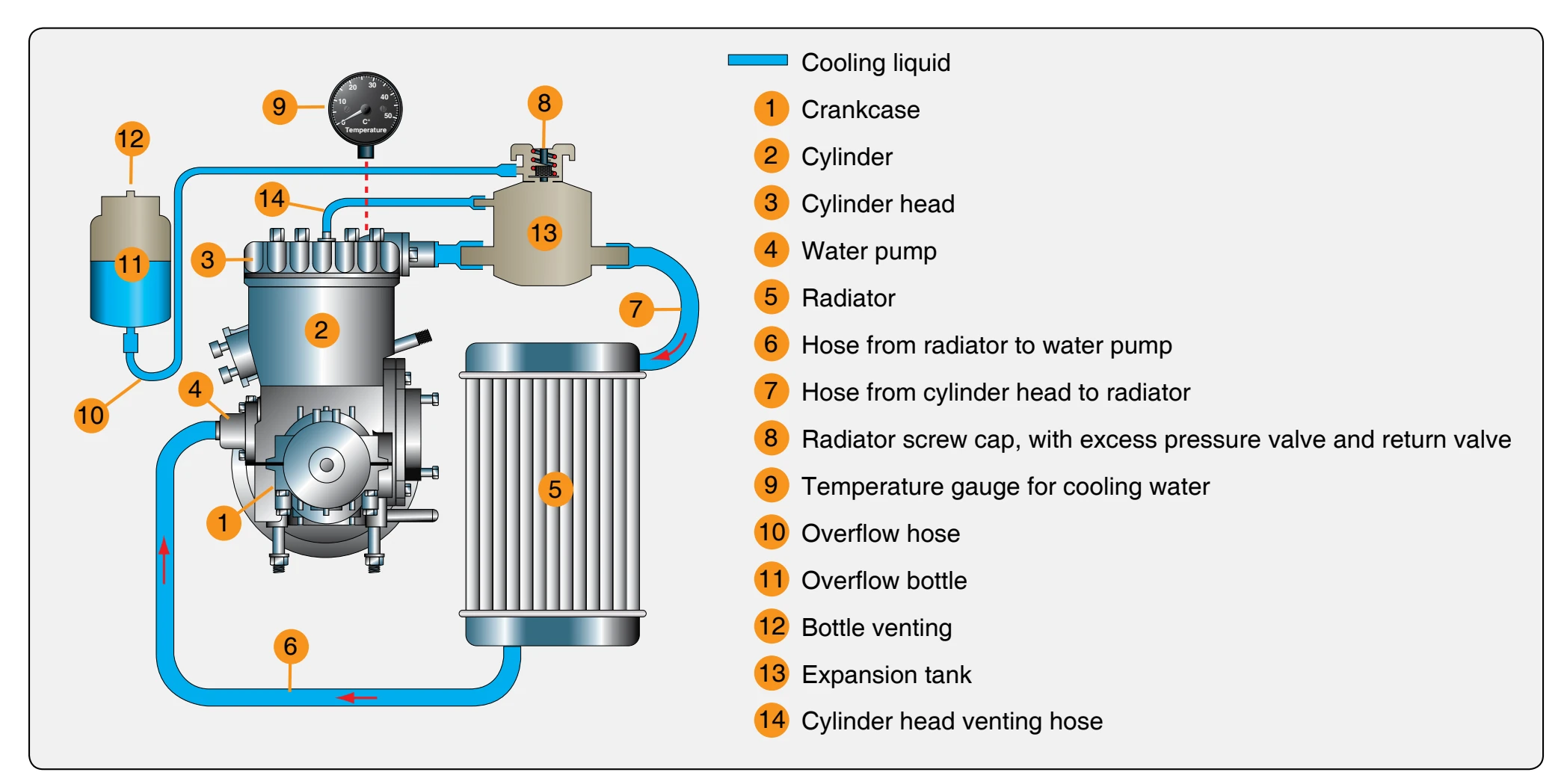
Engine cooling for the Rotax 582 is accomplished by liquid cooled cylinders and cylinder heads. [Figure 11-4] The cooling system is in a two circuit arrangement. The cooling liquid is supplied by an integrated pump in the engine through the cylinders and the cylinder head to the radiator. The cooling system has to be installed, so that vapor coming from the cylinders and the cylinder head can escape to the top via a hose, either into the water tank of the radiator or to an expansion chamber. The expansion tank is closed by a pressure cap (with excess pressure valve and return valve). As the temperature of the coolant rises, the excess pressure valve opens, and the coolant flows via a hose at atmospheric pressure to the transparent overflow bottle. When cooling down, the coolant is sucked back into the cooling circuit.
Lubrication Systems
Oil Injection Lubrication of Rotax 503 UL DCDE & 582 UL DCDI
Generally, the smaller two cycle engines are designed to run on a mixture of gasoline and 2 percent oil that is premixed in the fuel tank. The engines are planned to run on an oilgasoline mixture of 1:50. Other engines use oil injection systems that use an oil pump driven by the crankshaft via the pump gear that feeds the engine with the correct amount of fresh oil. The oil pump is a piston type pump with a metering system. Diffuser jets in the intake inject pump supplied twostroke oil with the exact proportioned quantity needed. The oil quantity is defined by the engine rotations per minute and the oil pump lever position. This lever is actuated via a cable connected to the throttle cable. The oil comes to the pump
from an oil tank by gravity.
Electric System
The 503 UL DCDI, 582 UL DCDI engine types are equipped with a breakerless, single capacitor discharge ignition unit with an integrated generator. [Figure 11-5] The 447 UL SCDI engine is equipped with a breakerless, single capacitor discharge ignition unit with integrated generator. The ignition unit is completely free of maintenance and needs no external power supply. Two charging coils fitted on the generator stator, independent from each other, each feed one ignition circuit. The energy supplied is stored in the ignition capacitor. At the moment of ignition, the external triggers supply an impulse to the control circuits and the ignition capacitors are discharged via the primary winding of the ignition coil. The secondary winding supplies the high voltage for the ignition spark.
Fuel System
Due to higher lead content in aviation gas (AVGAS), operation can cause wear and deposits in the combustion chamber to increase. Therefore, AVGAS should only be used if problems are encountered with vapor lock or if the other fuel types are not available. Caution must be exercised to use only fuel suitable for the relevant climatic conditions, such as using winter fuel for summer operation.
Fuel-Oil Mixing Procedure
The following describes the process for fuel-oil mixing. Use a clean approved container of known volume. To help predilute the oil, pour a small amount of fuel into the container. Fill known amount of oil (two-stroke oil ASTM/Coordinating European Council (CEC) standards, API-TC classification (e.g., Castrol TTS) mixing ratio 1:50 (2 percent)), into container. Oil must be approved for air-cooled engines at 50:1 mixing ratio. Agitate slightly to dilute oil with gasoline. Add gasoline to obtain desired mixture ratio; use fine mesh screen. Replace the container cap and shake the container thoroughly. Then, using a funnel with a fine mesh screen to prevent the entry of water and foreign particles, transfer mixture from container into the fuel tank.