
Chapter 11
Light-Sport Aircraft Engines
The holder of a repairman certificate (light-sport aircraft) with an inspection rating may perform the annual condition inspection on a light-sport aircraft that is owned by the holder, has been issued an experimental certificate for operating a light-sport aircraft under 14 CFR part 21, section 21.191(i), and is in the same class of light-sport aircraft for which the holder has completed the training specified in the above paragraphs.
The holder of a repairman certificate (light-sport aircraft) with a maintenance rating may approve and return to service an aircraft that has been issued a special Airworthiness Certificate in the light-sport category under 14 CFR part 21, section 21.190, or any part thereof, after performing or inspecting maintenance (to include the annual condition inspection and the 100-hour inspection required by 14 CFR part 91, section 91.327), preventive maintenance, or an alteration (excluding a major repair or a major alteration on a product produced under an FAA approval). They may perform the annual condition inspection on a light-sport aircraft that has been issued an experimental certificate for operating a light-sport aircraft under 14 CFR part 21, section 21.191(i). However, they may only perform maintenance, preventive maintenance, and an alteration on a light-sport aircraft for which the holder has completed the training specified in the preceding paragraphs. Before performing a major repair, the holder must complete additional training acceptable to the FAA and appropriate to the repair performed.
The holder of a repairman certificate (light-sport aircraft) with a maintenance rating may not approve for return to service any aircraft or part thereof unless that person has previously performed the work concerned satisfactorily. If that person has not previously performed that work, the person may show the ability to do the work by performing it under the direct supervision of a certificated and appropriately rated mechanic, or a certificated repairman who has had previous experience in the specific operation concerned. The repairman may not exercise the privileges of the certificate unless the repairman understands the current instructions of the manufacturer and the maintenance manuals for the specific operation concerned.
Authorized Personnel That Meet FAA Regulations
All applicable aviation regulatory authority regarding maintenance procedures must be met. Maintenance organizations and personnel are encouraged to contact the manufacturer for more information and guidance on any of the maintenance procedures.
It is a requirement that every individual or maintenance provider possess the required special tooling, training, or experience to perform all tasks outlined. Maintenance providers that meet the following conditions outlined below may perform engine maintenance providing they meet all of the following FAA requirements:
- Knowledge of the specific task as a result of receiving authorized training from a training provider.
- Previous experience in performing the task and formal instruction from a manufacturer’s authorized training facility or “on-the-job” instruction by a manufacturer’s representative.
- A suitable work environment to prevent contamination or damage to engine parts or modules is needed.
- Suitable tools and fixtures as outlined in the manufacturers’ Maintenance Manual should be used while performing maintenance requiring such tooling.
- Reasonable and prudent maintenance practices should be utilized.
Types of Light-Sport & Experimental Engines
Light-Sport Aircraft Engines
Light-sport/ultralight aircraft engines can be classified by several methods, such as by operating cycles, cylinder arrangement, and air- or water-cooled. An inline engine generally has two cylinders, is two-cycle, and is available in several horsepower ranges. These engines may be either liquid-cooled, air-cooled, or a combination of both. They have only one crankshaft that drives the reduction gearbox or propeller directly. Most of the other cylinder configurations used are horizontally opposed, ranging from two to six cylinders from several manufacturers. These engines are either gear reduction or direct drive.
Two-Cycle, Two Cylinder Rotax Engine
Rotax 447 UL Single Capacitor Discharge Ignition (SCDI) & Rotax 503 UL Dual Capacitor Discharge Ignition (DCDI)
The Rotax inline cylinder arrangement has a small frontal area and provides improved streamlining. [Figure 11-2] The two cylinder, inline two-stroke engine, which is piston ported with air-cooled cylinder heads and cylinders, is available in a fan or free air-cooled version. Being a two-stroke cycle engine, the oil and fuel must be mixed in the fuel tank on some models. Other models use a lubrication system, such as the 503 oil injection lubrication system. This system does not mix the fuel and oil as the oil is stored in a separate tank.
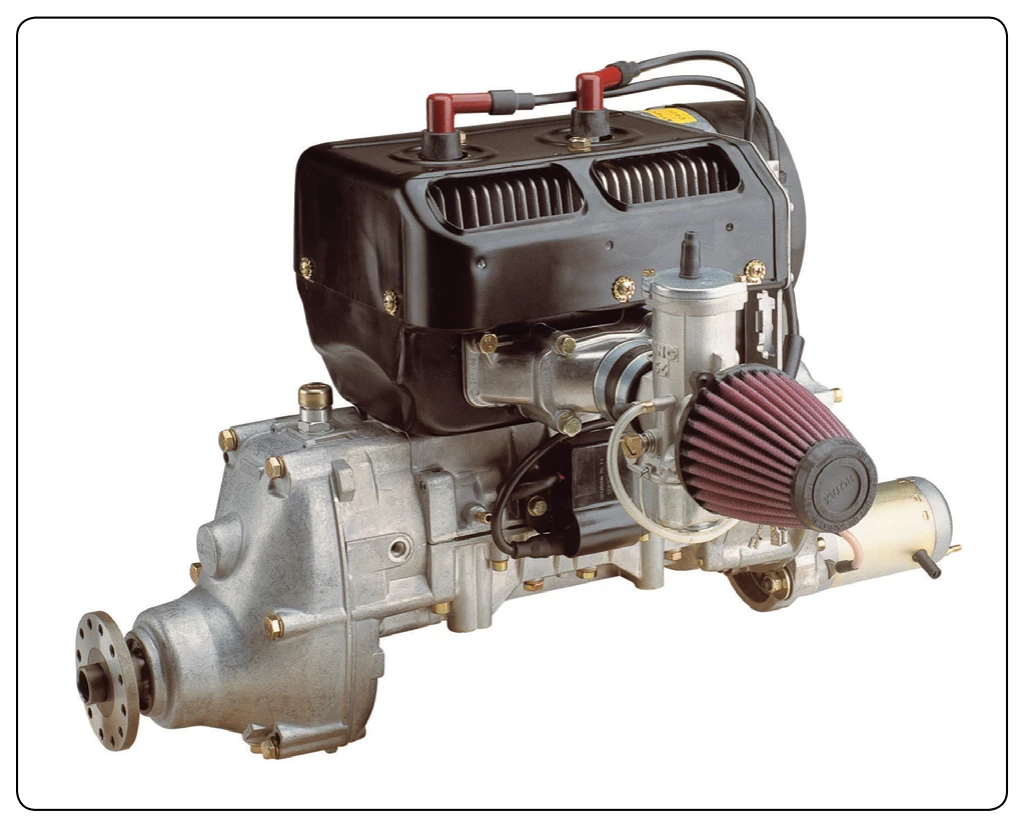
As the engine needs lubrication, the oil is injected directly from this tank. The typical ignition system is a breakerless ignition system with a dual ignition system used on the 503, and a single ignition system used on the 447 engine series. Both systems are of a magneto capacitor discharge design.
The engine is equipped with a carburetion system with one or two piston-type carburetors. One pneumatic driven fuel pump delivers the fuel to the carburetors. The propeller is driven via a flange connected gearbox with an incorporated shock absorber. The exhaust system collects the exhaust gases and directs them overboard. These engines come with an integrated alternating current (AC) generator (12V 170W) with external rectifier-regulator as an optional extra.
Rotax 582 UL DCDI
The Rotax 582 is a two-stroke engine, two cylinder inline with rotary valve inlet, has liquid-cooled cylinder heads, and cylinders that use an integrated water pump. [Figure 11-3] The lubrication system can be a fuel-oil mixture or oil injection lubrication. The ignition system is a dual ignition using a breakerless magneto capacitor discharge design. Dual piston type carburetors and a pneumatic fuel pump deliver the fuel to the cylinders. The propeller is driven via the prop flange connected gearbox with an incorporated torsional vibration shock absorber. This engine also uses a standard version exhaust system with an electric starter or manual rewind starter.