
Chapter 8
Engine Removal & Replacement
- Rotate propeller by hand several revolutions to remove preservative oil.
- Service and install spark plugs and ignition leads in accordance with the manufacturer’s instructions.
- Service engine and aircraft in accordance with the manufacturer’s instruction.
- Thoroughly clean the aircraft and engine. Perform visual inspection.
- Correct any discrepancies.
- Conduct a normal engine start.
- Perform operational test in accordance with operational inspection of the applicable Maintenance Manual.
- Correct any discrepancies. 12 Perform a test flight in accordance with airframe manufacturer’s instructions.
- Correct any discrepancies prior to returning aircraft to service.
- Change oil and filter after 25 hours of operation.
Engine Shipping Containers
For protection, engines are sealed in plastic or foil envelopes and can be packed in a wooden shipping case or in pressurized metal containers.
The engine is lowered into the shipping container so that the mounting plate can be bolted into position. The protective envelope is attached directly to the base of the shipping case. Then, the engine is lowered vertically onto the base and bolted directly to it. A carburetor not mounted on its reciprocating engine (or no provision is made to seal it in a small container to be placed inside the shipping case) can, in some cases, be fastened to a specially constructed platform bolted to the engine.
Before the protective envelope is sealed, silica gel should be placed around the engine to dehydrate the air sealed into the envelope. The amount of silica gel used is determined by the size of the engine. The protective envelope is then carefully gathered around the engine and partially sealed, leaving an opening at one end from which as much air as possible is exhausted. A vacuum applied to the container is very useful for this purpose and is also an aid in detecting any leaks in the envelope. The envelope is then completely sealed, usually by pressing the edges together and fusing them with heat.
Before lowering the shipping case cover over the engine, a quick inventory should be made. Be sure the humidity indicator card is placed so that it can be seen through the
inspection window and that everything required is enclosed in the container. While lowering the wooden shipping case cover into position, be careful that it does not twist and tear the protective envelope. Secure the cover and stencil or mark the date of preservation on the case. Also, indicate whether the engine is repairable or serviceable.
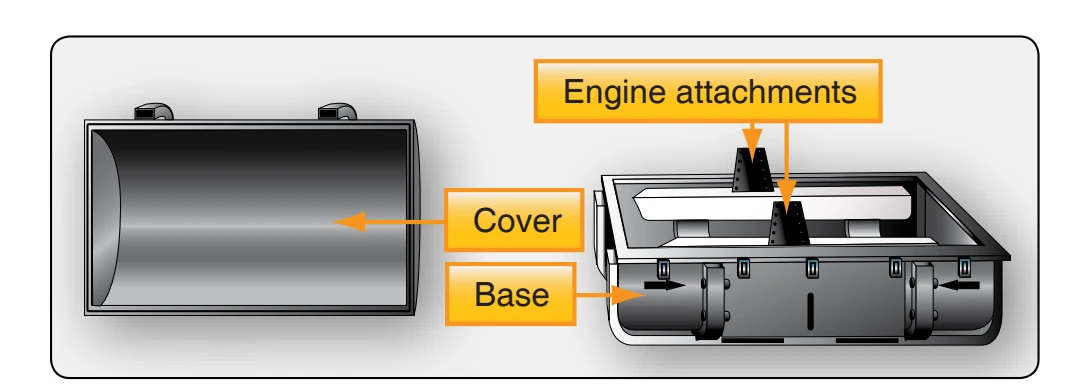
There are several types of shipping containers in use. [Figure 8-21] Another type allows horizontal installation of an engine, thus eliminating the need for an extra hoist. The engine is simply lowered onto the base portion of the container and secured. Then, silica gel bags are packed into the container, usually in a special section. The amount of silica gel required in a metal container is generally greater than that needed in a wooden shipping case, since the volume of air in the metal container is much greater than that in the protective envelope installed around an engine in a wooden shipping case. Also, in the metal container the silica gel bags must dehydrate the interior of the engine, since ventilatory plugs are normally installed in the engine openings in place of dehydrator plugs. All records of the engine should be enclosed inside the shipping container or on the outside for accessibility. A humidity indicator should be fastened inside the containers with an inspection window provided. Then, the rubber seal between the base and the top of the container must be carefully inspected. This seal is usually suitable for re-use several times. After the top of the container has been lowered into position and fastened to the base of the container, dehydrated air at approximately 5 pounds per square inch (psi) pressure is forced into the container. The container should be checked for leaks by occasional rechecks of the air pressure, since radical changes in temperature affect the air pressure in the container.
Inspection of Stored Engines
Most maintenance shops provide a scheduled inspection system for engines in storage. Normally, the humidity indicators on engines stored in shipping cases are inspected every 30 days. When the protective envelope must be opened to inspect the humidity indicator, the inspection period may be extended to once every 90 days, if local conditions permit. The humidity indicator of a metal container is inspected every 180 days under normal conditions.
If the humidity indicator in a wooden shipping case shows by its color that more than 30 percent relative humidity is present in the air around the engine, all desiccants should be replaced. If more than half the dehydrator plugs installed in the spark plug holes indicate the presence of excessive moisture, the interior of the cylinders should be resprayed. If the humidity indicator in a metal container gives a safe blue indication, but air pressure has dropped below 1 psi, the container needs only to be brought to the proper pressure with dehydrated air. However, if the humidity indicator shows an unsafe (pink) condition, the engine should be represerved.
Preservation & Depreservation of Gas Turbine Engines
The procedures for preserving and depreserving gas turbine engines vary depending upon the length of inactivity, the type of preservative used, and whether or not the engine may be rotated during the inactive period. Much of the basic information on corrosion control presented in the section on reciprocating engines is applicable to gas turbine engines. However, the requirements for the types of preservatives and their use are normally different.
The lubrication system is usually drained and may or may not be flushed with preservative oil. The engine fuel system is generally filled with preservative oil, including the fuel control. Before the engine can be returned to service, the preservative oil must be completely flushed from the fuel system by motoring the engine and bleeding the fuel system. Always follow the manufacturer’s instructions when performing any preservation or depreservation of gas turbine engines.