
Chapter 11
Air Masses, Fronts, and the Wave Cyclone Model
11.1 Introduction
An air mass is a large body of air with generally uniform temperature and humidity.
A wave cyclone is a low-pressure circulation that forms and moves along a front.
This chapter will discuss air masses, fronts, and the wave cyclone model.
11.2 Air Masses
The area from which an air mass originates is called a source region.
Air mass source regions range from extensive snow-covered polar areas to deserts to tropical oceans. The United States is not a favorable source region because of the relatively frequent passage of weather disturbances that disrupt any opportunity for an air mass to stagnate and take on the properties of the underlying region. The longer the air mass stays over its source region, the more likely it will acquire the properties of the surface below.
11.2.1 Air Mass Classification
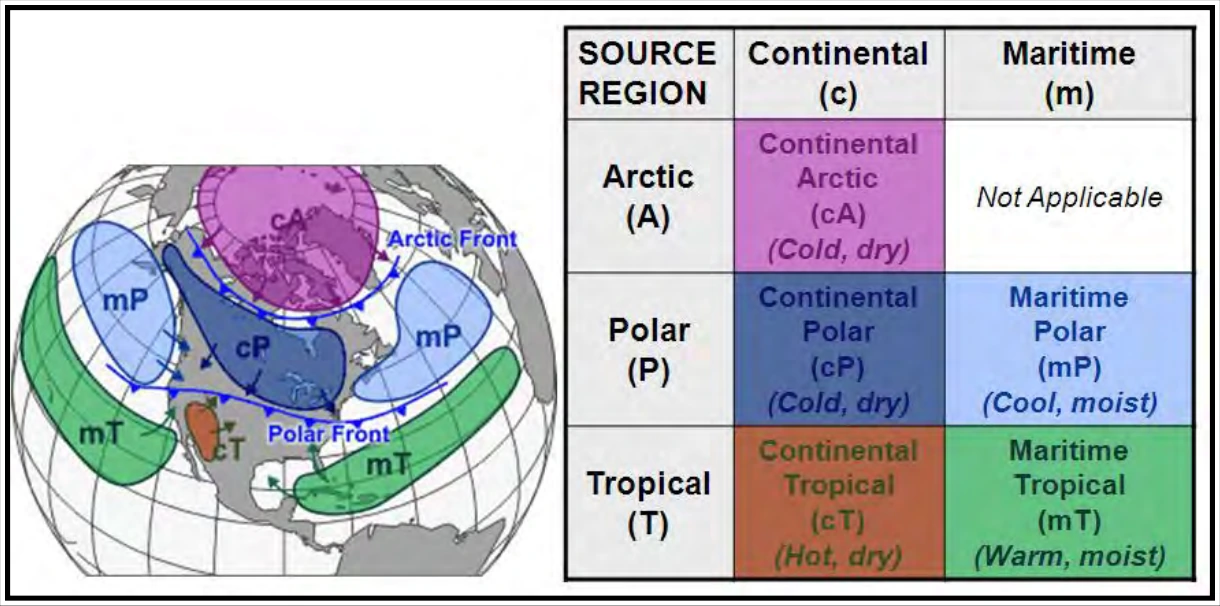
Air masses are classified according to the temperature and moisture properties of their source regions (see Figure 11-1).
11.2.1.1 Temperature Properties
- Arctic (A)—An extremely deep, cold air mass that develops mostly in winter over arctic surfaces of ice and snow.
- Polar (P)—A relatively shallow, cool to cold air mass that develops over high latitudes.
- Tropical (T)—A warm to hot air mass that develops over low latitudes.
11.2.1.2 Moisture Properties
- Continental (c)—A dry air mass that develops over land.
- Maritime (m)—A moist air mass that develops over water.
11.2.1.3 Five Air Masses
When this classification scheme is applied, the following five air masses (see Figure 11-1) may be identified:
- Continental Arctic (cA)—Cold, dry.
- Continental Polar (cP)—Cold, dry.
- Continental Tropical (cT)—Hot, dry.
- Maritime Polar (mP)—Cool, moist.
- Maritime Tropical (mT)—Warm, moist.
11.2.2 Air Mass Modification
As these air masses move around the Earth, they can begin to acquire different attributes. For example, in winter, an arctic air mass (very cold and dry air) can move over the ocean, picking up some warmth and moisture from the warmer ocean and becoming a maritime polar (mP) air mass—one that is still fairly cold but contains moisture. If that same polar air mass moves south from Canada into the southern United States, it will pick up some of the warmth of the ground, but due to lack of moisture, it remains very dry. This is called a continental polar (cP) air mass.