Chapter 13
Atmospheric Stability
13.1 Introduction
Convective clouds and precipitation pose a distinctly different flying environment than stratiform clouds and precipitation. These sharply contrasting conditions result from the atmosphere either resisting or accelerating the vertical motion of air parcels. Atmospheric stability is the property of the ambient air that either enhances or suppresses vertical motion of air parcels and determines which type of clouds and precipitation a pilot will encounter.
13.2 Using a Parcel as a Tool to Evaluate Stability
An air parcel can be used as a tool to evaluate atmospheric stability within a specified vertical column of air in the atmosphere. A parcel is selected from a specified altitude (usually the surface) and hypothetically lifted upward to a specified test altitude. As the parcel is lifted, its temperature decreases due to the expansion and latent heat effects discussed in Chapter 12, Vertical Motion and Clouds.
The parcel and the surrounding environmental air temperatures are then compared. If the lifted parcel is colder than the surrounding air, it will be denser (heavier) and sink back to its original level. In this case, the parcel is stable because it resists upward displacement. If the lifted parcel is the same temperature as the surrounding air, it will be the same density and remain at the same level. In this case, the parcel is neutrally stable. If the lifted parcel is warmer and, therefore, less dense (lighter) than the surrounding air, it will continue to rise on its own until it reaches the same temperature as its environment. This final case is an example of an unstable parcel. Greater temperature differences result in greater rates of vertical motion.
13.3 Stability Types
The stability of a column of air in the atmosphere is classified by the distribution of parcel stabilities within the column. The Earth’s surface is typically selected as the base while the top determines the column’s depth. Four unique types of atmospheric stability can be identified and are discussed in the following sections.
13.3.1 Absolute Stability
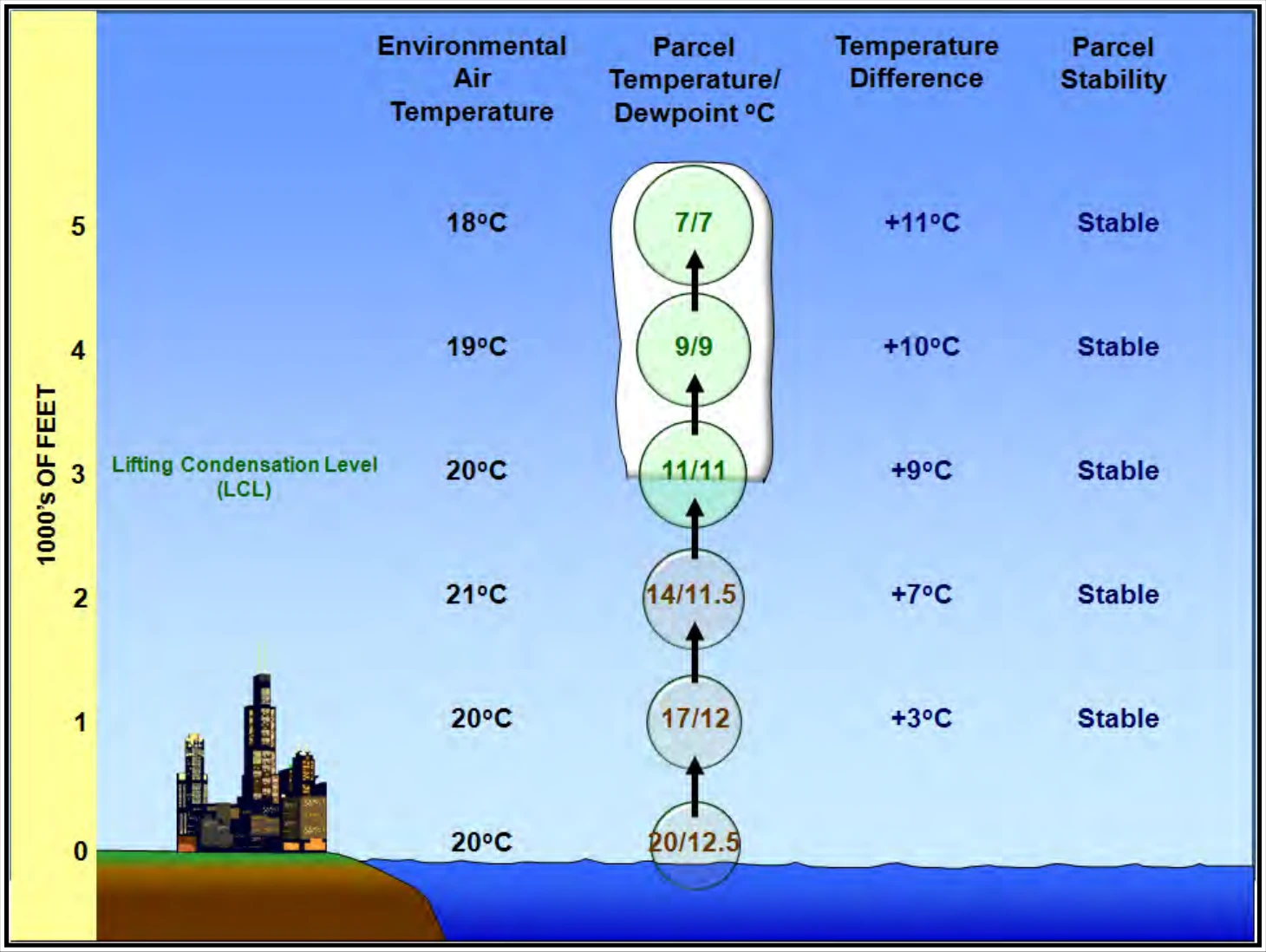
Absolute stability (see Figure 13-1) is the state of a column of air in the atmosphere when its lapse rate of temperature is less than the moist adiabatic lapse rate. This includes both isothermal and inversion temperature profiles. An air parcel lifted upward would be colder (denser) than the surrounding environmental air and would tend to sink back to its level of origin.
13.3.2 Neutral Stability
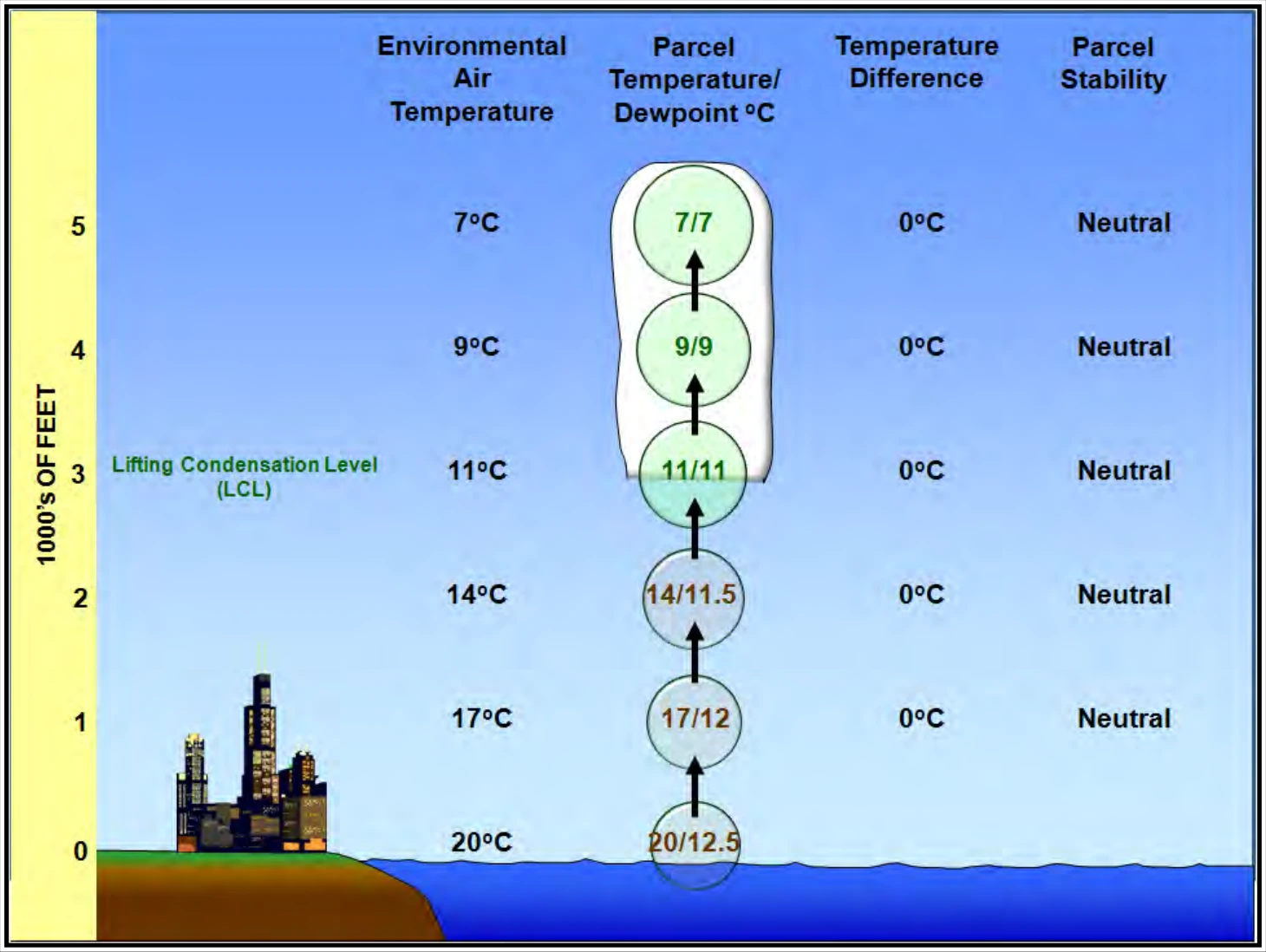
Neutral stability (see Figure 13-2) is the state of a column of air in the atmosphere in which an ascending (or descending) air parcel always has the same temperature (density) as the surrounding environmental air. If the column of air is unsaturated, then neutral stability exists when its lapse rate of temperature equals the dry adiabatic lapse rate. If the column of air is saturated, then neutral stability exists when its lapse rate of temperature equals the moist adiabatic lapse rate.
13.3.3 Absolute Instability
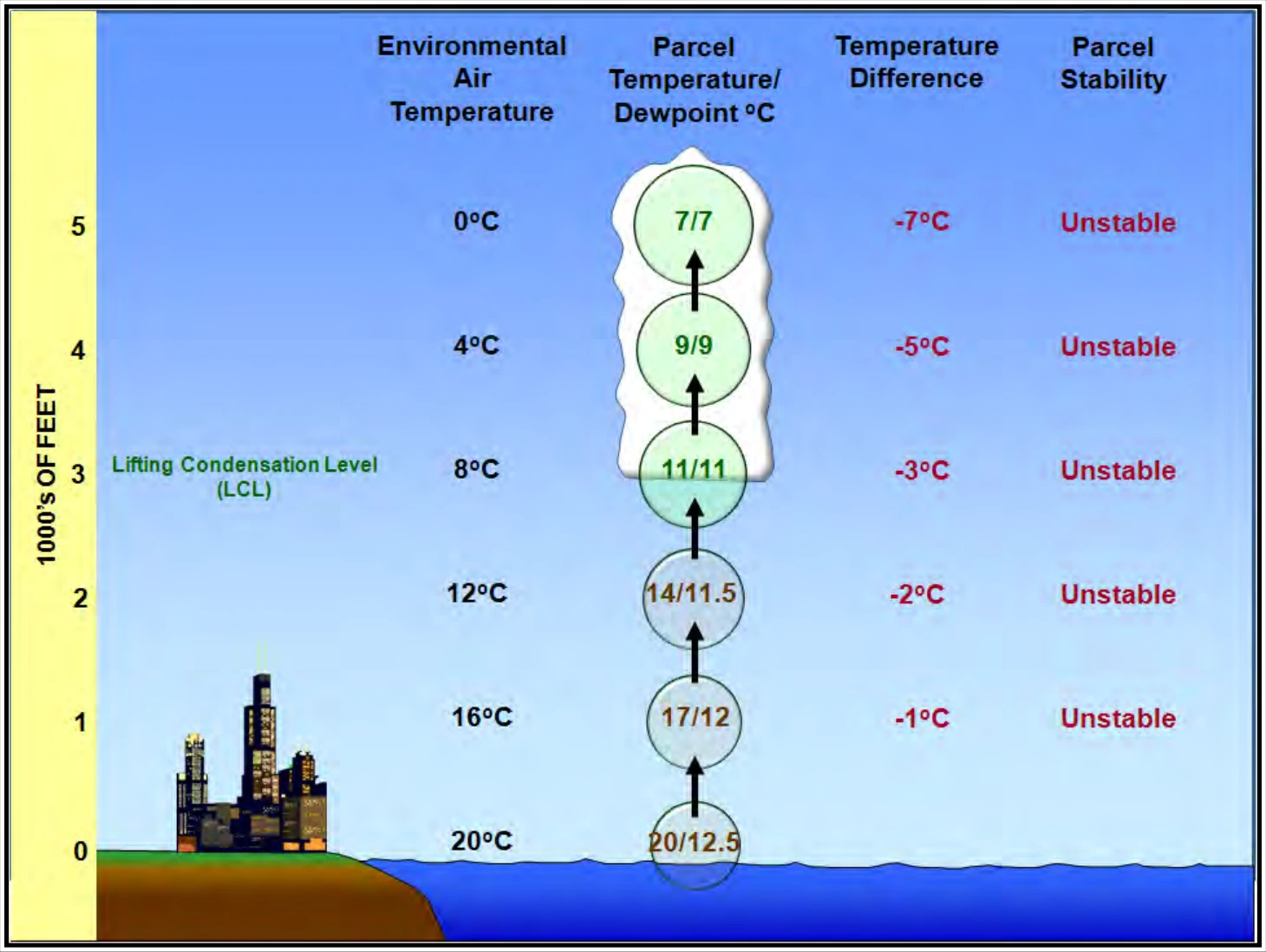
Absolute instability (see Figure 13-3) is the state of a column of air in the atmosphere when it has a superadiabatic lapse rate of temperature (i.e., greater than the dry adiabatic lapse rate). An air parcel displaced vertically would be accelerated in the direction of the displacement. The kinetic energy of the parcel would consequently increase with increasing distance from its level of origin.
13.3.4 Conditional Instability
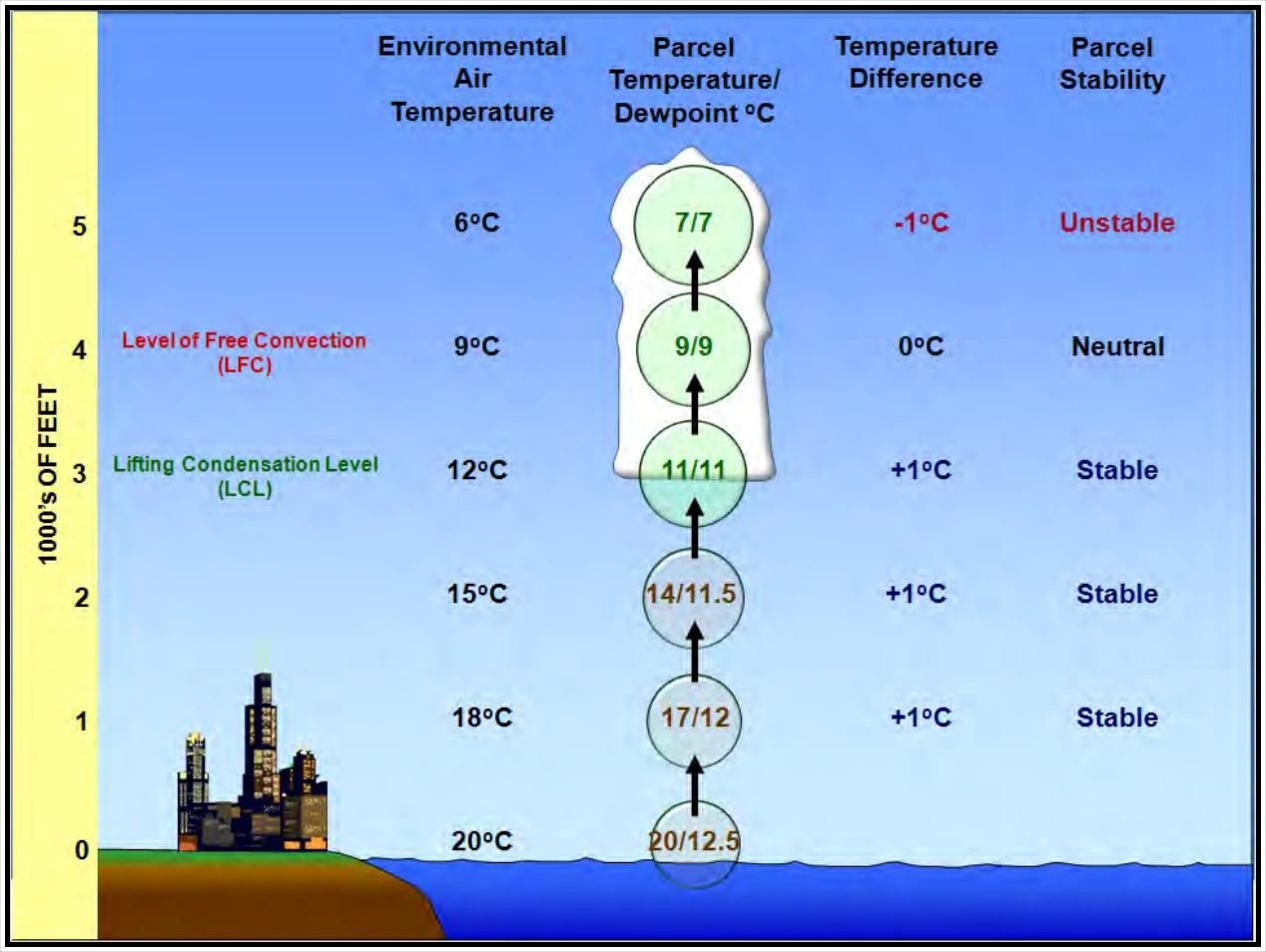
Conditional instability (see Figure 13-4) is the state of a column of unsaturated air in the atmosphere when its lapse rate of temperature is less than the dry adiabatic lapse rate but greater than the moist adiabatic lapse rate. An air parcel lifted upward would be initially stable, but at some point, above its LCL, it would become unstable. The term “conditional” means the parcel must be lifted to a particular level (altitude) before it becomes unstable and rises because of its own buoyancy. The Level of Free Convection (LFC) is the level at which a parcel of air lifted dry adiabatically until saturated and moist adiabatically thereafter would first become warmer than the surrounding environmental air (i.e., unstable) in a conditionally unstable column of air in the atmosphere. The LFC is a defining feature of a conditionally unstable column of air.