
Chapter 24
Observations
METAR KOKC 011955Z AUTO 22015G25KT 180V250 3/4SM R17L/2600FT +TSRA BR OVC010CB
18/16 A2992 RMK AO2 TSB25 TS OHD MOV E SLP132
The altimeter setting group codes the current pressure at elevation. This setting is then used by aircraft altimeters to determine the true altitude above a fixed plane of MSL.
The altimeter group always starts with an A and is followed by the four-digit group representing the pressure in tens, units, tenths, and hundredths of inches of mercury. The decimal point is not coded. For example, an altimeter setting of 29.92 inHg would be coded as A2992.
24.4.3.12 Remarks (RMK)
METAR KOKC 011955Z AUTO 22015G25KT 180V250 3/4SM R17L/2600FT +TSRA BR OVC010CB
18/16 A2992 RMK AO2 TSB25 TS OHD MOV E SLP132
Remarks are included in METAR and SPECI, when appropriate.
Remarks are separated from the body of the report by the contraction RMK. When no remarks are necessary, the contraction RMK is not used.
METAR/SPECI remarks fall into two categories (see Table 24-6):
- Automated, Manual, and Plain Language; and
- Additive and Automated Maintenance Data.
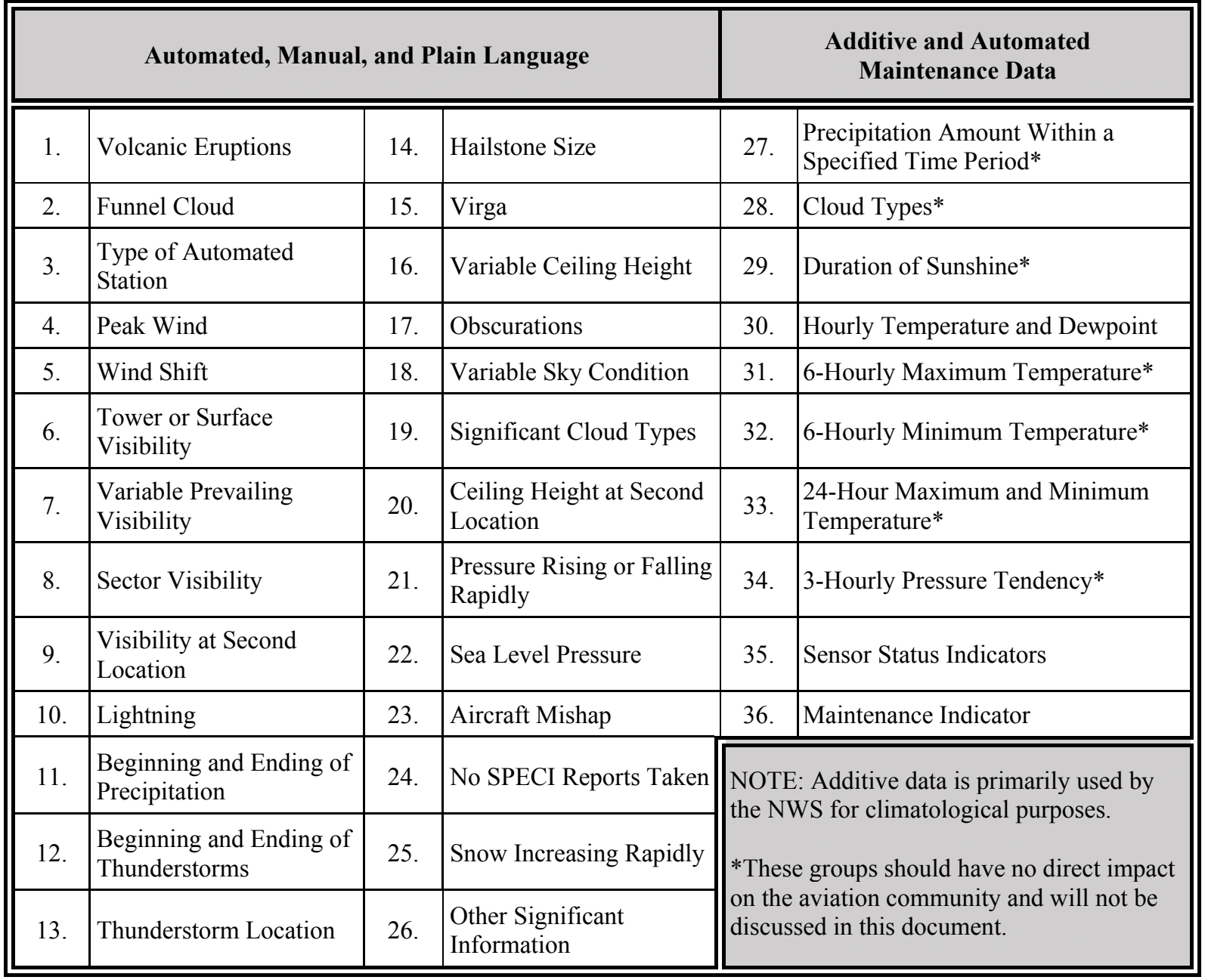
Remarks are made in accordance with the following:
- Time entries are made in minutes past the hour if the time reported occurs during the same hour the observation is taken. Hours and minutes are used if the hour is different.
- Present weather coded in the body of the report as VC may be further described (e.g., direction from the station, if known). Weather phenomena beyond 10 SM of the point(s) of observation are coded as distant (DSNT) followed by the direction from the station. For example, precipitation of unknown intensity within 10 SM east of the station would be coded as VCSH E; lightning 25 SM west of the station would be coded as LTG DSNT W.
- Distance remarks are in statute miles, except for automated lightning remarks, which are in nautical miles.
- Movement of clouds or weather, when known, is coded with respect to the direction toward which the phenomena are moving. For example, a thunderstorm moving toward the northeast would be coded as TS MOV NE.
- Directions use the eight points of the compass coded in a clockwise order.
- Insofar as possible, remarks are entered in the order they are presented in the following sections (and Table 24-6).
24.4.3.13 Automated, Manual, and Plain Language Remarks
These remarks generally elaborate on parameters reported in the body of the report. An automated station or observer may generate automated and manual remarks. Only an observer can provide plain language remarks.
24.4.3.13.1 Volcanic Eruptions
Volcanic eruptions are coded in plain language and contain the following, when known:
- Name of volcano;
- Latitude and longitude, or the direction and approximate distance from the station;
- Date/time (UTC) of the eruption;
- Size description, approximate height, and direction of movement of the ash cloud; and
- Any other pertinent data about the eruption.
For example, a remark on a volcanic eruption would look like the following:
RMK MT. AUGUSTINE VOLCANO 70 MILES SW ERUPTED AT 231505 LARGE ASH CLOUD EXTENDING
TO APRX 30000 FEET MOVING NE.
Pre-eruption volcanic activity is not coded. Pre-eruption refers to unusual and/or increasing volcanic activity that could presage a volcanic eruption.