
Chapter 26
Advisories
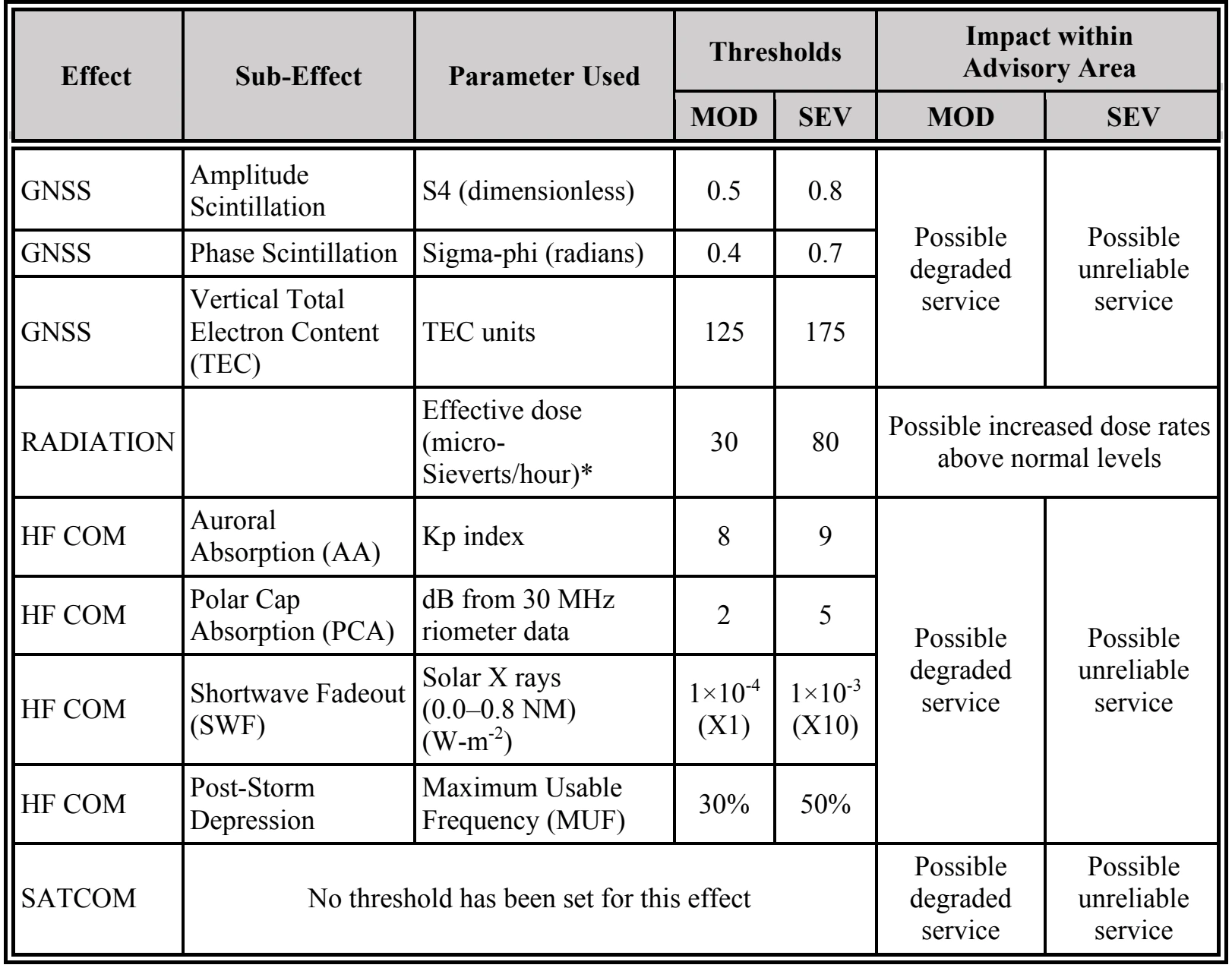
*MOD advisories will only be issued when the MOD threshold is reached between FL250 and FL460. SEV advisories will be issued when the SEV threshold is reached at any FL above FL250. For context, the background effective dose rate at FL370 at very high latitudes is approximately 9 micro-Sieverts/hour during solar minimum and 6 micro-Sieverts/hour during solar maximum. These rates decrease progressively toward the equatorial regions to values approximately one quarter of what is observed at very high latitudes.
26.7.2 Space Weather Advisory Format
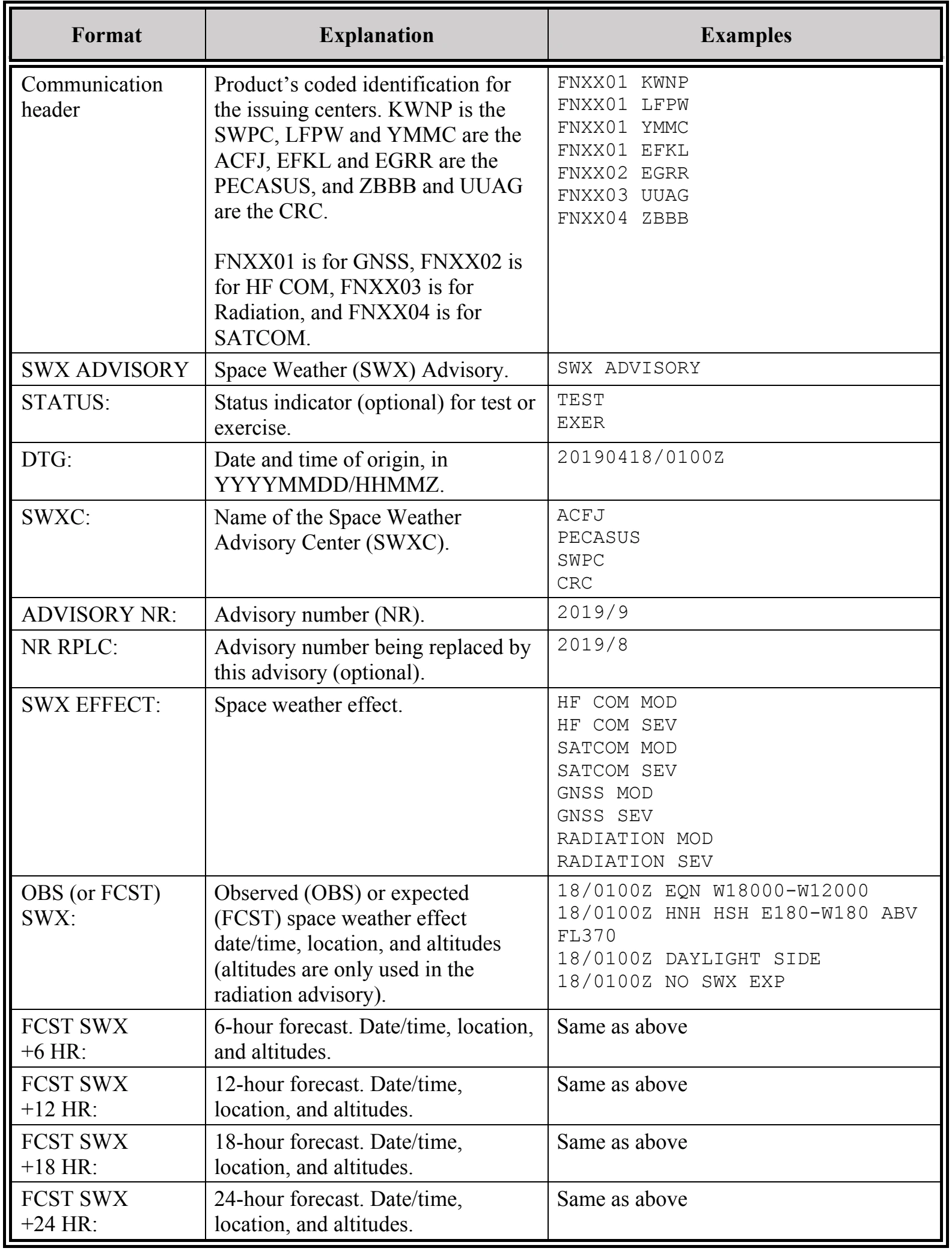
The Space Weather Advisory provides an observed or expected location for the impact and 6-, 12-, 18-, and 24-hour forecasts. The advisory describes the affected part of the globe in one of three ways:
- Six pre-defined latitude bands of width 30° shown in Table 26-7 (multiple bands may be given in one advisory), followed by a longitude range in 15-degree increments;*
- The term “DAYLIGHT SIDE,” meaning the extent of the planet that is in daylight; or
- A polygon using latitude and longitude coordinates.
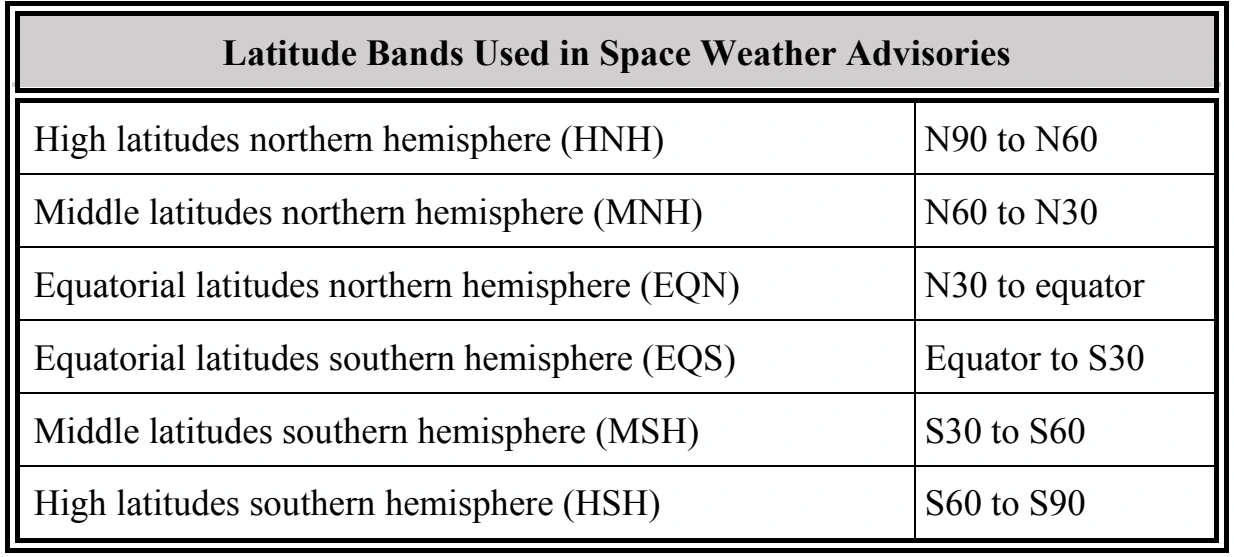
By design, the vertical and temporal resolutions of the advisory are very coarse. The use of 30° latitude bands, 15-degree longitude increments, 1,000-ft vertical increments (for radiation), and six-hour time intervals will at times result in over-forecasting the affected airspace. In addition, while an entire latitude band may be forecast to have MOD or SEV space weather, there will often be times that the effect does not cover the entire width of the band or is intermittent or temporary. Users should refer to the remarks section of the advisory for additional information. Users can also go to the center’s website, where a graphical depiction of the space weather event may be provided along with additional information.
Changes to the Space Weather Advisory content and format are possible in the coming years as experience is gained with the use of this product.
The Space Weather Advisory is not a replacement for the SWPC’s other products or the NOAA Space Weather Scales, which continue to be provided by the SWPC. Refer to the SWPC’s website for information on these products and the scales.

26.7.3 Space Weather Advisory Examples
26.7.3.1 Example Space Weather Advisory—GNSS
FNXX03 KWNP 020100
SWX ADVISORY
DTG: 20190502/0100Z
SWXC: SWPC
ADVISORY NR: 2019/59
NR RPLC: 2019/58
SWX EFFECT: GNSS MOD
OBS SWX: 02/0100Z HNH HSH E18000-W18000
FCST SWX + 6 HR: 02/0700Z HNH HSH E18000-W18000
FCST SWX + 12 HR: 02/1300Z HNH HSH E18000-W18000
FCST SWX + 18 HR: 02/1900Z NO SWX EXP
FCST SWX + 24 HR: 03/0100Z NO SWX EXP
RMK: IONOSPHERIC STORM CONTINUES TO CAUSE LOSS-OF-LOCK
OF GNSS IN AURORA ZONE. THIS ACTIVITY IS
EXPECTED TO SUBSIDE IN THE FORECAST PERIOD
NXT ADVISORY: 20190502/0700Z=
26.7.3.2 Example Space Weather Advisory—RADIATION
FNXX02 EFKL 190300
SWX ADVISORY
DTG: 20190219/0300Z
SWXC: PECASUS
ADVISORY NR: 2019/20
SWX EFFECT: RADIATION MOD
OBS SWX: 19/0300Z HNH HSH E18000-W18000 ABV FL370
FCST SWX + 6 HR: 19/0900Z NO SWX EXP
FCST SWX + 12 HR: 19/1500Z NO SWX EXP
FCST SWX + 18 HR: 19/2100Z NO SWX EXP
FCST SWX + 24 HR: 20/0300Z NO SWX EXP
RMK: RADIATION AT AIRCRAFT ALTITUDES ELEVATED
BY SMALL ENHANCEMENT JUST ABOVE PRESCRIBED
THRESHOLD. DURATION TO BE SHORT-LIVED
NXT ADVISORY: NO FURTHER ADVISORIES=