
Chapter 5
Heat and Temperature
5.1 Introduction
Temperature is one of the most basic variables used to describe the state of the atmosphere. Air temperature varies with time from one season to the next, between day and night, and even from one hour to the next. Air temperature also varies from one location to another, from high altitudes and latitudes to low altitudes and latitudes. Temperature can be critical to some flight operations. As a foundation for the study of temperature effects on aviation and weather, this chapter describes temperature, temperature measurement, and heat transfer and imbalances. For additional information on how temperature may affect flight performance, please see Chapter 8.
5.2 Matter
Matter is the substance of which all physical objects are composed. Matter is composed of atoms and molecules, both of which occupy space and have mass. The Earth’s gravity acting on the mass of matter produces weight.
5.3 Energy
Energy is the ability to do work. It can exist in many forms and can be converted from one form to another. For example, if a ball is located at the edge of a slide, it contains some amount of potential energy (energy of position). This potential energy is converted to kinetic energy (energy of motion) when the ball rolls down the slide. Atoms and molecules produce kinetic energy because they are in constant motion. Higher speeds of motion indicate higher levels of kinetic energy.
5.4 Heat
Heat is the total kinetic energy of the atoms and molecules composing a substance. The atoms and molecules in a substance do not all move at the same velocity. Thus, there is actually a range of kinetic energy among the atoms and molecules.
5.5 Temperature
Temperature is a numerical value representing the average kinetic energy of the atoms and molecules within matter. Temperature depends directly on the energy of molecular motion. Higher (warmer) temperatures indicate a higher average kinetic energy of molecular motion due to faster molecular speeds. Lower (colder) temperatures indicate a lower average kinetic energy of molecular motion due to slower molecular speeds. Temperature is an indicator of the internal energy of air.
5.5.1 Temperature Measurement
A thermometer is an instrument used to measure temperature. Higher temperatures correspond to higher molecular energies, while lower temperatures correspond to lower molecular energies.
5.5.2 Temperature Scales
Many scientists use the Kelvin (K) scale, a thermodynamic (absolute) temperature scale, where absolute zero, the theoretical absence of all thermal energy, is 0 K. Thus, the Kelvin scale is a direct measure of the average kinetic molecular activity. Because nothing can be colder than absolute zero, the Kelvin scale contains no negative numbers.
The Celsius (°C) scale is the most commonly used temperature scale worldwide and in meteorology. The scale is approximately based on the freezing point (0 °C) and boiling point (100 °C) of water under a pressure of one standard atmosphere (approximately sea level). Each degree on the Celsius scale is exactly the same size as a degree on the Kelvin scale.
In the early 1990s, the United States aligned with ICAO standards by moving to the metric system for aviation weather reports. While some websites and applications provide temperature from the METAR in degrees Fahrenheit, these are done by the conversion software, as the temperature in the METAR is strictly reported in degrees Celsius. The United States uses the Fahrenheit (°F) scale for everyday temperature measurements for non-aviation purposes. In this scale, the freezing point of water is 32 °F and the boiling point is 212 °F.
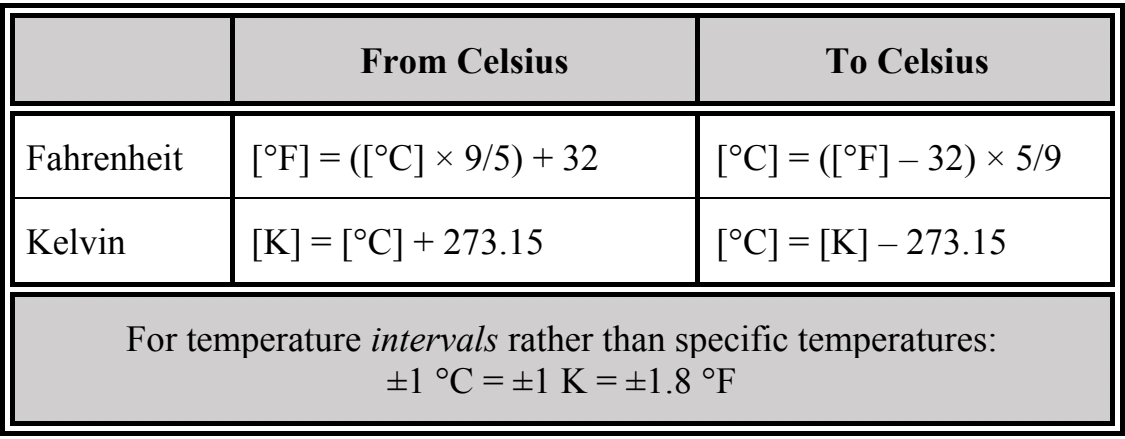
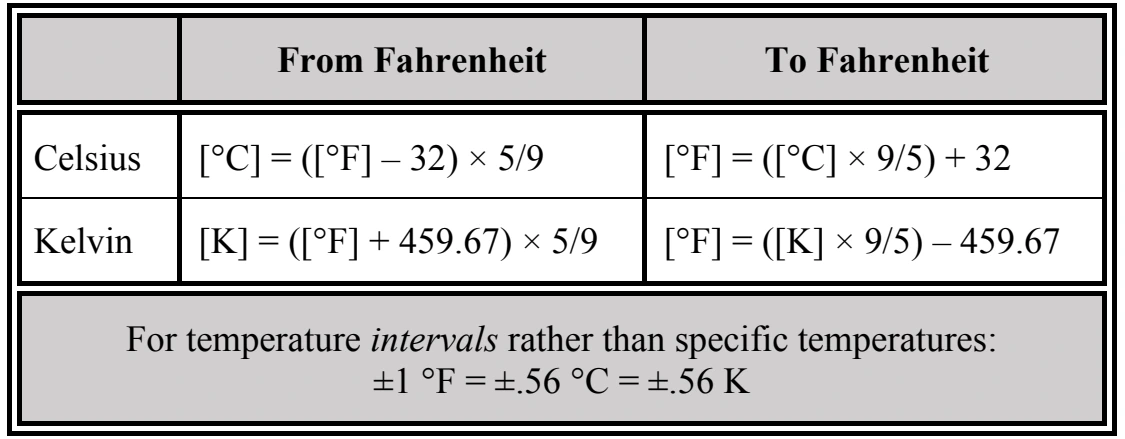
See Table 5-1 and Table 5-2 for conversion information between temperature scales.
A thermometer changes readings due to the addition or subtraction of heat. Heat and temperature are not the same, but they are related.