
Chapter 6
Water Vapor
6.1 Introduction
Water vapor is the gaseous form of water and one of the most important of all constituents of the atmosphere. It constitutes only a small percentage of the Earth’s atmosphere, varying from only trace amounts to 4 percent by volume, and its amount varies widely in space and time. Approximately half of all of the atmospheric water vapor is found below 2 km (6,500 ft) altitude, and only a minute fraction of the total occurs above the tropopause.
The development of clouds and precipitation can have potential impacts on flight operations. Water vapor is important, not only as the raw material for clouds and precipitation (e.g., rain and snow), but also as a vehicle for the transfer of heat energy and as a regulator of the Earth’s temperatures through absorption and emission of radiation, most significantly in the thermal infrared (i.e., the greenhouse effect). The amount of water vapor present in a given air sample may be measured in a number of different ways, involving such concepts as relative humidity and dewpoint. Before talking about these subjects, the process of water cycling through the Earth-atmosphere system will be discussed.
6.2 The Hydrologic Cycle
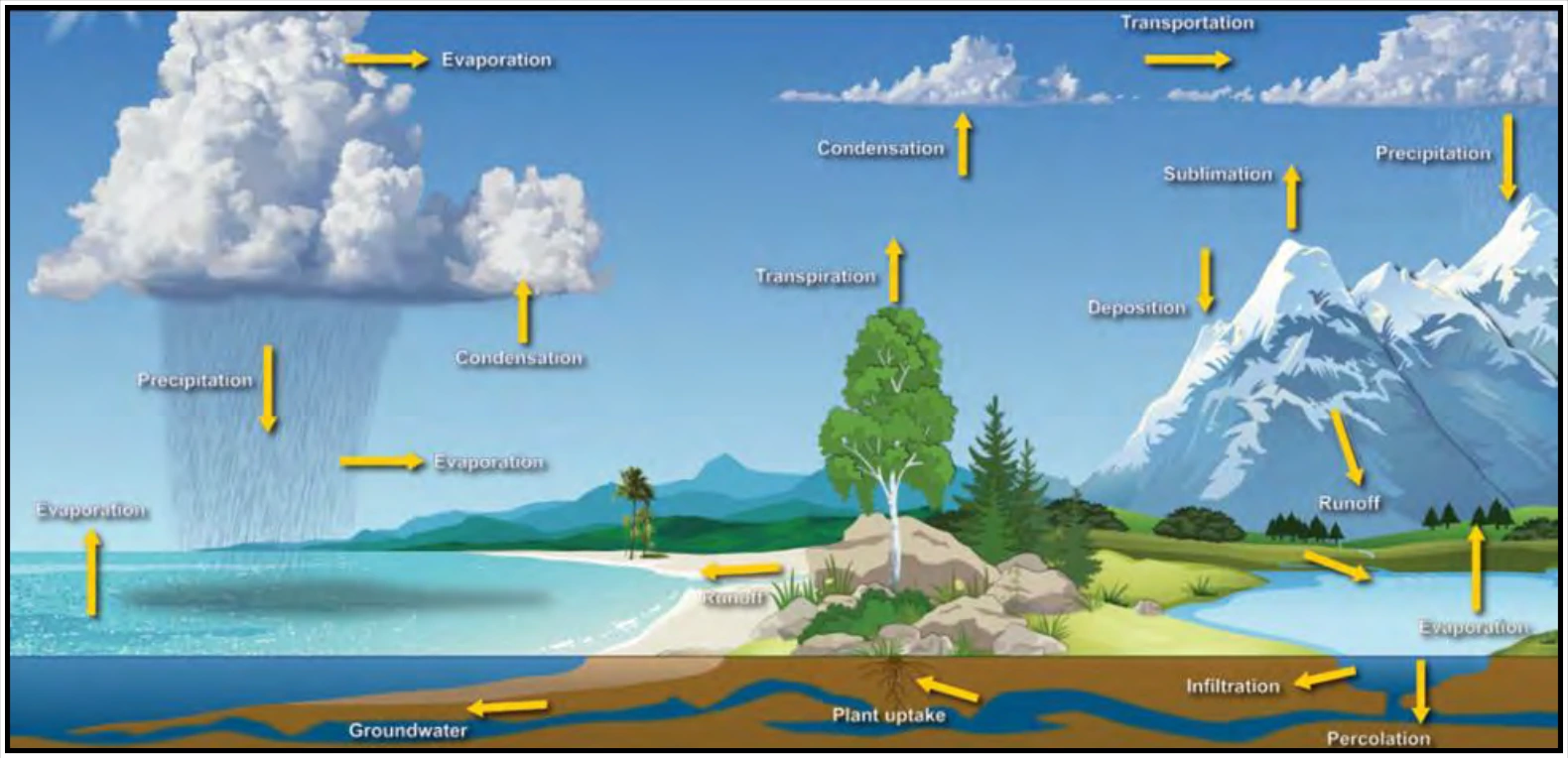
The hydrologic cycle (see Figure 6-1) involves the continuous circulation of water in the Earth-atmosphere system. Water vapor plays a critical role in the cycle.
6.2.1 Evaporation
Evaporation is the phase transition by which a liquid is changed to a vapor (gas). In meteorology, the substance meteorologists are concerned about the most is water, and the primary source is the ocean. On average, about 120 cm (47 in) is evaporated into the atmosphere from the ocean each year. For evaporation to take place, energy is required. The energy can come from any source: the Sun, the atmosphere, the Earth, or objects on the Earth, such as humans.
Humans experience evaporation in their body. When the body heats up due to the air temperature or through exercise, the body sweats, secreting water onto the skin. The purpose is to cause the body to use its heat to evaporate the liquid, thereby removing heat and cooling the body. The same effect can be seen when stepping out of a shower or swimming pool. The coolness felt is from the removal of bodily heat used to evaporate the water on the skin.
6.2.2 Transpiration
Transpiration is the evaporation of water from plants. In most plants, transpiration is a passive process largely controlled by the humidity of the atmosphere and the moisture content of the soil. Of the transpired water passing through a plant, only one percent is used in the growth process of the plant. The remaining 99 percent is passed into the atmosphere.
6.2.3 Sublimation
Sublimation is the phase transition by which a solid is changed into vapor (a gas) without passing through the liquid phase. In the atmosphere, sublimation of water occurs when ice and snow (solids) change into water vapor (a gas).
6.2.4 Deposition
Deposition is the phase transition by which vapor (a gas) is changed into a solid without passing through the liquid phase. In the atmosphere, deposition of water occurs when vapor (a gas) in a sub-freezing cloud changes into ice crystals (solid).
6.2.5 Condensation
Condensation is the phase transition by which vapor (a gas) is changed into a liquid. In the atmosphere, condensation may appear as clouds, fog, mist, dew, or frost, depending upon the physical conditions of the atmosphere.
6.2.6 Transportation
Transportation is the movement of solid, liquid, and gaseous water through the atmosphere. Without this movement, the water evaporated over the ocean would not precipitate over land.