
Chapter 8
Atmospheric Pressure and Altimetry
Density altitude is an index to aircraft performance. Higher density altitude decreases aircraft performance. Lower density altitude increases aircraft performance. High density altitude is a hazard, since it reduces aircraft performance in the following three ways:
- It reduces power because the engine takes in less air to support combustion.
- It reduces thrust because there is less air for the propeller to work with, or a jet has less mass of gases to force out of the exhaust.
- It reduces lift because the light air exerts less force on the airfoils.
A pilot cannot detect the effect of high-density altitude on the airspeed indicator. The aircraft lifts off, climbs, cruises, glides, and lands at the prescribed indicated airspeeds; but at a specified indicated airspeed, the pilot’s true airspeed and groundspeed increase proportionally as density altitude becomes higher.
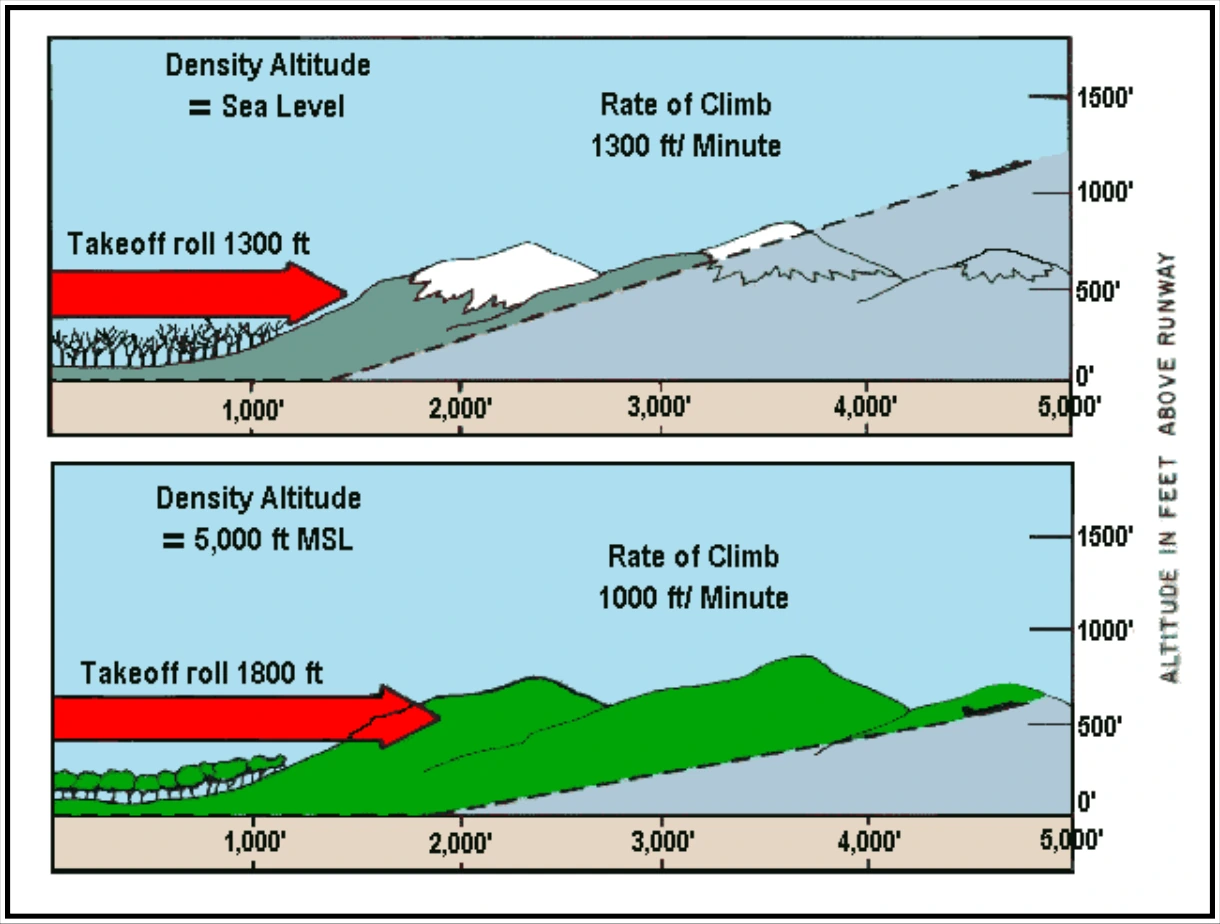
The net results are that high density altitude lengthens a pilot’s takeoff and landing rolls and reduces the rate of climb. Before lift-off, the plane must attain a faster groundspeed, and, therefore, needs more runway; and the reduced power and thrust add a need for still more runway. The plane lands at a faster groundspeed and, therefore, needs more room to stop. At a prescribed indicated airspeed, it is flying at a faster true airspeed, and, therefore, covers more distance in a given time, which means climbing at a shallower angle. Adding to this are the problems of reduced power and rate of climb. Figure 8-15 shows the effect of density altitude on takeoff distance and rate of climb.
High density altitude also can be a problem at cruising altitude. When air temperature is higher (warmer) than standard atmosphere, the higher density altitude lowers the service ceiling. For example, if temperature at a pressure altitude of 10,000 ft is 20 °C, density altitude is 12,700 ft. A pilot’s aircraft will perform as though it were at 12,700 ft indicated with a normal temperature of -8 °C.
To compute density altitude, a pilot can set the altimeter to 29.92 in (1,013.2 mb), read the pressure altitude from the altimeter, obtain the OAT, and then use a flight computer to compute density altitude.