
Chapter 8
Atmospheric Pressure and Altimetry
8.3.2 Changes in Density
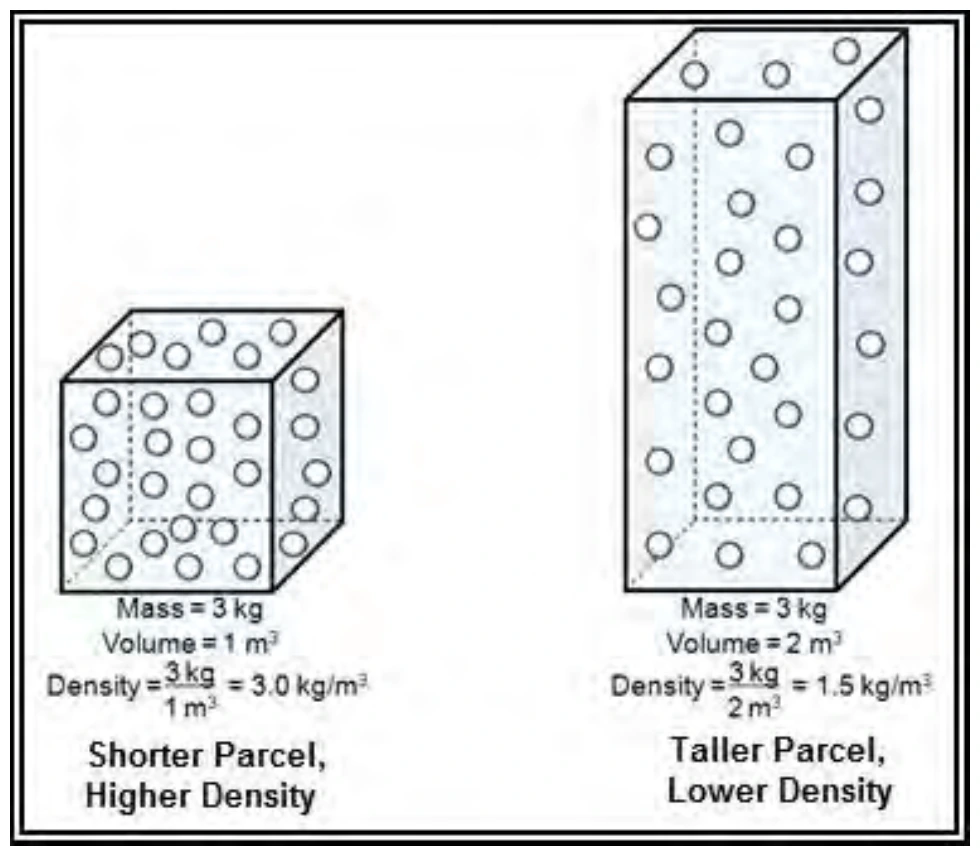
In general, the density of an air parcel can be changed by changing its mass, pressure, or temperature. Boyle’s law says that the density of an ideal gas (ρ, the Greek letter rho) is given by:
Where M is the molar mass, P is the pressure, R is the universal gas constant, and T is the absolute temperature.
8.3.3 Density’s Effects on Pressure
Density is directly related to pressure. Assuming constant mass and temperature, an air parcel with a higher pressure is denser than an air parcel with a lower pressure.
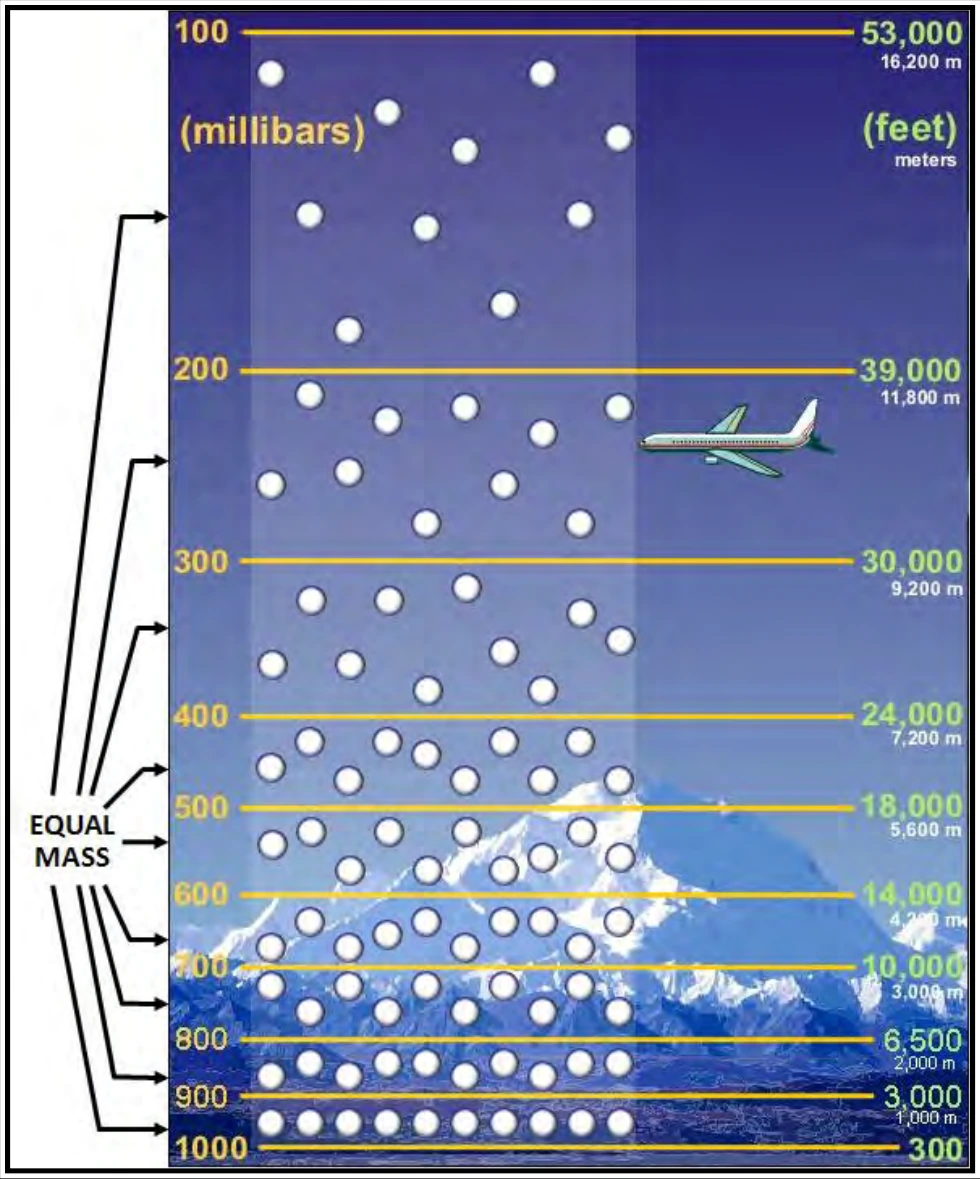
As previously discussed, air pressure decreases with height in the atmosphere. Therefore, the density also decreases with height (see Figure 8-9). In the atmosphere, pressure has the greatest effect on density in the vertical direction.
8.3.4 Temperature’s Effects on Density
Density is inversely related to temperature. Assuming constant mass and pressure, an air parcel with a higher temperature is less dense than an air parcel with a lower temperature (see Figure 8-10). This is because the warmer air occupies a large volume.
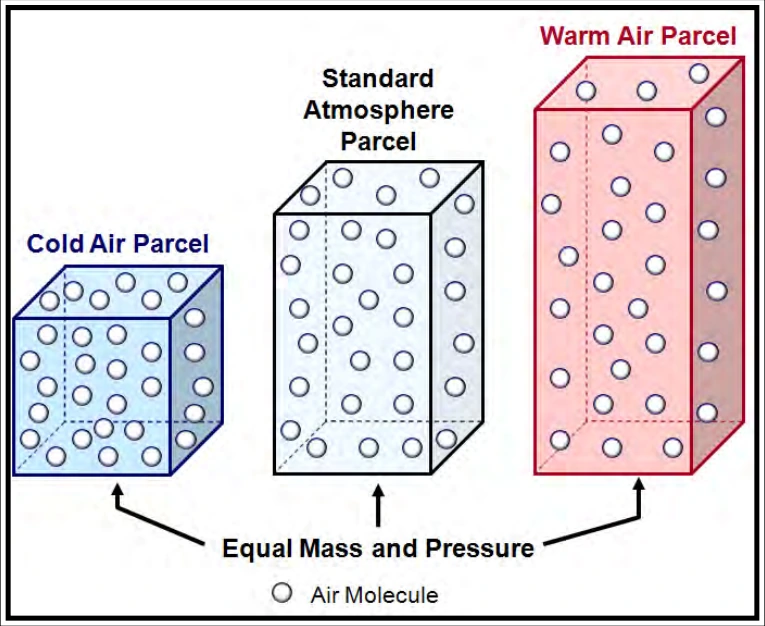
In the atmosphere, temperature has the most effect on density in the horizontal direction; that is, with horizontal changes of location (e.g., New York City versus Miami), temperature has the greatest effect on density.
8.3.5 Water Vapor’s Effects on Density
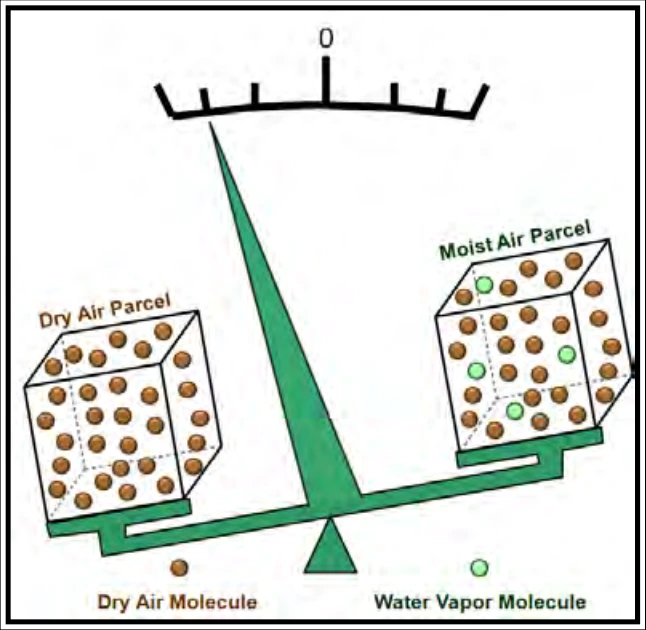
Density of an air parcel is inversely related to its quantity of water vapor. Assuming constant pressure, temperature, and volume, air with a greater amount of water vapor is less dense than air with a lesser amount of water vapor. This is because dry air molecules have a larger mass (weight) than water vapor molecules, and density is directly related to mass (see Figure 8-11).
8.4 Altimetry
The altimeter is essentially an aneroid barometer. The difference is the scale. The altimeter is graduated to read increments of altitude rather than units of pressure. The standard for graduating the altimeter is the standard atmosphere.
8.4.1 Altitude
Altitude seems like a simple term; it means the vertical elevation of an object above the surface of the Earth. However, in aviation, it can have many meanings.