
Appendix A: Cloud Types
In each level, the clouds may be divided by type (genera). The definitions of the cloud types (given below) do not cover all possible aspects, but they are limited to a description of the main types and of the essential characteristics necessary to distinguish a given type from another type having a somewhat similar appearance.
Clouds are identified based upon one’s observation point at a particular elevation. From sea level, one might observe stratus clouds enveloping the top of a mountain. However, on the mountaintop, one would observe and report that same cloud as fog.
The exception to this is cumulus or cumulonimbus clouds over a mountain. Even though these low-level clouds typically have bases under 6,500 ft (2,000 m), if one were to observe them over a mountaintop, their base might be 12,000 ft (3,600 m) or higher relative to a particular location closer to sea level. However, due to their location over the mountain, one would still call them cumulus or cumulonimbus clouds, as appropriate.
A.1 High Clouds
Cirrus (Ci), cirrocumulus (Cc), and cirrostratus (Cs) are high-level clouds. They are typically thin and white in appearance but can appear in a magnificent array of colors when the Sun is low on the horizon. They are composed almost entirely of ice crystals.
A.1.1 Cirrus (Ci)
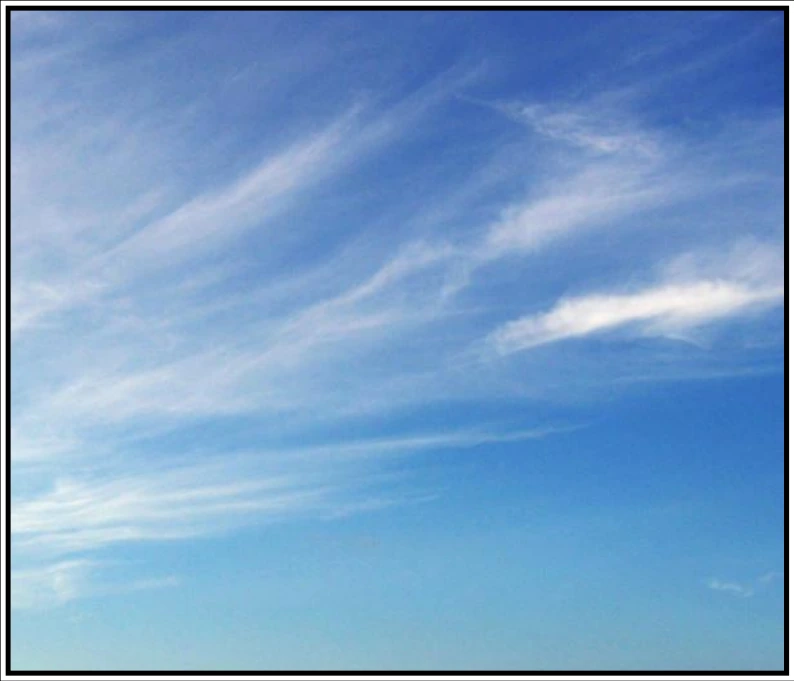
Cirrus (Ci) (see Figure A-1) is a cloud type composed of detached cirriform elements in the form of white, delicate filaments of white, or mostly white, patches or narrow bands. These clouds have a fibrous (hairlike) appearance and/or a silky sheen. Many of the ice crystal particles of cirrus are sufficiently large to acquire an appreciable speed of fall; therefore, the cloud elements often trail downward in well-defined wisps called “mares’ tails.” Cirrus clouds in themselves have little effect on aircraft and contain no significant icing or turbulence.
A.1.2 Cirrocumulus (Cc)
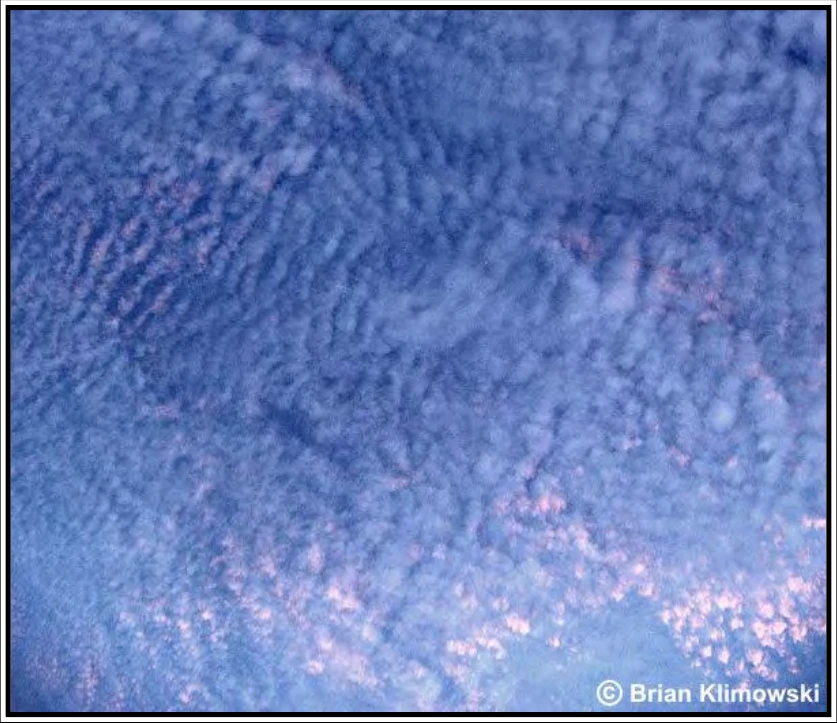
Cirrocumulus (Cc) is a cirriform cloud type appearing as a thin white patch, sheet, or layer of cloud without shading and is composed of very small elements in the form of grains, ripples, etc. The elements may be merged or separate, and more or less regularly arranged; they subtend an angle of less than one degree when observed at an angle of more than 30 degrees above the horizon.
Cirrocumulus (see Figure A-2) may be composed of highly supercooled water droplets as well as small ice crystals, or they may be a mixture of both. Usually, the droplets are rapidly replaced by ice crystals. Pilots can expect some turbulence and icing.
Cirrocumulus is not very common. It is composed of very small elements, which never show shading. The cloud is frequently associated with cirrus or cirrostratus.
A.1.3 Cirrostratus (Cs)
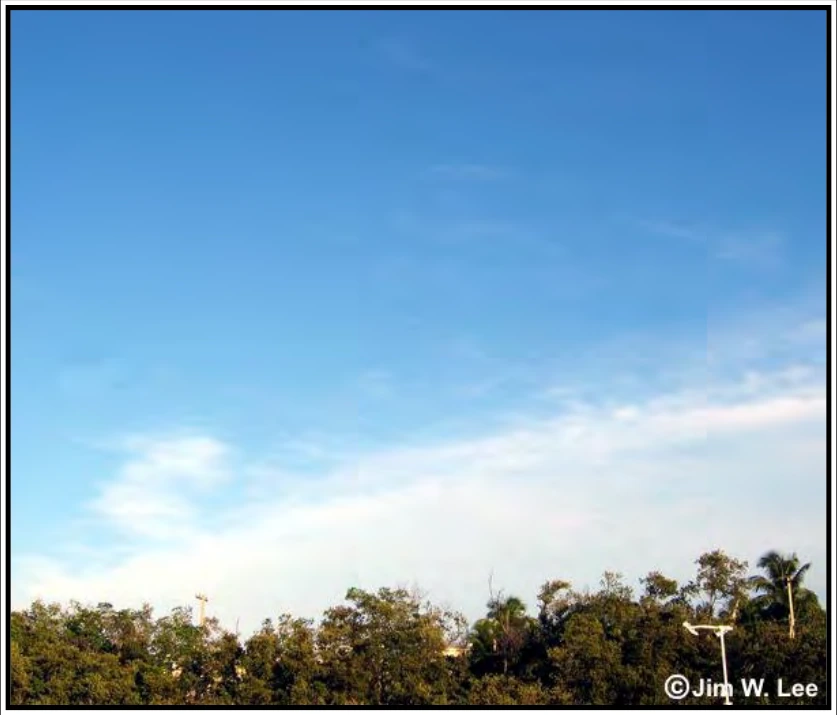
Cirrostratus (Cs) (see Figure A-3) is a cloud type appearing as a whitish veil and is usually fibrous (hairlike) but sometimes smooth. Cirrostratus may totally cover the sky, and that often produces halo phenomena, either partial or complete. Cirrostratus occasionally may be so thin and transparent as to render it nearly indiscernible, especially through haze or at night. At such times, the existence of a halo around the Sun or Moon may be the only revealing feature.
The angle of incidence of illumination upon a cirrostratus layer is an important consideration in evaluating the identifying characteristics. When the Sun is high (generally above 50° elevation), cirrostratus never prevents the casting of shadows by terrestrial objects, and a halo might be completely circular. At progressively lower angles of the Sun, halos become fragmentary, and light intensity noticeably decreases. When near the horizon, cirrostratus may be impossible to distinguish from cirrus.
Cirrostratus clouds are composed primarily of ice crystals and contain little, if any, icing and no turbulence.
A.2 Middle Clouds
Altocumulus (Ac), altostratus (As), and nimbostratus (Ns) are mid-level clouds. They are composed primarily of water droplets; however, they can also be composed of supercooled liquid water droplets and/or ice crystals when temperatures are below freezing. Altostratus is usually found in the middle level, but it often extends higher. Nimbostratus is almost invariably found in the middle level, but it usually extends into the other levels.