
Chapter 11
Helicopter Emergencies and Hazards
Helicopters with high-inertia rotor disks settle more slowly after the throttle is closed. In this case, when the helicopter has settled to approximately 1 foot AGL, apply upward collective control while holding the throttle in the idle detent position to slow the descent and cushion the landing. The timing of collective control application and the rate at which it is applied depend upon the particular helicopter being used, its gross weight, and the existing atmospheric conditions. Cyclic control is used to maintain a level attitude and to ensure a vertical descent. Maintain heading with antitorque pedals.
When the weight of the helicopter is entirely resting on the landing gear, cease application of upward collective. When the helicopter has come to a complete stop, lower the collective pitch to the full-down position.
The timing of the collective movement is a very important consideration. If it is applied too soon, the remaining rpm may not be sufficient to make a soft landing. On the other hand, if it is applied too late, surface contact may be made before sufficient blade pitch is available to cushion the landing. The collective must not be used to hold the helicopter off the surface, causing a blade stall. Low rotor rpm and ensuing blade stall can result in a total loss of rotor lift, allowing the helicopter to fall to the surface and possibly resulting in blade strikes to the tail boom and other airframe damage such as landing gear damage, transmission mount deformation, and fuselage cracking.
Common Errors
- Failure to use sufficient proper antitorque pedal when power is reduced.
- Failure to stop all sideward or backward movement prior to touchdown.
- Failure to apply up-collective pitch properly, resulting in a hard touchdown.
- Failure to touch down in a level attitude.
- Failure to roll the throttle completely to idle.
- Failure to hover at a safe altitude for the helicopter type, atmospheric conditions, and the level of training/proficiency of the pilot.
- Failure to go around if not within limits and specified criteria for safe autorotation.
Vortex Ring State
Vortex ring state (formerly referenced as settling-with-power) describes an aerodynamic condition in which a helicopter may be in a vertical descent with 20 percent up to maximum power applied, and little or no climb performance. The previously used term settling-with-power came from the fact that the helicopter keeps settling even though full engine power is applied.
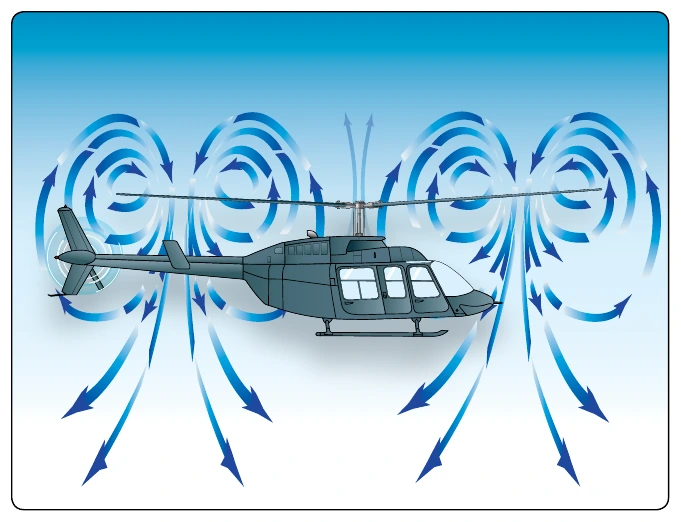
In a normal out-of-ground-effect (OGE) hover, the helicopter is able to remain stationary by propelling a large mass of air down through the main rotor. Some of the air is recirculated near the tips of the blades, curling up from the bottom of the rotor disk and rejoining the air entering the rotor from the top. This phenomenon is common to all airfoils and is known as tip vortices. Tip vortices generate drag and degrade airfoil efficiency. As long as the tip vortices are small, their only effect is a small loss in rotor efficiency. However, when the helicopter begins to descend vertically, it settles into its own downwash, which greatly enlarges the tip vortices. In this vortex ring state, most of the power developed by the engine is wasted in circulating the air in a doughnut pattern around the rotor.
In addition, the helicopter may descend at a rate that exceeds the normal downward induced-flow rate of the inner blade sections. As a result, the airflow of the inner blade sections is upward relative to the disk. This produces a secondary vortex ring in addition to the normal tip vortices. The secondary vortex ring is generated about the point on the blade where the airflow changes from up to down. The result is an unsteady turbulent flow over a large area of the disk. Rotor efficiency is lost even though power is still being supplied from the engine. [Figure 11-3]
A fully developed vortex ring state is characterized by an unstable condition in which the helicopter experiences uncommanded pitch and roll oscillations, has little or no collective authority, and achieves a descent rate that may approach 6,000 feet per minute (fpm) if allowed to develop.
A vortex ring state may be entered during any maneuver that places the main rotor in a condition of descending in a column of disturbed air and low forward airspeed. Airspeeds that are below translational lift airspeeds are within this region of susceptibility to vortex ring state aerodynamics. This condition is sometimes seen during quick-stop type maneuvers or during recovery from autorotation.
The following combination of conditions is likely to cause settling in a vortex ring state in any helicopter:
- A vertical or nearly vertical descent of at least 300 fpm. (Actual critical rate depends on the gross weight, rpm, density altitude, and other pertinent factors.)
- The rotor disk must be using some of the available engine power (20–100 percent).
- The horizontal velocity must be slower than effective translational lift.
Situations that are conducive to a vortex ring state condition are attempting to hover OGE without maintaining precise altitude control, and approaches, especially steep approaches, with a tailwind component.
When recovering from a vortex ring state condition, the pilot tends first to try to stop the descent by increasing collective pitch. However, this only results in increasing the stalled area of the rotor, thereby increasing the rate of descent. Since inboard portions of the blades are stalled, cyclic control may be limited. The traditional recovery is accomplished by increasing airspeed, and/or partially lowering collective to exit the vortex. In most helicopters, lateral cyclic thrust combined with an increase in power and lateral antitorque thrust will produce the quickest exit from the hazard. This technique, known as the Vuichard Recovery (named after the Swiss examiner from the Federal Office of Civil Aviation who developed it) recovers by eliminating the descent rate as opposed to exiting the vortex. If the vortex ring state and the corresponding descent rate is allowed to progress to what is called the windmill brake state, the point where the airflow is completely up through the rotor, the only recovery may be an autorotation.
Tandem rotor helicopters should maneuver laterally to achieve clean air in both rotors at the same time.
For vortex ring state demonstrations and training in recognition and recovery should be performed from a safe altitude to allow recovery no less than 1000 feet AGL or the manufacturer’s recommended altitude, whichever is higher.
To enter the maneuver, come to an OGE hover, maintaining little or no airspeed (any direction), decrease collective to begin a vertical descent, and as the turbulence begins, increase collective. Then allow the sink rate to increase to 300 fpm or more as the attitude is adjusted to obtain airspeed of less than 10 knots. When the aircraft begins to shudder, the application of additional up collective increases the vibration and sink rate. As the power is increased, the rate of sink of the aircraft in the column of air will increase.