
Chapter 11
Helicopter Emergencies and Hazards
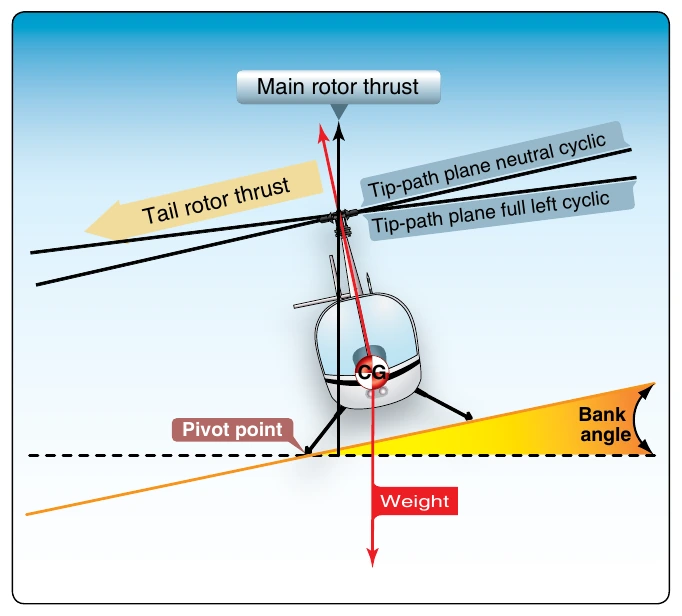
Dynamic rollover begins when the helicopter starts to pivot laterally around its skid or wheel. For dynamic rollover to occur the following three factors must be present:
- A rolling moment
- A pivot point other than the helicopter’s normal CG
- Thrust greater than weight
This can occur for a variety of reasons, including the failure to remove a tie down or skid-securing device, or if the skid or wheel contacts a fixed object while hovering sideward, or if the gear is stuck in ice, soft asphalt, or mud. Dynamic rollover may also occur if you use an improper landing or takeoff technique or while performing slope operations. Whatever the cause, dynamic rollover is possible if not using the proper corrective technique.
Once started, dynamic rollover cannot be stopped by application of opposite cyclic control alone. For example, the right skid contacts an object and becomes the pivot point while the helicopter starts rolling to the right. Even with full left cyclic applied, the main rotor thrust vector and its moment follows the aircraft as it continues rolling to the right. Quickly reducing collective pitch is the most effective way to stop dynamic rollover from developing. Dynamic rollover can occur with any type of landing gear and all types of rotor disks.
It is important to remember rotor blades have a limited range of movement. If the tilt or roll of the helicopter exceeds that range (5–8°), the controls (cyclic) can no longer command a vertical lift component and the thrust or lift becomes a lateral force that rolls the helicopter over. When limited rotor blade movement is coupled with the fact that most of a helicopter’s weight is high in the airframe, another element of risk is added to an already slightly unstable center of gravity. Pilots must remember that in order to remove thrust, the collective must be lowered as this is the only recovery technique available.
Critical Conditions
Certain conditions reduce the critical rollover angle, thus increasing the possibility for dynamic rollover and reducing the chance for recovery. The rate of rolling motion is also a consideration because, as the roll rate increases, there is a reduction of the critical rollover angle at which recovery is still possible. Other critical conditions include operating at high gross weights with thrust (lift) approximately equal to the weight.
Refer to Figure 11-5. The following conditions are most critical for helicopters with counterclockwise rotor rotation:
- Right side skid or landing wheel down, since translating tendency adds to the rollover force.
- Right lateral center of gravity (CG).
- Crosswinds from the left.
- Left yaw inputs.
For helicopters with clockwise rotor rotation, the opposite conditions would be true.
Cyclic Trim
When maneuvering with one skid or wheel on the ground, care must be taken to keep the helicopter cyclic control carefully adjusted. For example, if a slow takeoff is attempted and the cyclic is not positioned and adjusted to account for translating tendency, the critical recovery angle may be exceeded in less than two seconds. Control can be maintained if the pilot maintains proper cyclic position and does not allow the helicopter’s roll and pitch rates to become too great. Fly the helicopter into the air smoothly while keeping movements of pitch, roll, and yaw small; do not allow any abrupt cyclic pressures.
Normal Takeoffs and Landings
Dynamic rollover is possible even during normal takeoffs and landings on relatively level ground, if one wheel or skid is on the ground and thrust (lift) is approximately equal to the weight of the helicopter. If the takeoff or landing is not performed properly, a roll rate could develop around the wheel or skid that is on the ground. When taking off or landing, perform the maneuver smoothly and carefully adjust the cyclic so that no pitch or roll movement rates build up, especially the roll rate. If the bank angle starts to increase to an angle of approximately 5–8°, and full corrective cyclic does not reduce the angle, the collective should be reduced to diminish the unstable rolling condition. Excessive bank angles can also be caused by landing gear caught in a tie down strap, or a tie down strap still attached to one side of the helicopter. Lateral loading imbalance (usually outside published limits) is another contributing factor.
Slope Takeoffs and Landings
During slope operations, excessive application of cyclic control into the slope, together with excessive collective pitch control, can result in the downslope skid or landing wheel rising sufficiently to exceed lateral cyclic control limits, and an upslope rolling motion can occur. [Figure 11-6]
When performing slope takeoff and landing maneuvers, follow the published procedures and keep the roll rates small. Slowly raise the downslope skid or wheel to bring the helicopter level, and then lift off. During landing, first touch down on the upslope skid or wheel, then slowly lower the downslope skid or wheel using combined movements of cyclic and collective. If the helicopter rolls approximately 5–8° to the upslope side, decrease collective to correct the bank angle and return to level attitude, then start the landing procedure again.
Use of Collective
The collective is more effective in controlling the rolling motion than lateral cyclic, because it reduces the main rotor thrust (lift). A smooth, moderate collective reduction, at a rate of less than approximately full up to full down in two seconds, may be adequate to stop the rolling motion. Take care, therefore, not to dump collective at an excessively high rate, as this may cause a main rotor blade to strike the fuselage. Additionally, if the helicopter is on a slope and the roll starts toward the upslope side, reducing collective too fast may create a high roll rate in the opposite direction. When the upslope skid or wheel hits the ground, the dynamics of the motion can cause the helicopter to bounce off the upslope skid or wheel, and the inertia can cause the helicopter to roll about the downslope ground contact point and over on its side. [Figure 11-7]