Chapter 11
Helicopter Emergencies and Hazards
If altitude is sufficient, some time can be spent in the vortices, to enable the pilot to develop a healthy knowledge of the maneuver. However, helicopter pilots would normally initiate recovery at the first indication of vortex ring state. Recovery should be initiated at the first sign of vortex ring state by applying forward cyclic to increase airspeed and/ or simultaneously reducing collective. The recovery is complete when the aircraft passes through effective translational lift and a normal climb is established.
Common Errors—Traditional Recovery
- Too much lateral speed for entry into vortex ring state.
- Excessive decrease of collective.
Common Errors—Vuichard Recovery
- Excessive lateral cyclic
- Failure to maintain heading
Retreating Blade Stall
In forward flight, the relative airflow through the main rotor disk is different on the advancing and retreating side. The relative airflow over the advancing side is higher due to the forward speed of the helicopter, while the relative airflow on the retreating side is lower. This dissymmetry of lift increases as forward speed increases.
To generate the same amount of lift across the rotor disk, the advancing blade flaps up while the retreating blade flaps down. This causes the AOA to decrease on the advancing blade, which reduces lift, and increase on the retreating blade, which increases lift. At some point as the forward speed increases, the low blade speed on the retreating blade, and its high AOA cause a stall and loss of lift.
Retreating blade stall is a factor in limiting a helicopter’s never-exceed speed (VNE) and its development can be felt by a low frequency vibration, pitching up of the nose, and a roll in the direction of the retreating blade. High weight, low rotor rpm, high density altitude, turbulence and/or steep, abrupt turns are all conducive to retreating blade stall at high forward airspeeds. As altitude is increased, higher blade angles are required to maintain lift at a given airspeed. Thus, retreating blade stall is encountered at a lower forward airspeed at altitude. Most manufacturers publish charts and graphs showing a VNE decrease with altitude.
When recovering from a retreating blade stall condition caused by high airspeed, moving the cyclic aft only worsens the stall as aft cyclic produces a flare effect, thus increasing the AOA. Pushing forward on the cyclic also deepens the stall as the AOA on the retreating blade is increased. While the first step in a proper recovery is usually to reduce collective, RBS should be evaluated in light of the relevant factors discussed in the previous paragraph and addressed accordingly. For example, if a pilot at high weight and high DA is about to conduct a high reconnaissance prior to a confined area operation where rolling into a steep turn causes onset of RBS, the recovery is to roll out of the turn. If the cause is low rotor rpm, then increase the rpm.
Common Errors
- Failure to recognize the combination of contributing factors leading to retreating blade stall.
- Failure to compute VNE limits for altitudes to be flown.
Ground Resonance
Helicopters with articulating rotors (usually designs with three or more main rotor blades) are subject to ground resonance, a destructive vibration phenomenon that occurs at certain rotor speeds when the helicopter is on the ground. Ground resonance is a mechanical design issue that results from the helicopter’s airframe having a natural frequency that can be intensified by an out-of-balance rotor. The unbalanced rotor disk vibrates at the same frequency (or multiple thereof) of the airframe’s resonant frequency, and the harmonic oscillation increases because the engine is adding power to the system, increasing the magnitude (amplitude) of the vibrations until the structure or structures fail. This condition can cause a helicopter to self-destruct in a matter of seconds.
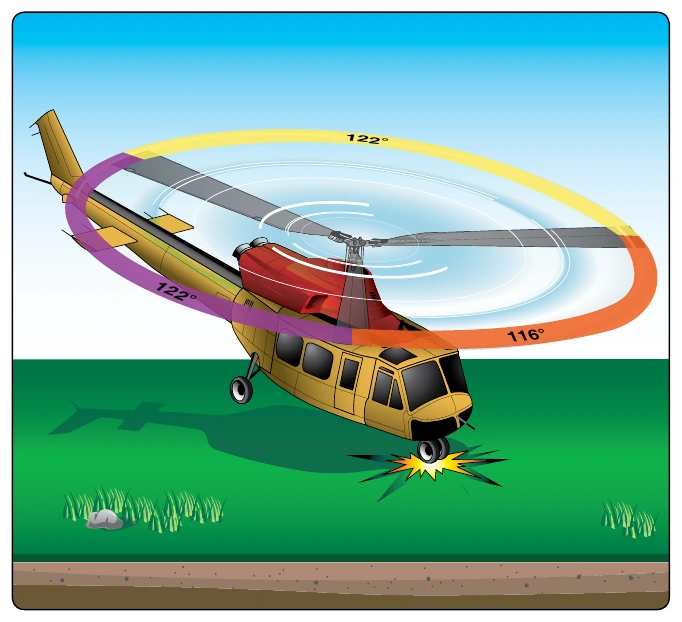
Hard contact with the ground on one corner (and usually with wheel-type landing gear) can send a shockwave to the main rotor head, resulting in the blades of a three-blade rotor disk moving from their normal 120° relationship to each other. This movement occurs along the drag hinge and could result in something like 122°, 122°, and 116° between blades. [Figure 11-4] When another part of the landing gear strikes the surface, the unbalanced condition could be further aggravated.
If the rpm is low, the only corrective action to stop ground resonance is to close the throttle immediately and fully lower the collective to place the blades in low pitch. If the rpm is in the normal operating range, fly the helicopter off the ground, and allow the blades to rephase themselves automatically. Then, make a normal touchdown. If a pilot lifts off and allows the helicopter to firmly re-contact the surface before the blades are realigned, a second shock could move the blades again and aggravate the already unbalanced condition. This could lead to a violent, uncontrollable oscillation.
This situation does not occur in rigid or semi-rigid rotor disks because there is no drag hinge. In addition, skid-type landing gear is not as prone to ground resonance as wheel-type landing gear, since the rubber tires' resonant frequency typically can match that of the spinning rotor, unlike the condition of a rigid landing gear.
Dynamic Rollover
A helicopter is susceptible to a lateral rolling tendency, called dynamic rollover, when it is in contact with the surface during takeoffs or landings. For dynamic rollover to occur, some factor must first cause the helicopter to roll or pivot around a skid or landing gear wheel, until its critical rollover angle is reached. The angle at which dynamic rollover occurs will vary based on helicopter type. Then, beyond this point, main rotor thrust continues the roll and recovery is impossible. After this angle is achieved, the cyclic does not have sufficient range of control to eliminate the thrust component and convert it to lift. If the critical rollover angle is exceeded, the helicopter rolls on its side regardless of the cyclic corrections made.