
Chapter 2
Aerodynamics of Flight
Introduction
This chapter presents aerodynamic fundamentals and principles as they apply to helicopters. The content relates to flight operations and performance of normal flight tasks. It covers theory and application of aerodynamics for the pilot, whether in flight training or general flight operations.
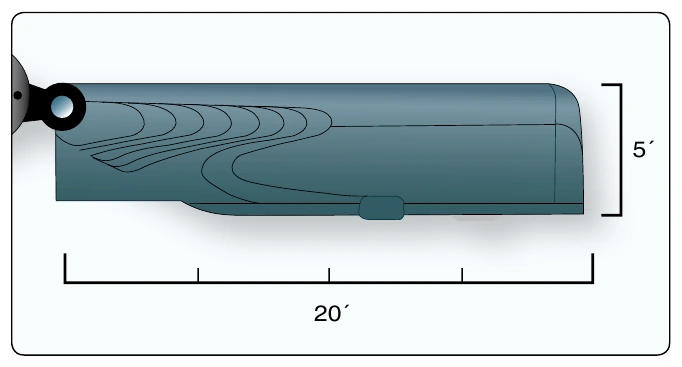
Gravity acting on the mass (the amount of matter) of an object creates a force called weight. The rotor blade below weighs 100 lbs. It is 20 feet long (span) and is 1 foot wide (chord). Accordingly, its surface area is 20 square feet. [Figure 2-1]
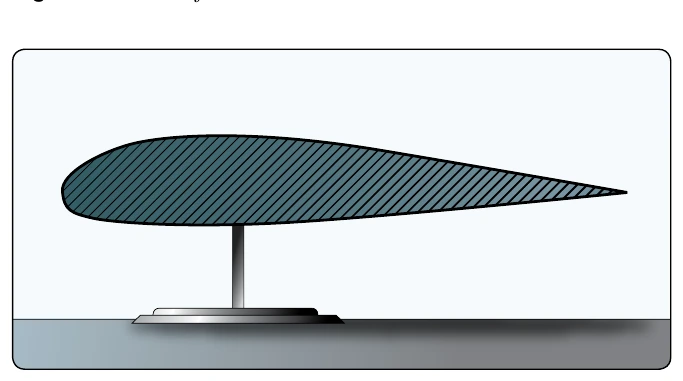
The blade is perfectly balanced on a pinpoint stand, as you can see in Figure 2-2 from looking at it from the end (the airfoil view). The goal is for the blade to defy gravity and stay exactly where it is when we remove the stand. If we do nothing before removing the stand, the blade will simply fall to the ground. Can we exert a force (a push or pull) opposite gravity that equals the 100 lb. weight of the blade? Yes, for example, electromagnetic force could be used. In helicopters, however, we use aerodynamic force to oppose weight and to maneuver.
Every object in the atmosphere is surrounded by a gas that exerts a static force of 2,116 lb per square foot (a force times a unit area, called pressure) at sea level. However, that pressure is exerted equally all over the blade (top and bottom) and therefore does not create any useful force on the blade. We need only create a difference of a single pound of static pressure differential per square foot of blade surface to have a force equal to the blade’s weight (100 lb of upward pressure opposite 100 lb downward weight).
Total pressure consists of static pressure and, if the air is moving, dynamic pressure (a pressure in the direction of the air movement). As shown in Figure 2-3, if dynamic pressure is increased the static pressure will decrease. Due to the design of the airfoil, the velocity of the air passing over the upper surface will be greater than that of the lower surface, leading to higher dynamic pressure on the upper surface than on the lower surface. The higher dynamic pressure on the upper surface lowers the static pressure on the upper surface. The static pressure on the bottom will now be greater than the static pressure on the top. The blade will experience an upward force. With just the right amount of air passing over the blade the upward force will equal one pound per square foot. This upward force is equal to, and acts opposite the blade’s weight of 100 lb. So, if we now remove the stand, the blade will defy gravity and remain in its position (ignoring rearward drag for the moment).
The force created by air moving over an object (or moving an object through the air) is called aerodynamic force. Aero means air. Dynamic means moving or motion. Accordingly, by moving the air over an airfoil we can change the static pressures on the top and bottom thereby generating a useful force (an aerodynamic force). The portion of the aerodynamic force that is usually measured perpendicular to the air flowing around the airfoil is called lift and is used to oppose weight. Drag is the portion of aerodynamic force that is measured as the resistance created by an object passing through the air (or having the air passed over it). Drag acts in a streamwise direction with the wind passing over the airfoil and retards forward movement.
Forces Acting on the Aircraft
Once a helicopter leaves the ground, it is acted upon by four aerodynamic forces; thrust, drag, lift, and weight. Understanding how these forces work and knowing how to control them with the use of power and flight controls are essential to flight. [Figure 2-3] They are defined as follows:
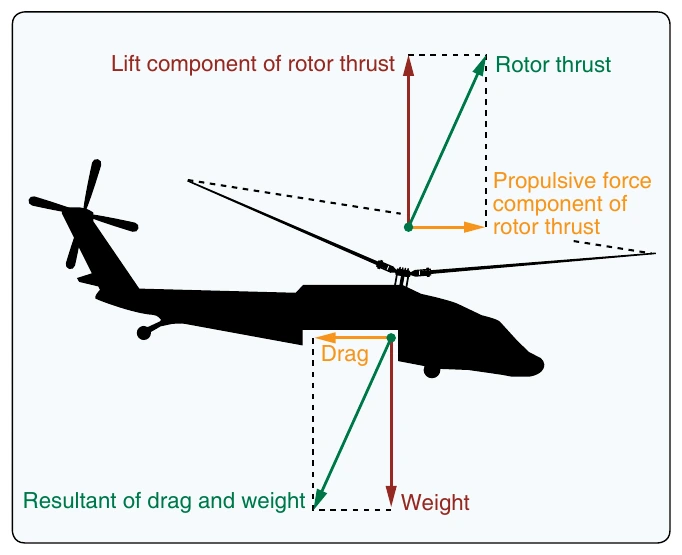
- Lift—opposes the downward force of weight, is produced by the dynamic effect of the air acting on the airfoil and acts perpendicular to the flightpath through the center of lift.
- Weight—the combined load of the aircraft itself, the crew, the fuel, and the cargo or baggage. Weight pulls the aircraft downward because of the force of gravity. It opposes lift and acts vertically downward through the aircraft’s center of gravity (CG).
- Thrust—the force produced by the power plant/propeller or rotor. It opposes or overcomes the force of drag. As a general rule, it acts parallel to the longitudinal axis. However, this is not always the case, as explained later.
- Drag—a rearward, retarding force caused by disruption of airflow by the wing, rotor, fuselage, and other protruding objects. Drag opposes thrust and acts rearward parallel to the relative wind.
For a more in-depth explanation of general aerodynamics, refer to the Pilot’s Handbook of Aeronautical Knowledge.
Lift
Lift is generated when an object changes the direction of flow of a fluid or when the fluid is forced to move by the object passing through it. When the object and fluid move relative to each other and the object turns the fluid flow in a direction perpendicular to that flow, the force required to do this work creates an equal and opposite force that is lift. The object may be moving through a stationary fluid, or the fluid may be flowing past a stationary object—these two are effectively identical as, in principle, it is only the frame of reference of the viewer which differs. The lift generated by an airfoil depends on such factors as:
- Speed of the airflow
- Density of the air
- Total area of the segment or airfoil
- Angle of attack (AOA) between the air and the airfoil
The AOA is the angle at which the airfoil meets the oncoming airflow (or vice versa). In the case of a helicopter, the object is the rotor blade (airfoil) and the fluid is the air. Lift is produced when a mass of air is deflected, and it always acts perpendicular to the resultant relative wind. A symmetric airfoil must have a positive AOA to generate positive lift. At a zero AOA, no lift is generated. At a negative AOA, negative lift is generated. A cambered or nonsymmetrical airfoil may produce positive lift at zero, or even small negative AOA.
The basic concept of lift is simple. However, the details of how the relative movement of air and airfoil interact to produce the turning action that generates lift are complex. In any case causing lift, an angled flat plate, revolving cylinder, airfoil, etc., the flow meeting the leading edge of the object is forced to split over and under the object. The sudden change in direction over the object causes an area of low pressure to form behind the leading edge on the upper surface of the object. In turn, due to this pressure gradient and the viscosity of the fluid, the flow over the object is accelerated down along the upper surface of the object. At the same time, the flow forced under the object is rapidly slowed or stagnated causing an area of high pressure. This also causes the flow to accelerate along the upper surface of the object. The two sections of the fluid each leave the trailing edge of the object with a downward component of momentum, producing lift. [Figure 2-4]