
Chapter 10
IFR Flight
- A control tower is in operation at the airport where the approaches are conducted.
- Direct communications are maintained between the pilot and the Center or approach controller until the pilot is instructed to contact the tower.
- If more than one MAP is available, none require a course reversal.
- If only one MAP is available, the following conditions are met:
- Course reversal is not required; and
- Reported ceiling and visibility are equal to or greater than the highest prescribed circling minimums for the IAP.
- When cleared for the approach, pilots should not execute a procedure turn.
Approaches to Parallel Runways
Procedures permit ILS instrument approach operations to dual or triple parallel runway configurations. A parallel approach is an ATC procedure that permits parallel ILS approach to airports with parallel runways separated by at least 2,500 feet between centerlines. Wherever parallel approaches are in progress, pilots are informed that approaches to both runways are in use.
Simultaneous approaches are permitted to runways:
- With centerlines separated by 4,300 to 9,000 feet;
- Equipped with final monitor controllers;
- Requiring radar monitoring to ensure separation between aircraft on the adjacent parallel approach course.
The approach procedure chart includes the note “simultaneous approaches authorized RWYS 14L and 14R,” identifying the appropriate runways. When advised that simultaneous parallel approaches are in progress, pilots must advise approach control immediately of malfunctioning or inoperative components.
Parallel approach operations demand heightened pilot situational awareness. The close proximity of adjacent aircraft conducting simultaneous parallel approaches mandates strict compliance with all ATC clearances and approach procedures. Pilots should pay particular attention to the following approach chart information: name and number of the approach, localizer frequency, inbound course, glideslope intercept altitude, DA/DH, missed approach instructions, special notes/procedures, and the assigned runway location and proximity to adjacent runways. Pilots also need to exercise strict radio discipline, which includes continuous monitoring of communications and the avoidance of lengthy, unnecessary radio transmissions.
Side-Step Maneuver
ATC may authorize a side-step maneuver to either one of two parallel runways that are separated by 1,200 feet or less, followed by a straight-in landing on the adjacent runway. Aircraft executing a side-step maneuver are cleared for a specified nonprecision approach and landing on the adjacent parallel runway. For example, “Cleared ILS runway 7 left approach, side-step to runway 7 right.” The pilot is expected to commence the side-step maneuver as soon as possible after the runway or runway environment is in sight. Landing minimums to the adjacent runway are based on nonprecision criteria and therefore higher than the precision minimums to the primary runway, but are normally lower than the published circling minimums.
Circling Approaches
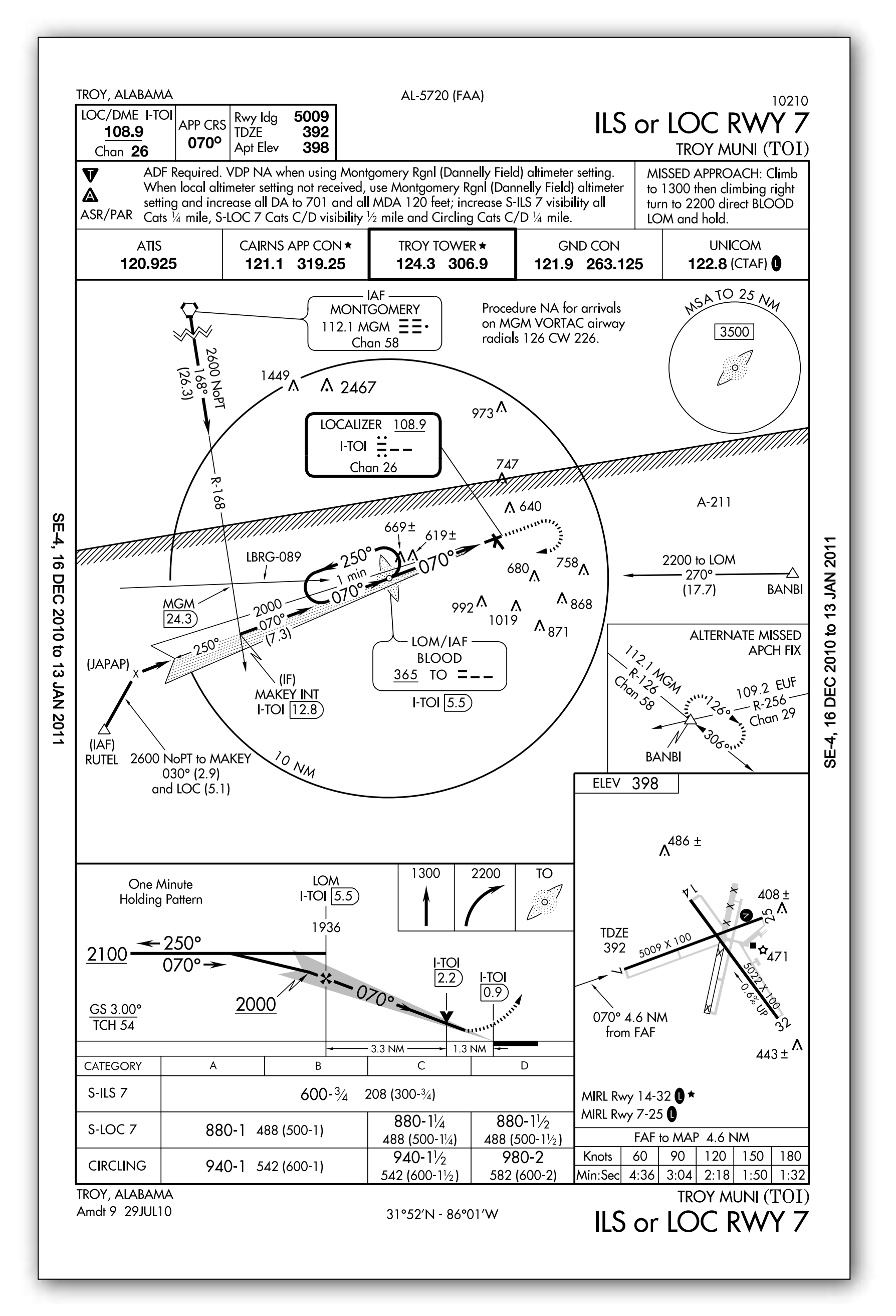
Landing minimums listed on the approach chart under “CIRCLING” apply when it is necessary to circle the airport, maneuver for landing, or when no straight-in minimums are specified on the approach chart. [Figure 10-11]
The circling minimums published on the instrument approach chart provide a minimum of 300 feet of obstacle clearance in the circling area. [Figure 10-12] During a circling approach, the pilot should maintain visual contact with the runway of intended landing and fly no lower than the circling minimums until positioned to make a final descent for a landing. It is important to remember that circling minimums are only minimums. If the ceiling allows it, fly at an altitude that more nearly approximates VFR traffic pattern altitude. This makes any maneuvering safer and brings the view of the landing runway into a more normal perspective.
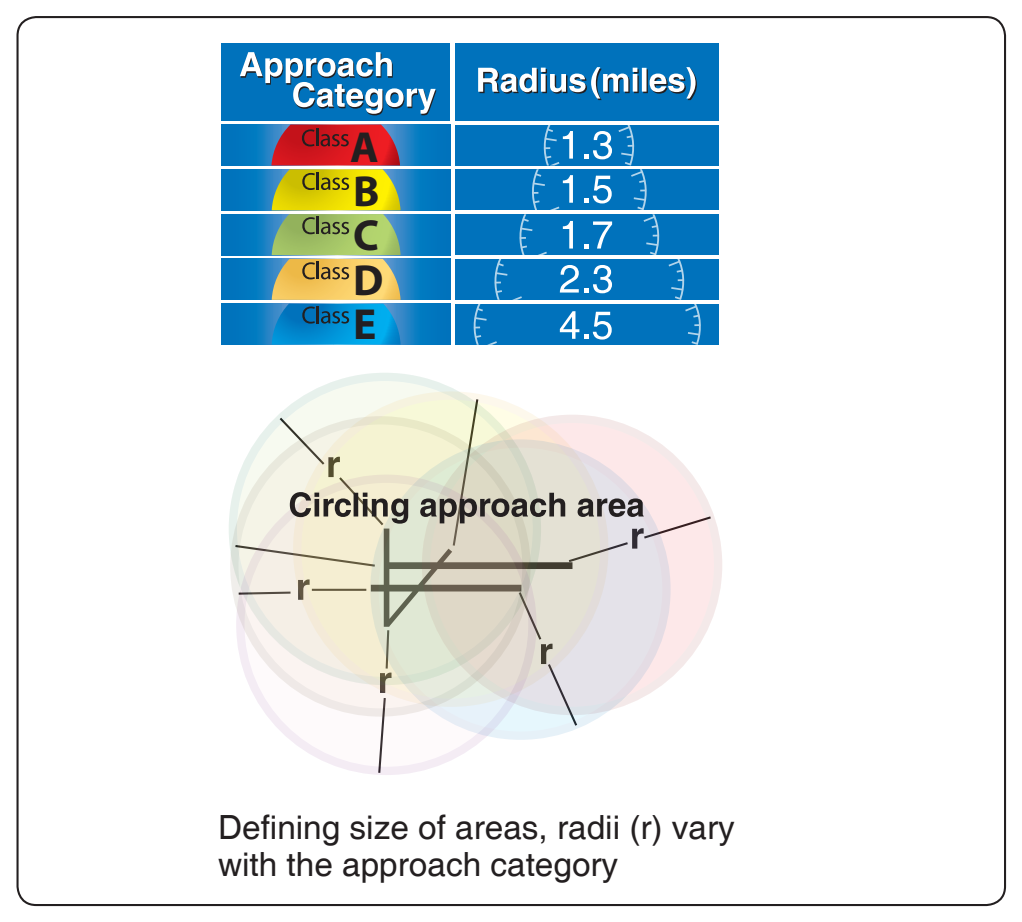
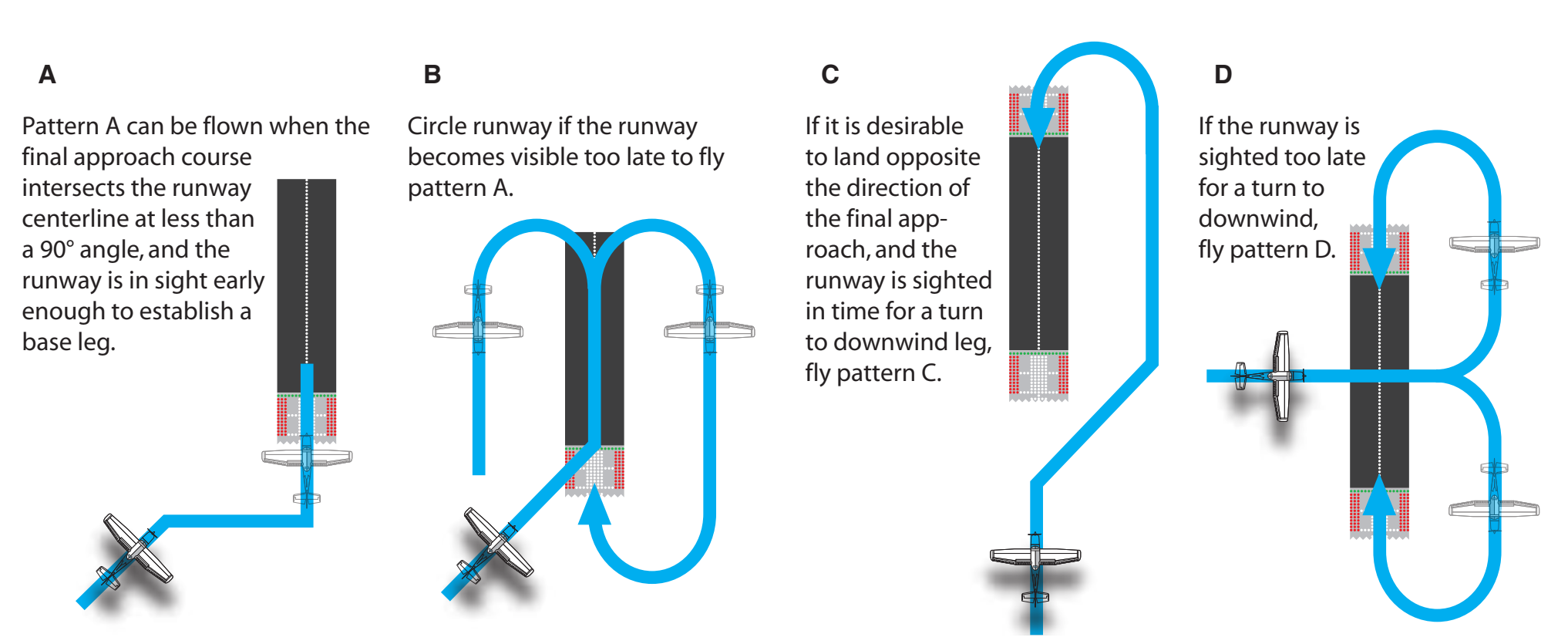
Figure 10-13 shows patterns that can be used for circling approaches. Pattern A can be flown when the final approach course intersects the runway centerline at less than a 90° angle, and the runway is in sight early enough to establish a base leg. If the runway becomes visible too late to fly pattern A, circle as shown in B. Fly pattern C if it is desirable to land opposite the direction of the final approach, and the runway is sighted in time for a turn to downwind leg. If the runway is sighted too late for a turn to downwind, fly pattern “D.” Regardless of the pattern flown, the pilot must maneuver the aircraft to remain within the designated circling area. Refer to section A (“Terms and Landing Minima Data”) in the front of each TPP for a description of circling approach categories. The criteria for determining the pattern to be flown are based on personal flying capabilities and knowledge of the performance characteristics of the aircraft. In each instance, the pilot must consider all factors: airport design, ceiling and visibility, wind direction and velocity, final approach course alignment, distance from the final approach fix to the runway, and ATC instructions.
IAP Minimums
Pilots may not operate an aircraft at any airport below the authorized MDA or continue an approach below the authorized DA/DH unless: