
Chapter 10
IFR Flight
PAR is one in which a controller provides highly accurate navigational guidance in azimuth and elevation to a pilot.
The controller gives the pilot headings to fly that direct the aircraft to, and keep the aircraft aligned with, the extended centerline of the landing runway. The pilot is told to anticipate glidepath interception approximately 10 to 30 seconds before it occurs and when to start descent. The published decision height (DH) is given only if the pilot requests it. If the aircraft is observed to deviate above or below the glidepath, the pilot is given the relative amount of deviation by use of terms “slightly” or “well” and is expected to adjust the aircraft’s rate of descent/ascent to return to the glidepath. Trend information is also issued with respect to the elevation of the aircraft and may be modified by the terms “rapidly” and “slowly” (e.g., “well above glidepath, coming down rapidly”).
Range from touchdown is given at least once each mile. If an aircraft is observed by the controller to proceed outside of specified safety zone limits in azimuth and/or elevation and continue to operate outside these prescribed limits, the pilot is directed to execute a missed approach or to fly a specified course unless the pilot has the runway environment (runway, approach lights, etc.) in sight. Navigational guidance in azimuth and elevation is provided to the pilot until the aircraft reaches the published DH. Advisory course and glidepath information is furnished by the controller until the aircraft passes over the landing threshold. At this point, the pilot is advised of any deviation from the runway centerline. Radar service is automatically terminated upon completion of the approach.
ASR is one in which a controller provides navigational guidance in azimuth only.
The controller furnishes the pilot with headings to fly to align the aircraft with the extended centerline of the landing runway. Since the radar information used for a surveillance approach is considerably less precise than that used for a precision approach, the accuracy of the approach is not as great and higher minimums apply. Guidance in elevation is not possible, but the pilot is advised when to commence descent to the Minimum Descent Altitude (MDA) or, if appropriate, to an intermediate step-down fix Minimum Crossing Altitude (MCA) and subsequently to the prescribed MDA. In addition, the pilot is advised of the location of the Missed Approach Point (MAP) prescribed for the procedure and the aircraft’s position each mile on final from the runway, airport, heliport, or MAP, as appropriate.
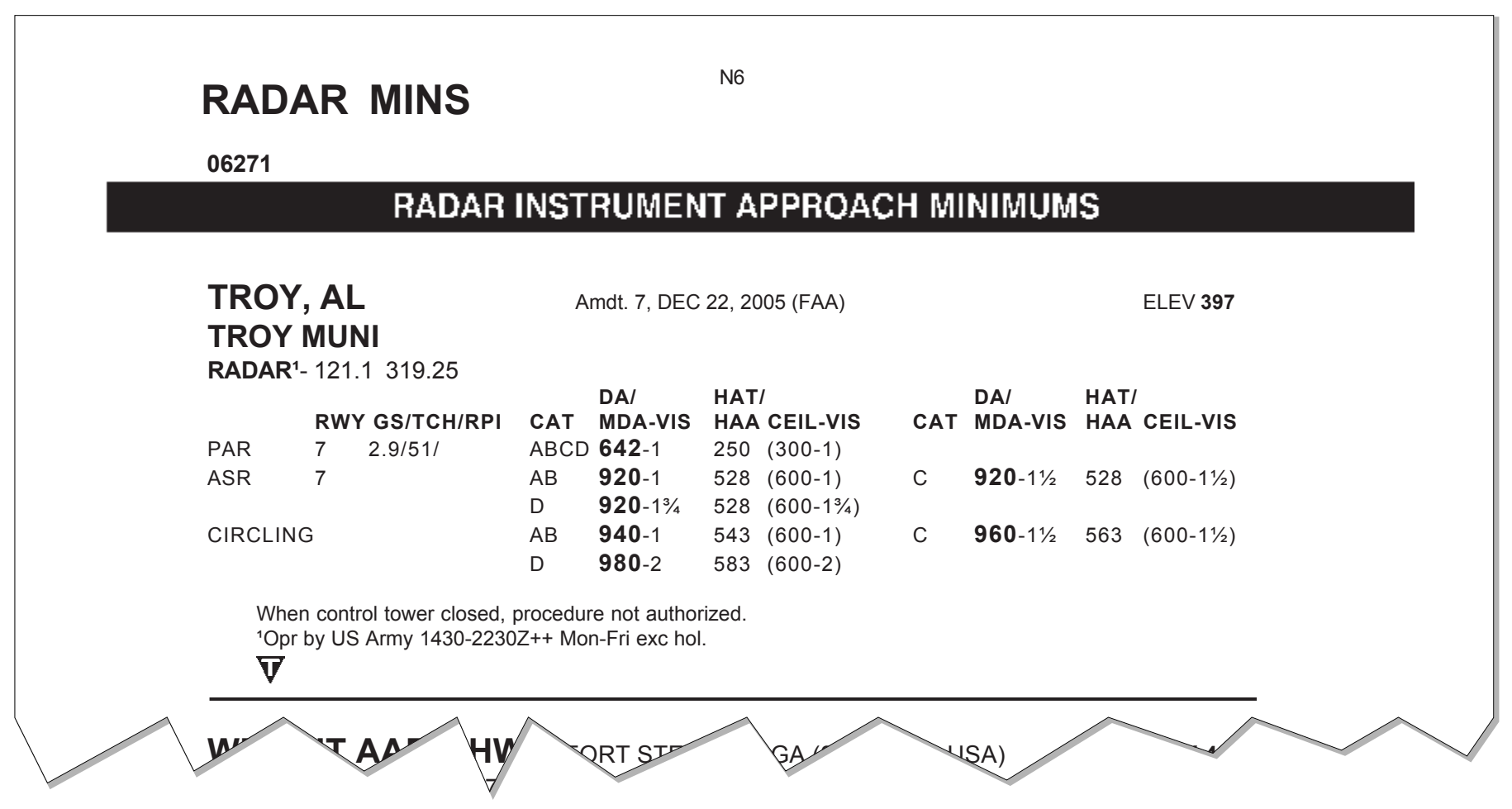
If requested by the pilot, recommended altitudes are issued at each mile, based on the descent gradient established for the procedure, down to the last mile that is at or above the MDA. Normally, navigational guidance is provided until the aircraft reaches the MAP.
Radar service is automatically terminated at the completion of a radar approach.
No-Gyro Approach is available to a pilot under radar control who experiences circumstances wherein the directional gyro or other stabilized compass is inoperative or inaccurate. When this occurs, the pilot should so advise ATC and request a no-gyro vector or approach. The pilot of an aircraft not equipped with a directional gyro or other stabilized compass who desires radar handling may also request a no-gyro vector or approach. The pilot should make all turns at standard rate and should execute the turn immediately upon receipt of instructions. For example, “TURN RIGHT,” “STOP TURN.” When a surveillance or precision approach is made, the pilot is advised after the aircraft has been turned onto final approach to make turns at half standard rate.
Radar Monitoring of Instrument Approaches
PAR facilities operated by the FAA and the military services at some joint-use (civil and military) and military installations monitor aircraft on instrument approaches and issue radar advisories to the pilot when weather is below VFR minimums (1,000 and 3), at night, or when requested by a pilot. This service is provided only when the PAR Final Approach Course coincides with the final approach of the navigational aid and only during the operational hours of the PAR. The radar advisories serve only as a secondary aid since the pilot has selected the NAVAID as the primary aid for the approach.
Prior to starting final approach, the pilot is advised of the frequency on which the advisories are transmitted. If, for any reason, radar advisories cannot be furnished, the pilot is so advised.
Advisory information, derived from radar observations, includes information on:
- Passing the final approach fix inbound (nonprecision approach) or passing the outer marker or fix used in lieu of the outer marker inbound (precision approach).
- Trend advisories with respect to elevation and/or azimuth radar position and movement are provided.
- If, after repeated advisories, the aircraft proceeds outside the PAR safety limit or if a radical deviation is observed, the pilot is advised to execute a missed approach unless the prescribed visual reference with the surface is established.
Radar service is automatically terminated upon completion of the approach. [Figure 10-11]
Timed Approaches From a Holding Fix
Timed approaches from a holding fix are conducted when many aircraft are waiting for an approach clearance. Although the controller does not specifically state “timed approaches are in progress,” the assigning of a time to depart the FAF inbound (nonprecision approach), or the outer marker or fix used in lieu of the outer marker inbound (precision approach), indicates that timed approach procedures are being utilized.
In lieu of holding, the controller may use radar vectors to the final approach course to establish a distance between aircraft that ensures the appropriate time sequence between the FAF and outer marker or fix used in lieu of the outer marker and the airport. Each pilot in the approach sequence is given advance notice of the time they should leave the holding point on approach to the airport. When a time to leave the holding point is received, the pilot should adjust the flightpath in order to leave the fix as closely as possible to the designated time.
Timed approaches may be conducted when the following conditions are met: