
Chapter 10
IFR Flight
The purpose of this information is to help the pilot plan arrival actions; however, it is not an ATC clearance or commitment and is subject to change. Fluctuating weather, shifting winds, blocked runway, etc., are conditions that may result in changes to the approach information previously received. It is important for a pilot to advise ATC immediately if he or she is unable to execute the approach or prefers another type of approach.
If the destination is an airport without an operating control tower and has automated weather data with broadcast capability, the pilot should monitor the automated surface observing system/automated weather observing system (ASOS/AWOS) frequency to ascertain the current weather for the airport. ATC should be advised that weather information has been received and what the pilot’s intentions are.
When the approach to be executed has been determined, the pilot should plan for and request a descent to the appropriate altitude prior to the initial approach fix (IAF) or transition route depicted on the IAP. When flying the transition route, a pilot should maintain the last assigned altitude until ATC gives the instructions “cleared for the approach.” Lower altitudes can be requested to bring the transition route altitude closer to the required altitude at the initial approach fix. When ATC uses the phrase “at pilot’s discretion” in the altitude information of a clearance, the pilot has the option to start a descent at any rate and may level off temporarily at any intermediate altitude. However, once an altitude has been vacated, return to that altitude is not authorized without a clearance. When ATC has not used the term “at pilot’s discretion” nor imposed any descent restrictions, initiate descent promptly upon acknowledgment of the clearance.
Descend at an optimum rate (consistent with the operating characteristics of the aircraft) to 1,000 feet above the assigned altitude. Then attempt to descend at a rate of between 500 and 1,500 fpm until the assigned altitude is reached. If at anytime a pilot is unable to maintain a descent rate of at least 500 fpm, advise ATC. Also advise ATC if it is necessary to level off at an intermediate altitude during descent. An exception to this is when leveling off at 10,000 feet mean sea level (MSL) on descent or 2,500 feet above airport elevation (prior to entering a Class B, Class C, or Class D surface area) when required for speed reduction.
Standard Terminal Arrival Routes (STARs)
Standard Terminal Arrival Routes (STARs) (as described in Chapter 1) have been established to simplify clearance delivery procedures for arriving aircraft at certain areas having high density traffic. A STAR serves a purpose parallel to that of a DP for departing traffic. [Figure 10-3] The following points regarding STARs are important to remember:
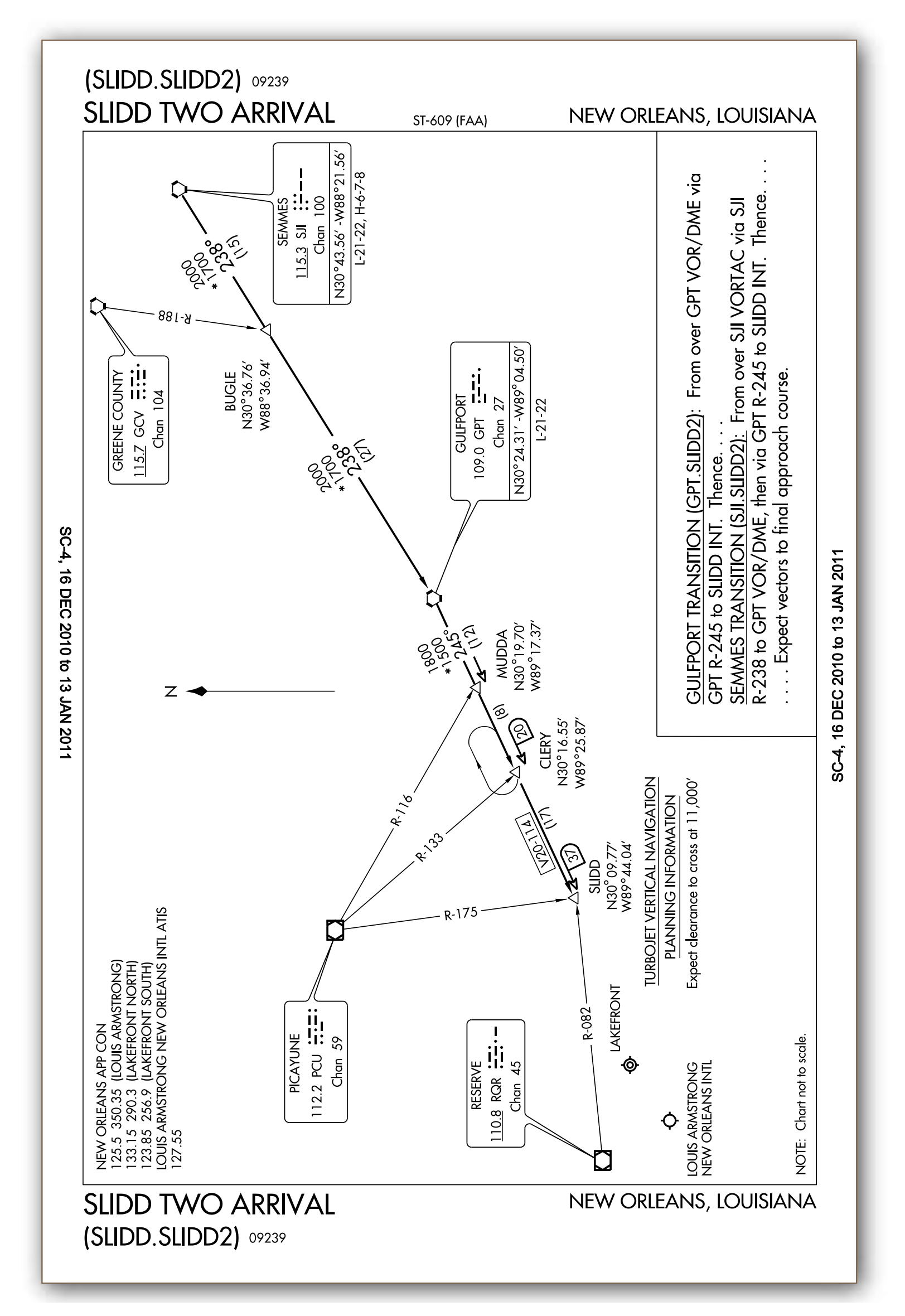
- All STARs are contained in the Terminal Procedures Publication (TPP), along with the IAP charts for the destination airport. The AIM also describes STAR procedures.
- If the destination is a location for which STARs have been published, a pilot may be issued a clearance containing a STAR whenever ATC deems it appropriate. To accept the clearance, a pilot must possess at least the approved textual description.
- It is the pilot’s responsibility to either accept or refuse an issued STAR. If a STAR will not or cannot be used, advise ATC by placing “NO STAR” in the remarks section of the filed flight plan or by advising ATC.
- If a STAR is accepted in a clearance, compliance is mandatory.
Substitutes for Inoperative or Unusable Components
The basic ground components of an ILS are the localizer, glideslope, outer marker, middle marker, and inner marker (when installed). A compass locator or precision radar may be substituted for the outer or middle marker. Distance measuring equipment (DME), VOR, or nondirectional beacon (NDB) fixes authorized in the standard IAP or surveillance radar may be substituted for the outer marker.
Additionally, IFR-certified GPS equipment, operated in accordance with Advisory Circular (AC) 90-94, Guidelines for Using Global Positioning System Equipment for IFR En Route and Terminal Operations and for Nonprecision Instrument Approaches in the United States National Airspace System, may be substituted for ADF and DME equipment, except when flying NDB IAP. Specifically, GPS can be substituted for ADF and DME equipment when:
- Flying a DME arc;
- Navigating TO/FROM an NDB;
- Determining the aircraft position over an NDB;
- Determining the aircraft position over a fix made up of a crossing NDB bearing;
- Holding over an NDB;
- Determining aircraft position over a DME fix.
Holding Procedures
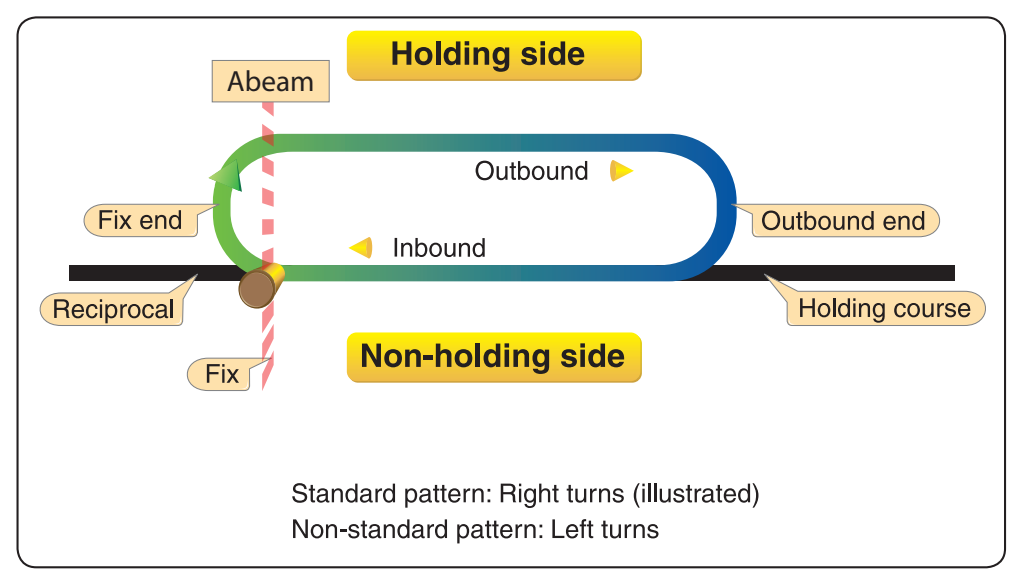
Depending upon traffic and weather conditions, holding may be required. Holding is a predetermined maneuver that keeps aircraft within a specified airspace while awaiting further clearance from ATC. A standard holding pattern uses right turns, and a nonstandard holding pattern uses left turns. The ATC clearance always specifies left turns when a nonstandard pattern is to be flown.
Standard Holding Pattern (No Wind)
In a standard holding pattern with no winds [Figure 10-4], the aircraft follows the specified course inbound to the holding fix, turns 180° to the right, flies a parallel straight course outbound for 1 minute, turns 180° to the right, and flies the inbound course to the fix.
Standard Holding Pattern (With Wind)
A standard symmetrical holding pattern cannot be flown when winds exist. In those situations, the pilot is expected to:
- Compensate for the effect of a known wind except when turning.
- Adjust outbound timing to achieve a 1-minute (1 ⁄ minutes above 14,000 feet) inbound leg.