
Chapter 10
IFR Flight
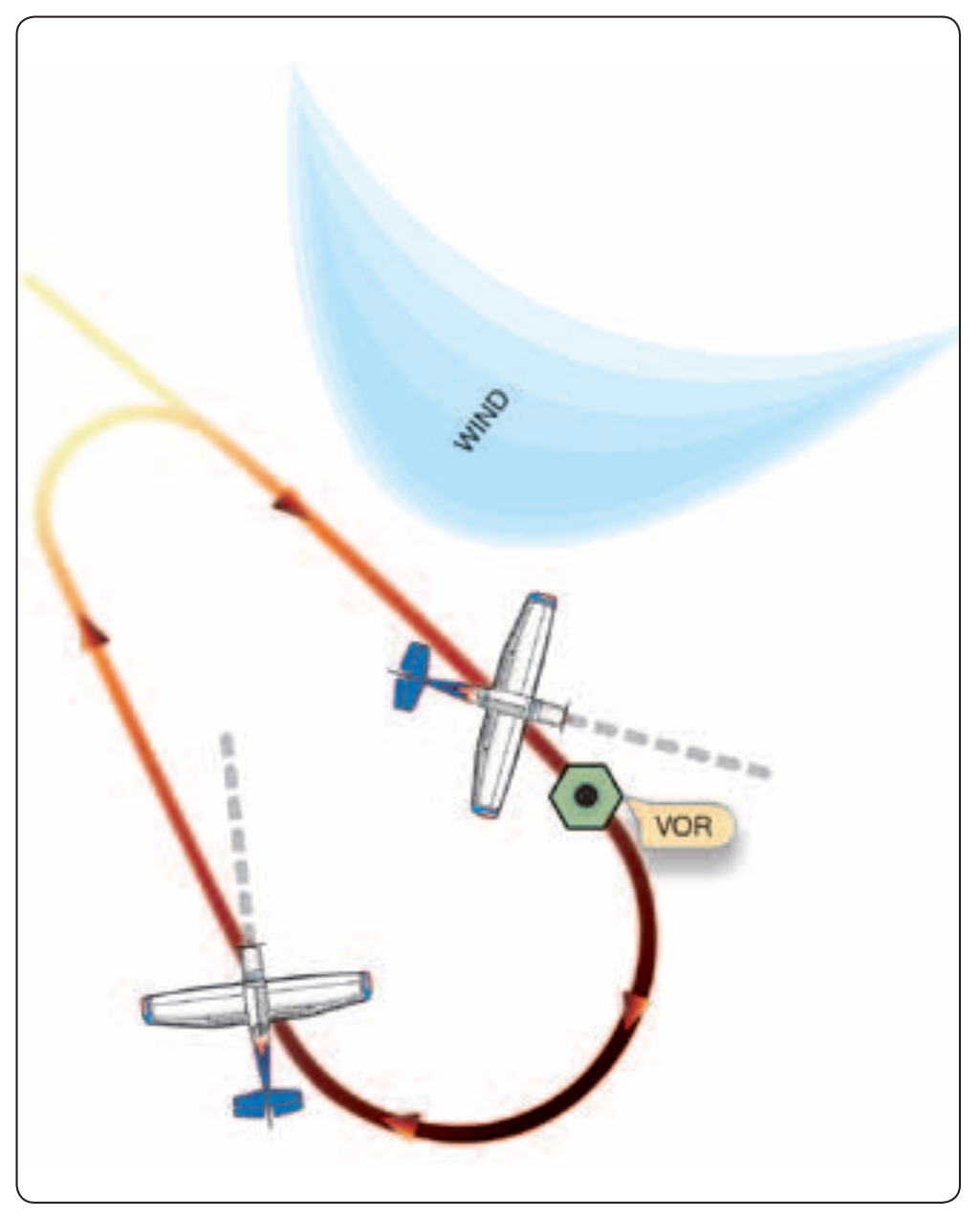
Figure 10-5 illustrates the holding track followed with a left crosswind. The effect of wind is counteracted by applying drift corrections to the inbound and outbound legs and by applying time allowances to the outbound leg.
Holding Instructions
If an aircraft arrives at a clearance limit before receiving clearance beyond the fix, ATC expects the pilot to maintain the last assigned altitude and begin holding in accordance with the charted holding pattern. If no holding pattern is charted and holding instructions have not been issued, enter a standard holding pattern on the course on which the aircraft approached the fix and request further clearance as soon as possible. Normally, when no delay is anticipated, ATC issues holding instructions at least 5 minutes before the estimated arrival at the fix. Where a holding pattern is not charted, the ATC clearance specifies the following:
- Direction of holding from the fix in terms of the eight cardinal compass points (N, NE, E, SE, etc.)
- Holding fix (the fix may be omitted if included at the beginning of the transmission as the clearance limit)
- Radial, course, bearing, airway, or route on which the aircraft is to hold.
- Leg length in miles if DME or RNAV is to be used (leg length is specified in minutes on pilot request or if the controller considers it necessary).
- Direction of turn, if left turns are to be made, because the pilot requests or the controller considers it necessary.
- Time to expect-further-clearance (EFC) and any pertinent additional delay information.
ATC instructions are also issued whenever:
- It is determined that a delay will exceed 1 hour.
- A revised EFC is necessary.
- In a terminal area having a number of NAVAIDs and approach procedures, a clearance limit may not indicate clearly which approach procedures will be used. On initial contact, or as soon as possible thereafter, approach control advises the pilot of the type of approach to expect.
- Ceiling and/or visibility is reported as being at or below the highest “circling minimums” established for the airport concerned. ATC transmits a report of current weather conditions and subsequent changes, as necessary.
- An aircraft is holding while awaiting approach clearance, and the pilot advises ATC that reported weather conditions are below minimums applicable to the operation. In this event, ATC issues suitable instructions to aircraft desiring either to continue holding while awaiting weather improvement or proceed to another airport.
Standard Entry Procedures
The entry procedures given in the AIM evolved from extensive experimentation under a wide range of operational conditions. The standardized procedures should be followed to ensure that an aircraft remains within the boundaries of the prescribed holding airspace.
When a speed reduction is required, start the reduction when 3 minutes or less from the holding fix. Cross the holding fix initially at or below the maximum holding airspeed (MHA). The purpose of the speed reduction is to prevent overshooting the holding airspace limits, especially at locations where adjacent holding patterns are close together.
All aircraft may hold at the following altitudes and maximum holding airspeeds:
Altitude, Mean Sea Level (MSL) — Airspeed (KIAS)
- Up to 6,000 feet — 200
- 6,001–14,000 feet — 230
- 14,001 feet and above — 265
The following are exceptions to the maximum holding airspeeds:
- Holding patterns from 6,001 to 14,000 feet may be restricted to a maximum airspeed of 210 knots indicated airspeed (KIAS). This nonstandard pattern is depicted by an icon.
- Holding patterns may be restricted to a maximum airspeed of 175 KIAS. This nonstandard pattern is depicted by an icon. Holding patterns restricted to 175 KIAS are generally found on IAPs applicable to category A and B aircraft only.
- Holding patterns at Air Force airfields only—310 KIAS maximum, unless otherwise depicted.
- Holding patterns at Navy airfields only—230 KIAS maximum, unless otherwise depicted.
- The pilot of an aircraft unable to comply with maximum airspeed restrictions should notify ATC.
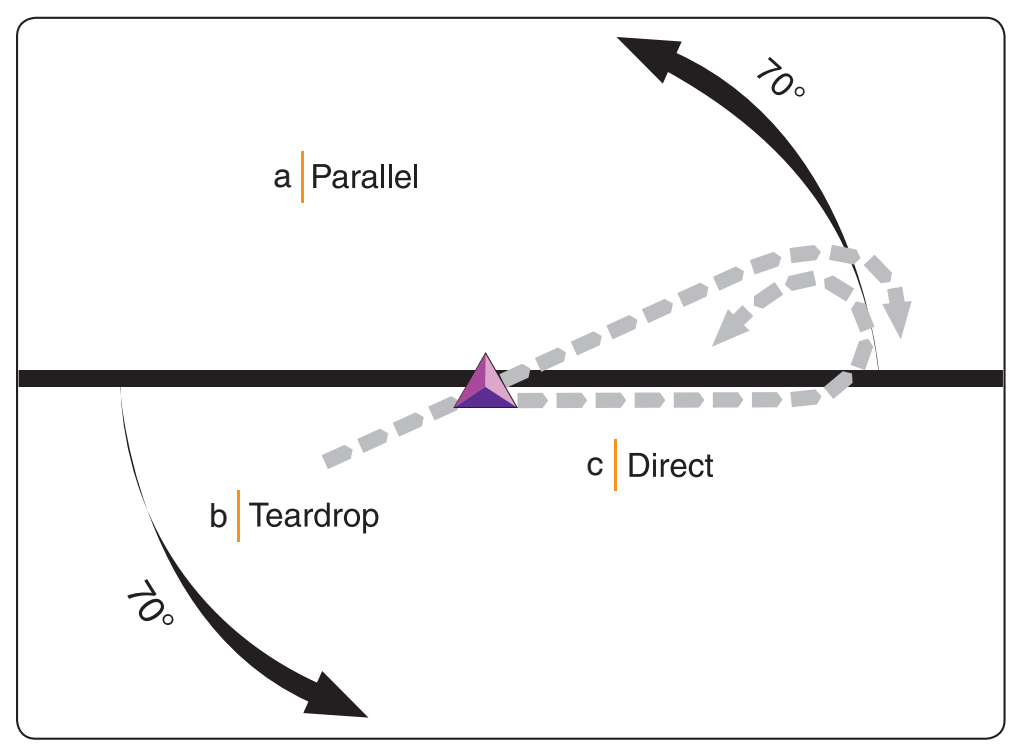
While other entry procedures may enable the aircraft to enter the holding pattern and remain within protected airspace, the parallel, teardrop, and direct entries are the procedures for entry and holding recommended by the FAA. Additionally, paragraph 5-3-7 in the AIM should be reviewed. [Figure 10-6]
- Parallel Procedure. When approaching the holding fix from anywhere in sector (a), fly to the fix. Afterwards, turn to a heading to parallel the holding course outbound. Fly outbound for 1 minute, turn in the direction of the holding pattern through more than 180°, and return to the holding fix or intercept the holding course inbound.
- Teardrop Procedure. When approaching the holding fix from anywhere in sector (b), the teardrop entry procedure would be to fly to the fix, turn outbound to a heading for a 30° teardrop entry within the pattern (on the holding side) for a period of 1 minute, then turn in the direction of the holding pattern to intercept the inbound holding course.
- Direct Entry Procedure. When approaching the holding fix from anywhere in sector (c), the direct entry procedure would be to fly directly to the fix and turn to follow the holding pattern.
A pilot should make all turns during entry and while holding at: