
Chapter 2
The Air Traffic Control System
Primary radar returns indicate only range and bearing from the radar antenna to the target; secondary radar returns can display altitude, Mode C, on the control scope if the aircraft is equipped with an encoding altimeter or blind encoder. In either case, when the transponder’s function switch is in the ALT position, the aircraft’s pressure altitude is sent to the controller. Adjusting the altimeter’s Kollsman window has no effect on the altitude read by the controller.
Transponders, when installed, must be ON at all times when operating in controlled airspace; altitude reporting is required by regulation in Class B and Class C airspace and inside a 30-mile circle surrounding the primary airport in Class B airspace. Altitude reporting should also be ON at all times.
Communication Procedures
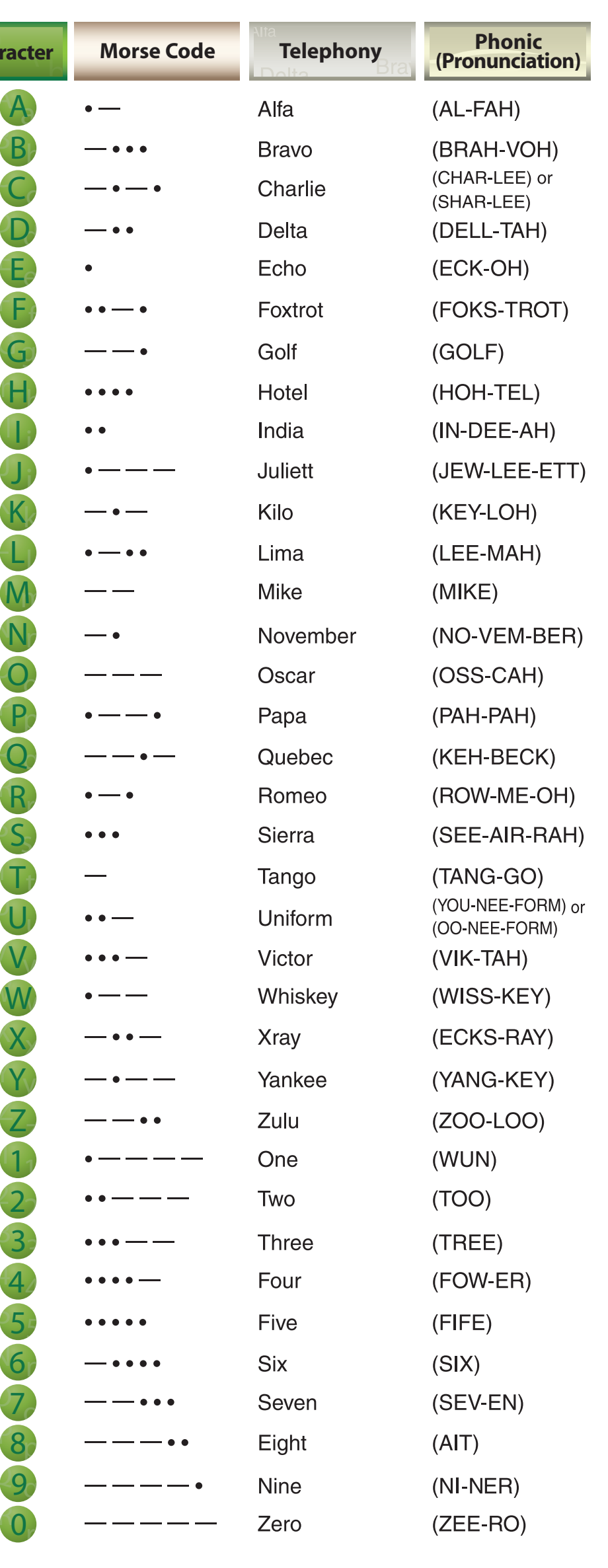
Clarity in communication is essential for a safe instrument flight. This requires pilots and controllers to use terms that are understood by both—the Pilot/Controller Glossary in the Aeronautical Information Manual (AIM) is the best source of terms and definitions. The AIM is revised twice a year and new definitions are added, so the glossary should be reviewed frequently. Because clearances and instructions are comprised largely of letters and numbers, a phonetic pronunciation guide has been developed for both. [Figure 2-5]
ATC must follow the guidance of the Air Traffic Control Manual when communicating with pilots. The manual presents the controller with different situations and prescribes precise terminology that must be used. This is advantageous for pilots because once they have recognized a pattern or format, they can expect future controller transmissions to follow that format. Controllers are faced with a wide variety of communication styles based on pilot experience, proficiency, and professionalism.
Pilots should study the examples in the AIM, listen to other pilots communicate, and apply the lessons learned to their own communications with ATC. Pilots should ask for clarification of a clearance or instruction. If necessary, use plain English to ensure understanding, and expect the controller to reply in the same way. A safe instrument flight is the result of cooperation between controller and pilot.
Communication Facilities
The controller’s primary responsibility is separation of aircraft operating under IFR. This is accomplished with ATC facilities, to include the FSS, airport traffic control tower (ATCT), terminal radar approach control (TRACON), and air route traffic control center (ARTCC).
Flight Service Stations (FSS)
A pilot’s first contact with ATC is usually through FSS, either by radio or telephone. FSSs provide pilot briefings, receive and process flight plans, relay ATC clearances, originate Notices to Airmen (NOTAMs), and broadcast aviation weather. Some facilities provide En Route Flight Advisory Service (EFAS), take weather observations, and advise United States Customs and Immigration of international flights.
Telephone contact with Flight Service can be obtained by dialing 1-800-WX-BRIEF. This number can be used anywhere in the United States and connects to the nearest FSS based on the area code from which the call originates. There are a variety of methods of making radio contact: direct transmission, remote communication outlets (RCOs), ground communication outlets (GCOs), and by using duplex transmissions through navigational aids (NAVAIDs). The best source of information on frequency usage is the Airport/Facility Directory (A/FD) and the legend panel on sectional charts also contains contact information.
The briefer sends a flight plan to the host computer at the ARTCC (Center). After processing the flight plan, the computer sends flight strips to the tower, to the radar facility that handles the departure route, and to the Center controller whose sector the flight first enters. Figure 2-6 shows a typical strip. These strips are delivered approximately 30 minutes prior to the proposed departure time. Strips are delivered to en route facilities 30 minutes before the flight is expected to enter their airspace. If a flight plan is not opened, it will “time out” 2 hours after the proposed departure time.
When departing an airport in Class G airspace, a pilot receives an IFR clearance from the FSS by radio or telephone. It contains either a clearance void time, in which case an aircraft must be airborne prior to that time, or a release time. Pilots should not take off prior to the release time. Pilots can help the controller by stating how soon they expect to be airborne. If the void time is, for example, 10 minutes past the hour and an aircraft is airborne at exactly 10 minutes past the hour, the clearance is void—a pilot must take off prior to the void time. A specific void time may be requested when filing a flight plan.
ATC Towers
Several controllers in the tower cab are involved in handling an instrument flight. Where there is a dedicated clearance delivery position, that frequency is found in the A/FD and on the instrument approach chart for the departure airport. Where there is no clearance delivery position, the ground controller performs this function. At the busiest airports, pre-taxi clearance is required; the frequency for pre-taxi clearance can be found in the A/FD. Taxi clearance should be requested not more than 10 minutes before proposed taxi time.
It is recommended that pilots read their IFR clearance back to the clearance delivery controller. Instrument clearances can be overwhelming when attempting to copy them verbatim, but they follow a format that allows a pilot to be prepared when responding “Ready to copy.” The format is: clearance limit (usually the destination airport); route, including any departure procedure; initial altitude; frequency (for departure control); and transponder code. With the exception of the transponder code, a pilot knows most of these items before engine start. One technique for clearance copying is writing C-R-A-F-T.
Assume an IFR flight plan has been filed from Seattle, Washington to Sacramento, California via V-23 at 7,000 feet. Traffic is taking off to the north from Seattle-Tacoma (Sea-Tac) airport and, by monitoring the clearance delivery frequency, a pilot can determine the departure procedure being assigned to southbound flights. The clearance limit is the destination airport, so write “SAC” after the letter C. Write “SEATTLE TWO – V23” after R for Route because departure control issued this departure to other flights. Write “70” after the A, the departure control frequency printed on the approach charts for Sea-Tac after F, and leave the space after the letter T blank—the transponder code is generated by computer and can seldom be determined in advance. Then, call clearance delivery and report “Ready to copy.”
As the controller reads the clearance, check it against what is already written down; if there is a change, draw a line through that item and write in the changed item. Chances are the changes are minimal, and most of the clearance is copied before keying the microphone. Still, it is worthwhile to develop clearance shorthand to decrease the verbiage that must be copied (see Appendix 1).
Pilots are required to have either the text of a departure procedure (DP) or a graphic representation (if one is available), and should review it before accepting a clearance. This is another reason to find out ahead of time which DP is in use. If the DP includes an altitude or a departure control frequency, those items are not included in the clearance.