
Chapter 7
Airplane Basic Flight Maneuvers
Second, make smooth and small pitch changes with positive pressure. With practice, a pilot can make these small pitch corrections up or down, “freezing” (holding constant) the one-half, full, and one-and-one-half bar widths on the attitude indicator.
Third, with the airplane properly trimmed for level flight, momentarily release all pressure on the elevator control when becoming aware of tenseness. This is a reminder that the airplane is stable; except under turbulent conditions, it maintains level flight if left alone. Even when no control change is called for, it is difficult to resist the impulse to move the controls. This may be one of the most difficult initial training problems in instrument flight.
Altimeter
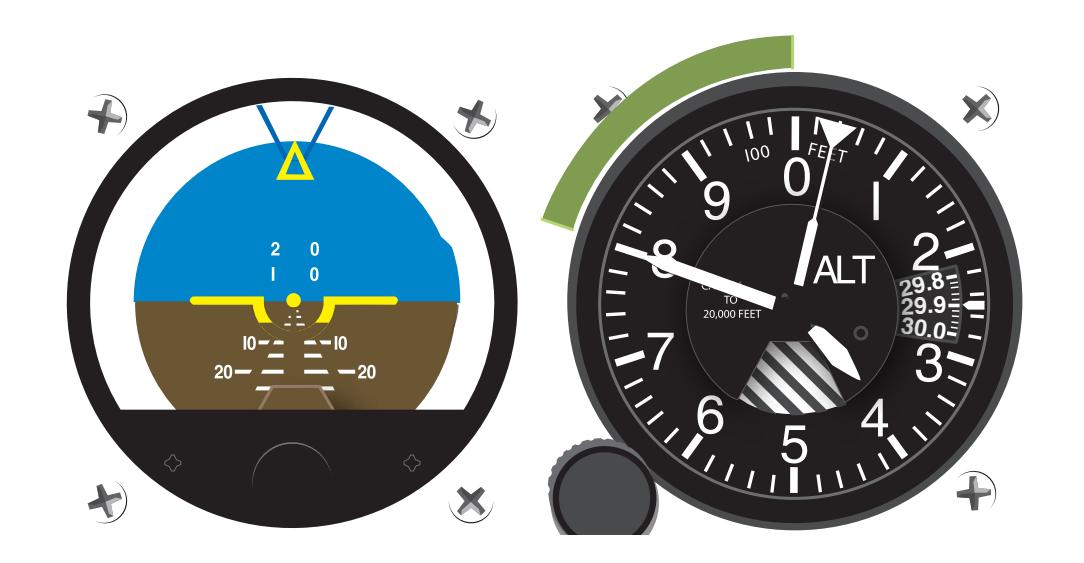
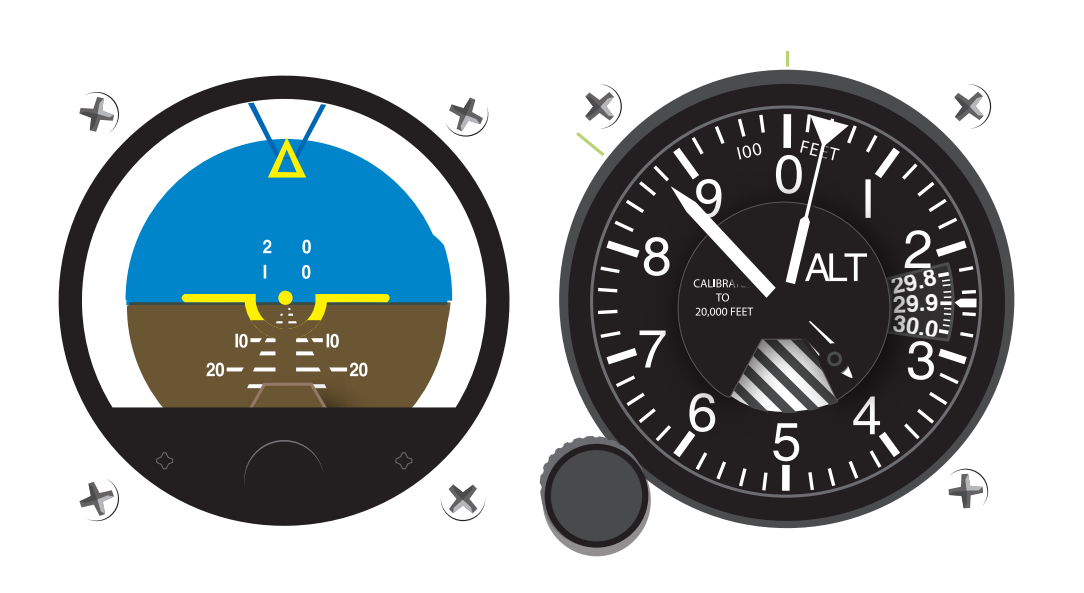
At constant power, any deviation from level flight (except in turbulent air) is the result of a pitch change. Therefore, the altimeter gives an indirect indication of the pitch attitude in level flight, assuming constant power. Since the altitude should remain constant when the airplane is in level flight, any deviation from the desired altitude signals the need for a pitch change. If the aircraft is gaining altitude, the nose must be lowered. [Figures 7-7 and 7-8]
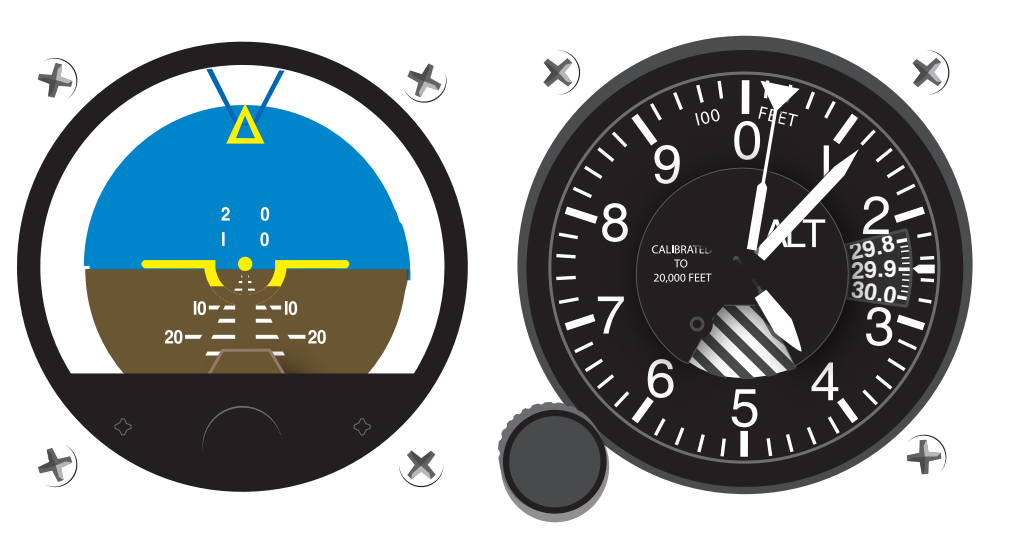
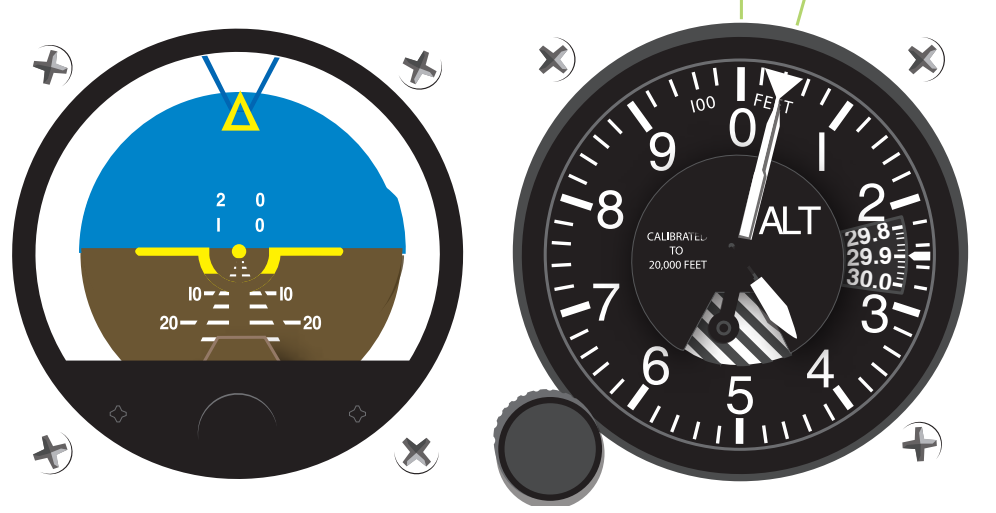
The rate of movement of the altimeter needle is as important as its direction of movement in maintaining level flight without the use of the attitude indicator. An excessive pitch deviation from level flight results in a relatively rapid change of altitude; a slight pitch deviation causes a slow change. Thus, if the altimeter needle moves rapidly clockwise, assume a considerable nose-high deviation from level flight attitude. Conversely, if the needle moves slowly counterclockwise to indicate a slightly nose-low attitude, assume that the pitch correction necessary to regain the desired altitude is small. As the altimeter is added to the attitude indicator in a cross-check, a pilot learns to recognize the rate of movement of the altimeter needle for a given pitch change as shown on the attitude indicator.
To practice precision control of pitch in an airplane without an attitude indicator, make small pitch changes by visual reference to the natural horizon and note the rate of movement of the altimeter. Note what amount of pitch change gives the slowest steady rate of change on the altimeter. Then practice small pitch corrections by accurately interpreting and controlling the rate of needle movement.
An instructor pilot can demonstrate an excessive nose-down deviation (indicated by rapid movement of the altimeter needle) and then, as an example, show the result of improper corrective technique. The normal impulse is to make a large pitch correction in a hurry, but this inevitably leads to overcontrolling. The needle slows down, then reverses direction, and finally indicates an excessive nose-high deviation. The result is tension on the controls, erratic control response, and increasingly extreme control movements. The correct technique, which is slower and smoother, returns the airplane to the desired attitude more quickly, with positive control and no confusion.
When a pitch error is detected, corrective action should be taken promptly, but with light control pressures and two distinct changes of attitude: (1) a change of attitude to stop the needle movement and (2) a change of attitude to return to the desired altitude.
When the altimeter indicates an altitude deviation, apply just enough elevator pressure to decrease the rate of needle movement. If it slows down abruptly, ease off some of the pressure until the needle continues to move, but ease off slowly. Slow needle movement means the airplane attitude is close to level flight. Add slightly more corrective pressure to stop the direction of needle movement. At this point, level flight is achieved; a reversal of needle movement means the aircraft has passed through it. Relax control pressures carefully, continuing to cross-check since changing airspeed causes changes in the effectiveness of a given control pressure. Next, adjust the pitch attitude with elevator pressure for the rate of change of altimeter needle movement that is correlated with normal pitch corrections and return to the desired altitude.
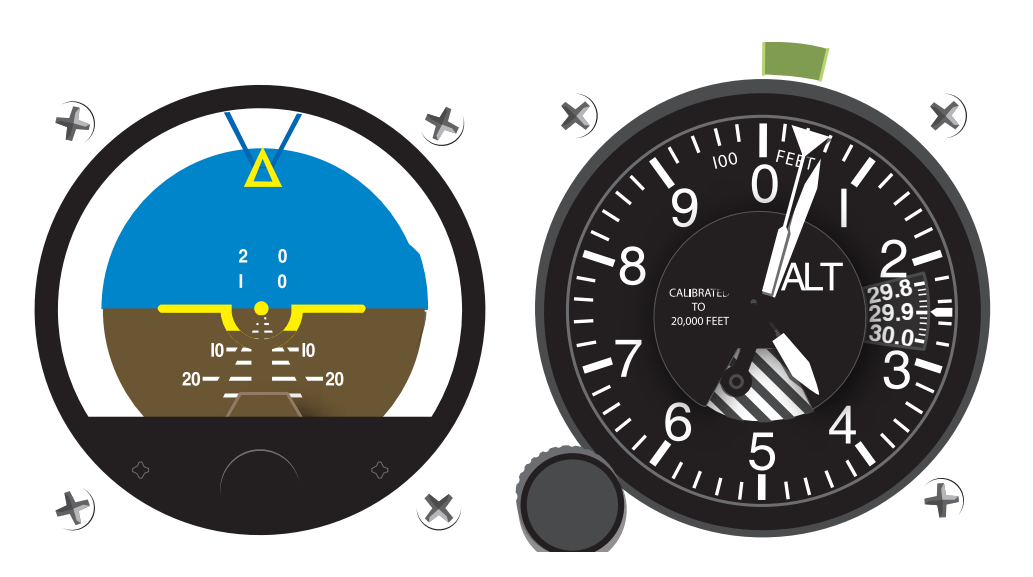
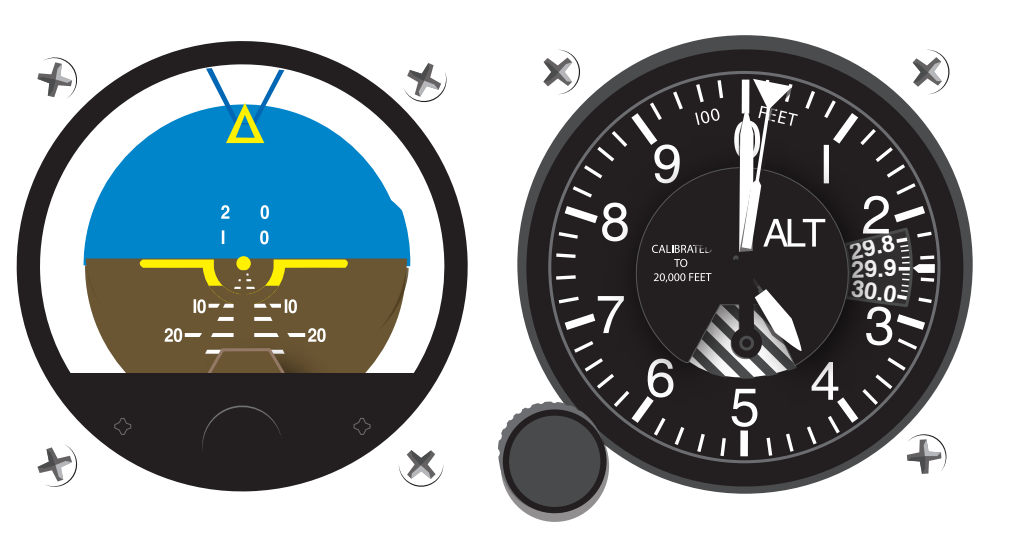
As a rule of thumb, for errors of less than 100 feet, use a half bar width correction. [Figures 7-9 and 7-10] For errors in excess of 100 feet, use an initial full bar width correction. [Figures 7-11 and 7-12] Practice predetermined altitude changes using the altimeter alone, then in combination with the attitude indicator.
Vertical Speed Indicator (VSI)
The VSI, like the altimeter, gives an indirect indication of pitch attitude and is both a trend and a rate instrument. As a trend instrument, it shows immediately the initial vertical movement of the airplane, which disregarding turbulence can be considered a reflection of pitch change. To maintain level flight, use the VSI in conjunction with the altimeter and attitude indicator. Note any positive or negative trend of the needle from zero and apply a very light corrective elevator pressure. As the needle returns to zero, relax the corrective pressure. If control pressures have been smooth and light, the needle reacts immediately and slowly, and the altimeter shows little or no change of altitude. As a rate instrument, the VSI requires consideration of lag characteristics.
Lag refers to the delay involved before the needle attains a stable indication following a pitch change. Lag is directly proportional to the speed and magnitude of a pitch change. If a slow, smooth pitch change is initiated, the needle moves with minimum lag to a point of deflection corresponding to the extent of the pitch change, and then stabilizes as the aerodynamic forces are balanced in the climb or descent. A large and abrupt pitch change produces erratic needle movement, a reverse indication, and introduces greater time delay (lag) before the needle stabilizes. Pilots are cautioned not to chase the needle when flight through turbulent conditions produces erratic needle movements. The apparent lag in airspeed indications with pitch changes varies greatly among different airplanes and is due to the time required for the airplane to accelerate or decelerate when the pitch attitude is changed. There is no appreciable lag due to the construction or operation of the instrument. Small pitch changes, smoothly executed, result in an immediate change of airspeed.
When using the VSI as a rate instrument and combining it with the altimeter and attitude indicator to maintain level flight, a pilot should know that the amount the altimeter needle moves from the desired altitude governs the rate that should be used to return to that altitude. A rule of thumb is to make an attitude change that results in a vertical-speed rate approximately double the error in altitude. For example, if altitude is off by 100 feet, the rate of return to the desired altitude should be approximately 200 feet per minute (fpm). If it is off by more than 100 feet, the correction should be correspondingly greater, but should never exceed the optimum rate of climb or descent for the airplane at a given airspeed and configuration.