
Chapter 7
Airplane Basic Flight Maneuvers
A deviation of more than 200 fpm from the desired rate of return is considered overcontrolling. For example, if attempting to change altitude by 200 feet, a rate in excess of 400 fpm indicates overcontrolling.
When returning to an altitude, the VSI is the primary pitch instrument. Occasionally, the VSI is slightly out of calibration and may indicate a climb or descent when the airplane is in level flight. If the instrument cannot be adjusted, take the error into consideration when using it for pitch control. For example, if the needle indicates a descent of 200 fpm while in level flight, use this indication as the zero position.
Airspeed Indicator (ASI)
The ASI presents an indirect indication of the pitch attitude. In non-turbulent conditions with a constant power setting and pitch attitude, airspeed remains constant. [Figure 7-13] As the pitch attitude lowers, airspeed increases, and the nose should be raised. [Figure 7-14] As the pitch attitude rises, airspeed decreases, and the nose should be lowered. [Figure 7-15] A rapid change in airspeed indicates a large pitch change, and a slow change of airspeed indicates a small pitch change.
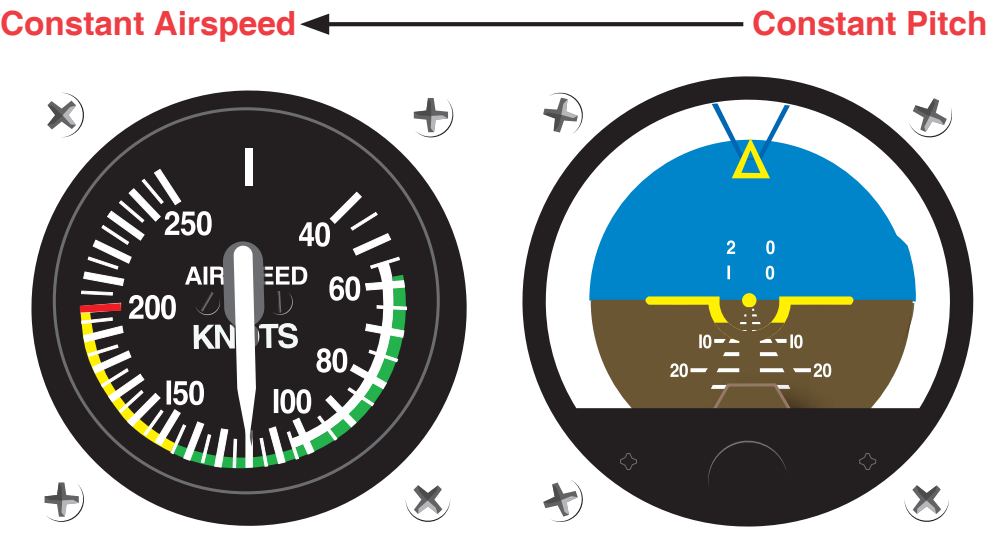
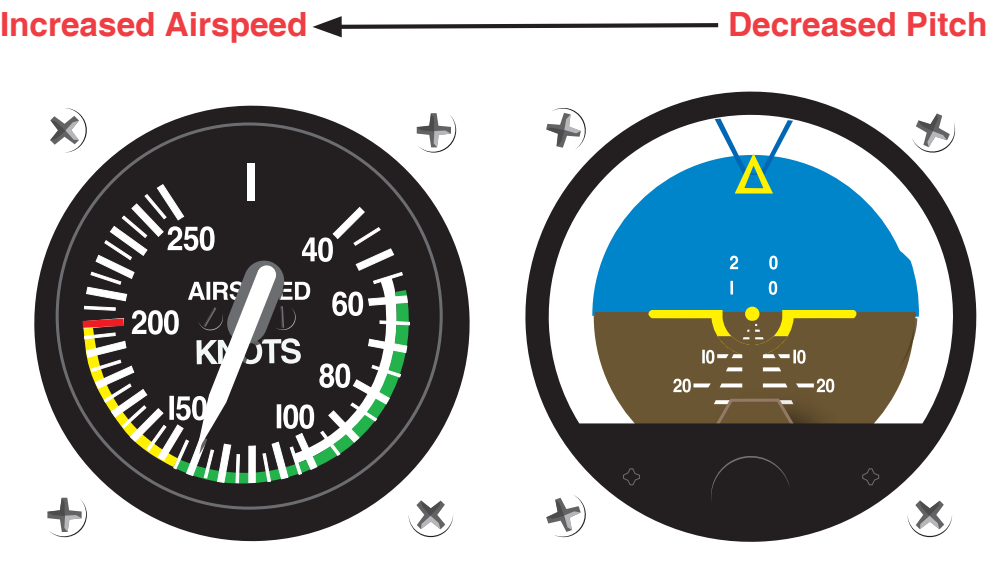
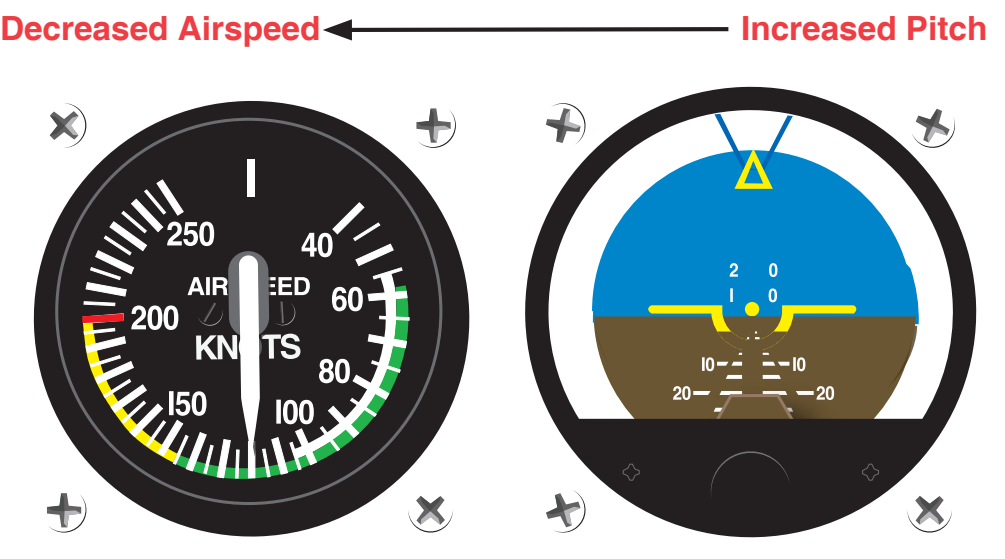
Pitch control in level flight is a question of cross-check and interpretation of the instrument panel for the instrument information that enables a pilot to visualize and control pitch attitude. Regardless of individual differences in cross-check technique, all pilots should use the instruments that give the best information for controlling the airplane in any given maneuver. Pilots should also check the other instruments to aid in maintaining the primary instruments at the desired indication.
As noted previously, the primary instrument is the one that gives the most pertinent information for a particular maneuver. It is usually the one that should be held at a constant indication. Which instrument is primary for pitch control in level flight, for example? This question should be considered in the context of specific airplane, weather conditions, pilot experience, operational conditions, and other factors. Attitude changes must be detected and interpreted instantly for immediate control action in high-performance airplanes. On the other hand, a reasonably proficient instrument pilot in a slower airplane may rely more on the altimeter for primary pitch information, especially if it is determined that too much reliance on the attitude indicator fails to provide the necessary precise attitude information. Whether the pilot decides to regard the altimeter or the attitude indicator as primary depends on which approach will best help control the attitude. In this handbook, the altimeter is normally considered as the primary pitch instrument during level flight.
Bank Control
The bank attitude of an airplane is the angle between the airplane’s wings and the natural horizon. To maintain a straight-and-level flightpath, the wings of the airplane are kept level with the horizon (assuming the airplane is in coordinated flight). The instruments used for bank control are the attitude indicator, the heading indicator, and the turn coordinator. Figure 7-16 illustrates coordinated flight. The aircraft is banked left with the attitude indicator and turn coordinator indicating the bank. The heading indicator indicates a left turn by apparent clockwise rotation of the compass card behind the airplane silhouette.
Attitude Indicator
The attitude indicator shows any change in bank attitude directly and instantly and is, therefore, a direct indicator. On the standard attitude indicator, the angle of bank is shown pictorially by the relationship of the miniature aircraft to the artificial horizon bar and by the alignment of the pointer with the banking scale at the top of the instrument. On the face of the standard three-inch instrument, small angles of bank can be difficult to detect by reference to the miniature aircraft, especially if leaning to one side or changing a seating position slightly. The position of the scale pointer is a good check against the apparent miniature aircraft position. Disregarding precession error, small deviations from straight coordinated flight can be readily detected on the scale pointer. The banking index may be graduated as shown in Figure 7-17, or it may be graduated in 30° increments.
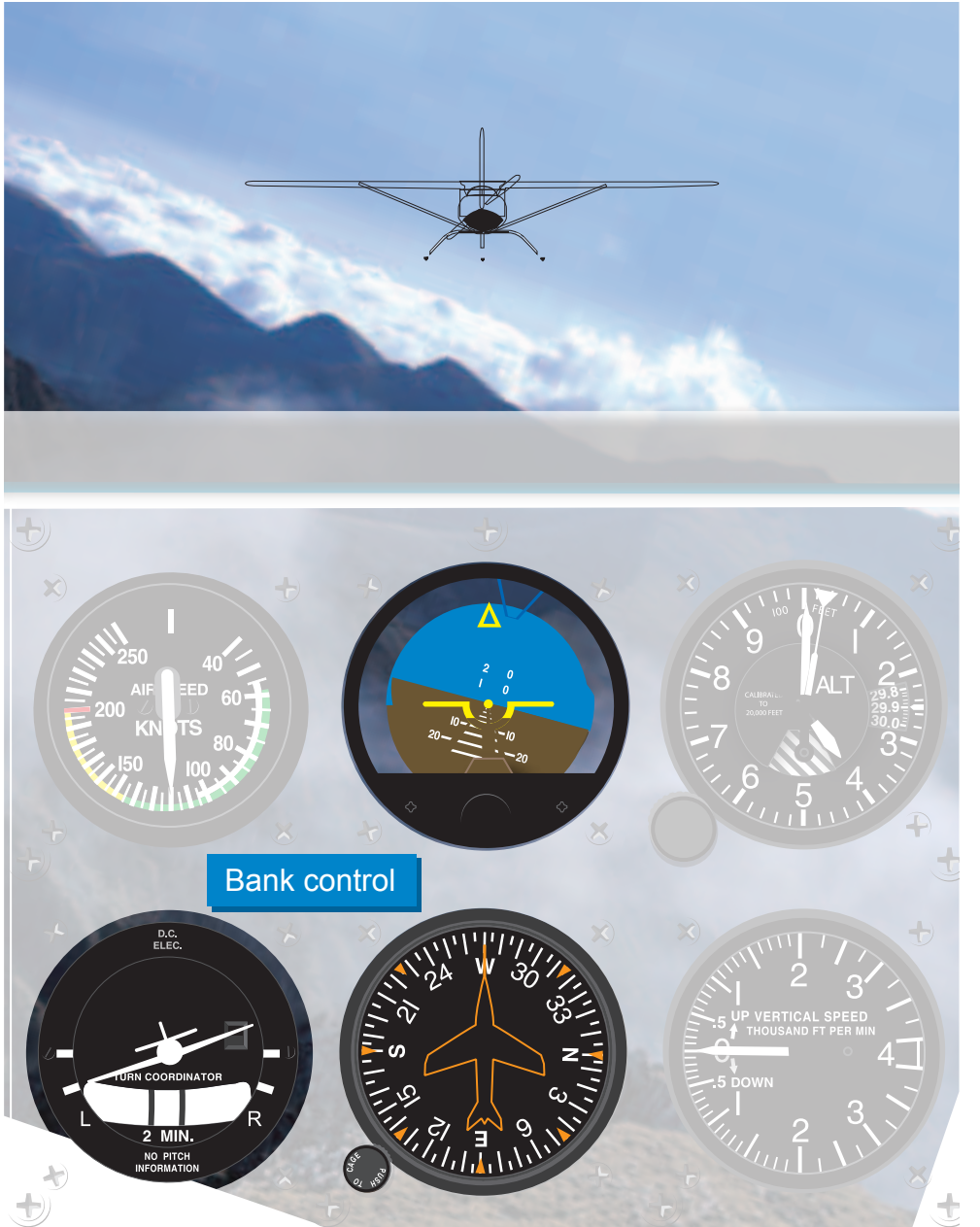
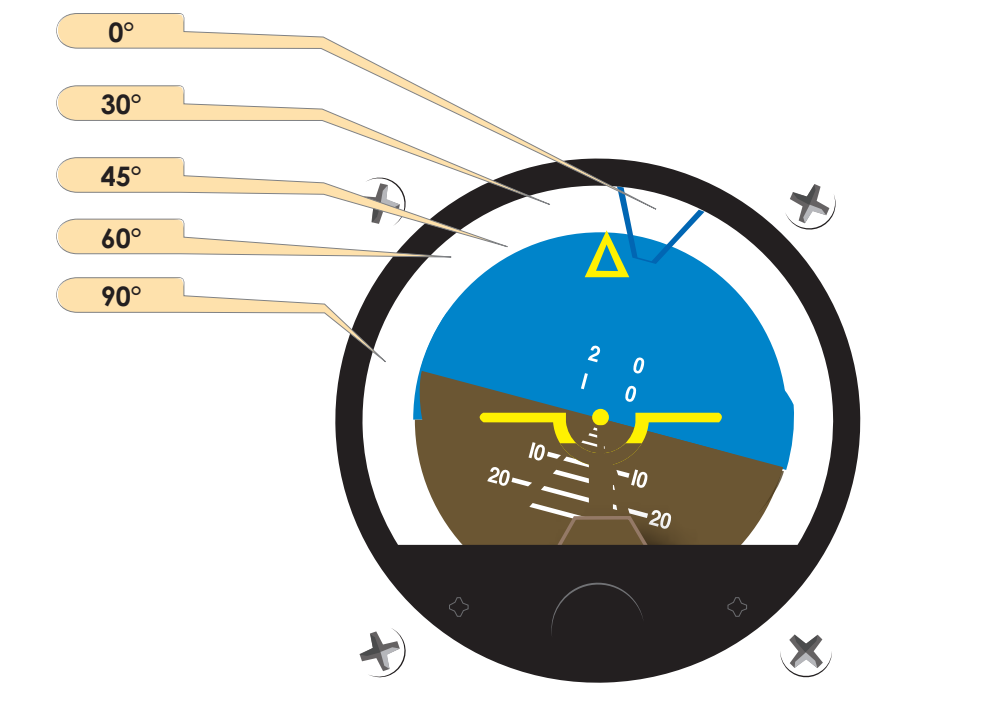
The instrument depicted in Figure 7-17 has a scale pointer that moves in the same direction of bank shown by the miniature aircraft. In this case, the aircraft is in a left 15° bank. Precession errors in this instrument are common and predictable, but the obvious advantage of the attitude indicator is an immediate indication of both pitch attitude and bank attitude in a single glance. Even with the precession errors associated with many attitude indicators, the quick attitude presentation requires less visual effort and time for positive control than other flight instruments.
Heading Indicator
The bank attitude of an aircraft in coordinated flight is shown indirectly on the heading indicator, since banking results in a turn and change in heading. Assuming the same airspeed in both instances, a rapid movement of the heading indicator (azimuth card in a directional gyro) indicates a large angle of bank, whereas slow movement reflects a small angle of bank. Note the rate of movement of the heading indicator and compare it to the attitude indicator’s degrees of bank. The attitude indicator’s precession error makes a precise check of heading information necessary in order to maintain straight flight.
When deviations from straight flight are noted on the heading indicator, correct to the desired heading using a bank angle no greater than the number of degrees to be turned. In any case, limit bank corrections to a bank angle no greater than that required for a standard rate turn. Use of larger bank angles requires a very high level of proficiency, and normally results in overcontrolling and erratic bank control.