
Chapter 7
Airplane Basic Flight Maneuvers
The miniature aircraft of the turn coordinator gives an indirect indication of the bank attitude of the airplane. When the miniature aircraft is level, the airplane is in straight flight. When the miniature airplane is aligned with one of the alignment marks and the aircraft is rolling to the left or right the indication represents the roll rate, with the alignment marks indicating a roll of 3 degrees per second in the direction of the miniature aircraft. This can be seen in level flight when a bank is introduced either to the left or the right. The turn coordinator’s indicator will indicate the rolling motion although there is no turn being made. Conversely, a pedal input to the right or left causes the aircraft to turn momentarily about its vertical axis (with no rolling motion) with an indication of turn on the turn coordinator. After the turn becomes stabilized and the aircraft is no longer rolling, the turn coordinator displays the rate of turn with the alignment marks equaling a turn of 3 degrees per second. The turn coordinator is able to display both roll and turn parameters because its electrically-powered gyroscope is canted at an angle. As a result, the turn coordinator indicator provides both roll and turn indications. Autopilots in general aviation today use this instrument in determining both roll and turn information. After the completion of a turn, return to straight flight is accomplished by coordinated aileron and rudder pressure to level the miniature aircraft. Include the miniature aircraft in the cross-check and correct for even the smallest deviations from the desired position. When this instrument is used to maintain straight flight, control pressures must be applied very lightly and smoothly.
The ball of the turn coordinator is actually a separate instrument, conveniently located under the miniature aircraft because the two instruments are used together. The ball instrument indicates the quality of the turn. If the ball is off-center, the airplane is slipping or skidding. That is, if the coordinator’s miniature airplane is tilted left and the ball is displaced to the right, the aircraft is in a skid. [Figure 7-18] If however, the miniature airplane is tilted to the right with the ball off-center to the right, the aircraft is in a slip. [Figure 7-19] If the wings are level and the airplane is properly trimmed, the ball remains in the center, and the airplane is in straight flight. If the ball is not centered, the airplane is improperly trimmed.
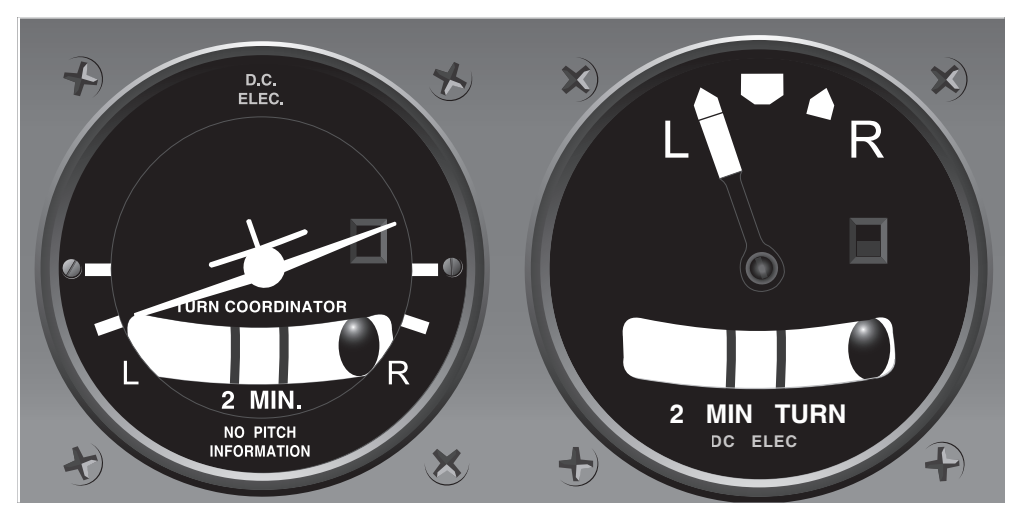
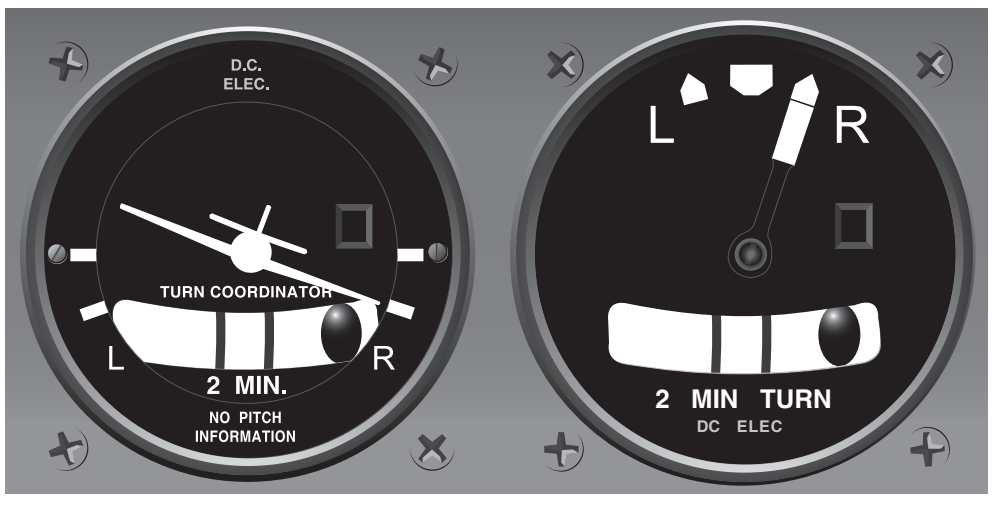
To maintain straight-and-level flight with proper trim, note the direction of ball displacement. If the ball is to the left of center and the left wing is low, apply left rudder pressure to center the ball and correct the slip. At the same time, apply right aileron pressure as necessary to level the wings, cross-checking the heading indicator and attitude indicator while centering the ball. If the wings are level and the ball is displaced from the center, the airplane is skidding. Note the direction of ball displacement and use the same corrective technique as for an indicated slip. Center the ball (left ball/left rudder, right ball/right rudder), use aileron as necessary for bank control and retrim.
To trim the airplane using only the turn coordinator, use aileron pressure to level the miniature aircraft and rudder pressure to center the ball. Hold these indications with control pressures, gradually releasing them while applying rudder trim sufficient to relieve all rudder pressure. Apply aileron trim, if available, to relieve aileron pressure. With a full instrument panel, maintain a wings-level attitude by reference to all available instruments while trimming the airplane.
Turn-and-Slip Indicator (Needle and Ball)
Unlike the turn coordinator that provides three indications (roll, turn, and trim), the turn-and-slip indicator provides two: turn-rate and trim. Although the turn-and-slip indicator needle provides an indication of turn only, it provides an indirect indication of aircraft attitude when used with roll indicators, such as a heading indicator or magnetic compass. As with the turn coordinator (after stabilizing from a roll), when the turn-and-slip indicator’s needle is aligned with the alignment marks, the aircraft is in a standard turn of 3 degrees per second or 360° in 2 minutes.
The ball of the turn-and-bank indicator provides important trim in the same manner that the ball in the turn coordinator does. Figures 7-18 and 7-19 provide a comparison of the two instruments.
Power Control
Power produces thrust which, with the appropriate angle of attack of the wing, overcomes the forces of gravity, drag, and inertia to determine airplane performance.
Power control must be related to its effect on altitude and airspeed, since any change in power setting results in a change in the airspeed or the altitude of the airplane. At any given airspeed, the power setting determines whether the airplane is in level flight, in a climb, or in a descent. If the power is increased in straight-and-level flight and the airspeed held constant, the airplane climbs. If power is decreased while the airspeed is held constant, the airplane descends. On the other hand, if altitude is held constant, the power applied determines the airspeed.
The relationship between altitude and airspeed determines the need for a change in pitch or power. If the airspeed is not the desired value, always check the altimeter before deciding that a power change is necessary. Think of altitude and airspeed as interchangeable; altitude can be traded for airspeed by lowering the nose or convert airspeed to altitude by raising the nose. If altitude is higher than desired and airspeed is low, or vice versa, a change in pitch alone may return the airplane to the desired altitude and airspeed. [Figure 7-20] If both airspeed and altitude are high or if both are low, then a change in both pitch and power is necessary in order to return to the desired airspeed and altitude. [Figure 7-21]
For changes in airspeed in straight-and-level flight, pitch, bank, and power must be coordinated in order to maintain constant altitude and heading. When power is changed to vary airspeed in straight-and-level flight, a single-engine, propeller-driven airplane tends to change attitude around all axes of movement. Therefore, to maintain constant altitude and heading, apply various control pressures in proportion to the change in power. When power is added to increase airspeed, the pitch instruments indicate a climb unless forward elevator control pressure is applied as the airspeed changes. With an increase in power, the airplane tends to yaw and roll to the left unless counteracting aileron and rudder pressures are applied. Keeping ahead of these changes requires increasing cross-check speed, which varies with the type of airplane and its torque characteristics, the extent of power, and speed change involved.
Power Settings
Power control and airspeed changes are much easier when approximate power settings necessary to maintain various airspeeds in straight-and-level flight are known in advance. However, to change airspeed by any appreciable amount, the common procedure is to underpower or overpower on initial power changes to accelerate the rate of airspeed change.
(For small speed changes, or in airplanes that decelerate or accelerate rapidly, overpowering or underpowering is not necessary.)
Consider the example of an airplane that requires 23 inches of mercury ("Hg) of manifold pressure to maintain a normal cruising airspeed of 120 knots, and 18 "Hg of manifold pressure to maintain an airspeed of 100 knots. The reduction in airspeed from 120 knots to 100 knots while maintaining straight-and-level flight is discussed below and illustrated in Figures 7-22, 7-23, and 7-24.
Instrument indications, prior to the power reduction, are shown in Figure 7-22. The basic attitude is established and maintained on the attitude indicator. The specific pitch, bank, and power control requirements are detected on these primary instruments:
Altimeter—Primary Pitch Heading Indicator—Primary Bank Airspeed Indicator—Primary Power