
Chapter 7
Airplane Basic Flight Maneuvers
Power errors usually result from but are not limited to the following errors:
- Failure to become familiar with the aircraft’s specific power settings and pitch attitudes.
- Abrupt use of throttle.
- Failure to lead the airspeed when making power changes, climbs, or descents. Example: When leveling off from a descent, increase the power in order to avoid the airspeed from bleeding off due to the decrease in momentum of the aircraft. If the pilot waits to bring in the power until after the aircraft is established in the level pitch attitude, the aircraft will have already decreased below the speed desired, which will require additional adjustment in the power setting.
- Fixation on airspeed tape or manifold pressure indications during airspeed changes, resulting in erratic control of airspeed, power, as well as pitch and bank attitudes.
Trim
Trim errors usually result from the following faults:
- Improper adjustment of seat or rudder pedals for comfortable position of legs and feet. Tension in the ankles makes it difficult to relax rudder pressures.
- Confusion about the operation of trim devices, which differ among various airplane types. Some trim wheels are aligned appropriately with the airplane’s axes; others are not. Some rotate in a direction contrary to expectations.
- Failure to understand the principles of trim and that the aircraft is being trimmed for airspeed, not a pitch attitude.
- Faulty sequence in trim techniques. Trim should be utilized to relieve control pressures, not to change pitch attitudes. The proper trim technique has the pilot holding the control wheel first and then trimming to relieve any control pressures. Continuous trim changes are required as the power setting is changed. Utilize the trim continuously, but in small amounts.
Straight Climbs and Descents
Each aircraft has a specific pitch attitude and airspeed that corresponds to the most efficient climb rate for a specified weight. The POH/AFM contains the speeds that produce the desired climb. These numbers are based on maximum gross weight. Pilots must be familiar with how the speeds vary with weight so they can compensate during flight.
Entry
Constant Airspeed Climb From Cruise Airspeed
To enter a constant airspeed climb from cruise airspeed, slowly and smoothly apply aft elevator pressure in order to raise the yellow chevron (aircraft symbol) until the tip points to the desired degree of pitch. [Figure 7-63] Hold the aft control pressure and smoothly increase the power to the climb power setting. This increase in power may be initiated either prior to initiating the pitch change or after having established the desired pitch setting. Consult the POH/AFM for specific climb power settings if anything other than a full power climb is desired. Pitch attitudes vary depending on the type of aircraft being flown. As airspeed decreases, control forces need to be increased in order to compensate for the additional elevator deflection required to maintain attitude. Utilize trim to eliminate any control pressures. By effectively using trim, the pilot is better able to maintain the desired pitch without constant attention. The pilot is thus able to devote more time to maintaining an effective scan of all instrumentation.
The VSI should be utilized to monitor the performance of the aircraft. With a smooth pitch transition, the VSI tape should begin to show an immediate trend upward and stabilize on a rate of climb equivalent to the pitch and power setting being utilized. Depending on current weight and atmospheric conditions, this rate will be different. This requires the pilot to be knowledgeable of how weight and atmospheric conditions affect aircraft performance.
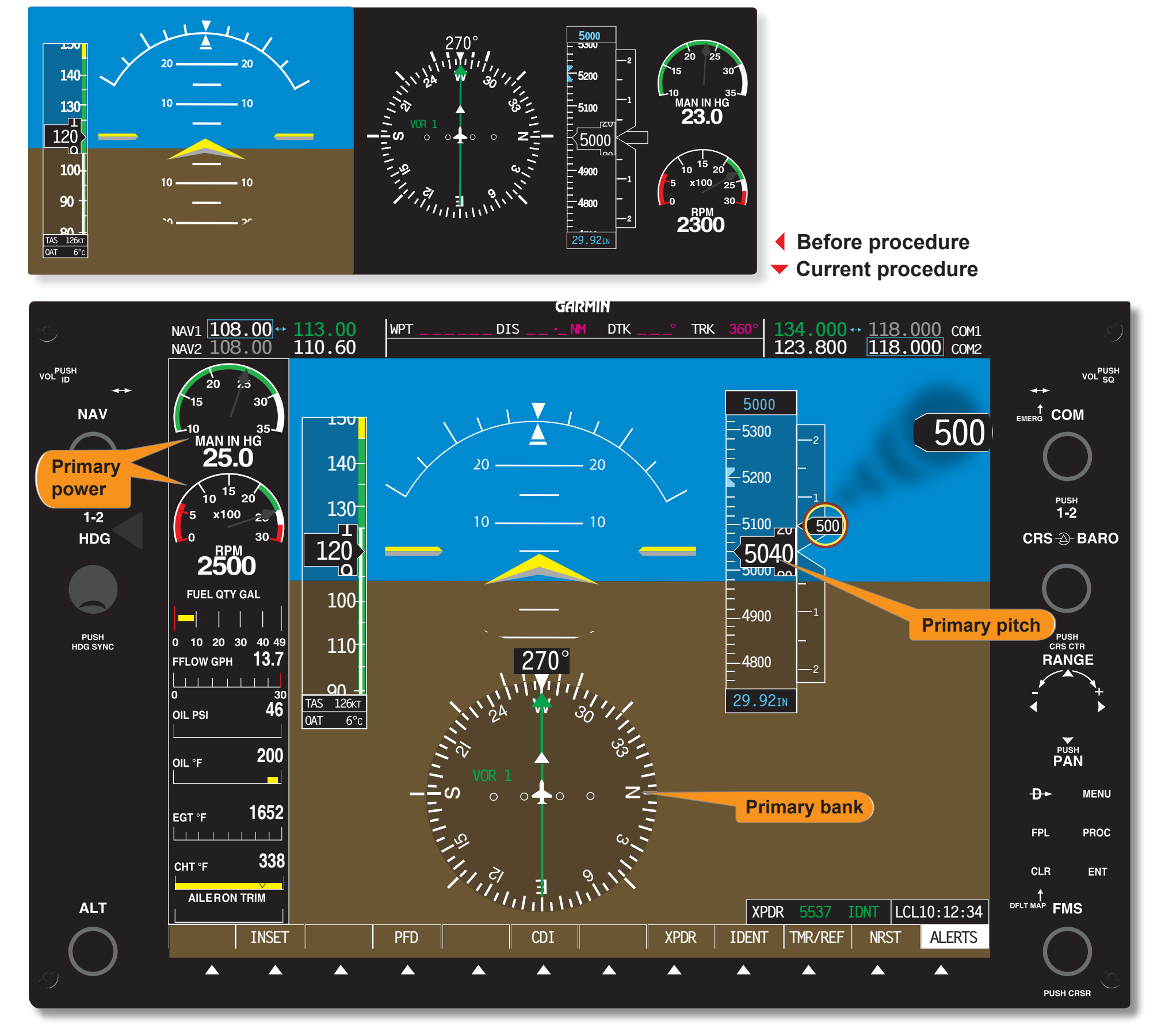
Once the aircraft is stabilized at a constant airspeed and pitch attitude, the primary flight instrument for pitch will be the ASI and the primary bank instrument will be the heading indicator. The primary power instrument will be the tachometer or the manifold pressure gauge depending on the aircraft type. If the pitch attitude is correct, the airspeed should slowly decrease to the desired speed. If there is any variation in airspeed, make small pitch changes until the aircraft is stabilized at the desired speed. Any change in airspeed requires a trim adjustment.
Constant Airspeed Climb from Established Airspeed
In order to enter a constant airspeed climb, first complete the airspeed reduction from cruise airspeed to climb airspeed. Maintain straight-and-level flight as the airspeed is reduced. The entry to the climb is similar to the entry from cruise airspeed with the exception that the power must be increased when the pitch attitude is raised. [Figure 7-64] Power added after the pitch change shows a decrease in airspeed due to the increased drag encountered. Power added prior to a pitch change causes the airspeed to increase due to the excess thrust.
Constant Rate Climbs
Constant rate climbs are very similar to the constant airspeed climbs in the way the entry is made. As power is added, smoothly apply elevator pressure to raise the yellow chevron to the desired pitch attitude that equates to the desired vertical speed rate. The primary instrument for pitch during the initial portion of the maneuver is the ASI until the vertical speed rate stabilizes and then the VSI tape becomes primary. The ASI then becomes the primary instrument for power. If any deviation from the desired vertical speed is noted, small pitch changes will be required in order to achieve the desired vertical speed. [Figure 7-65]
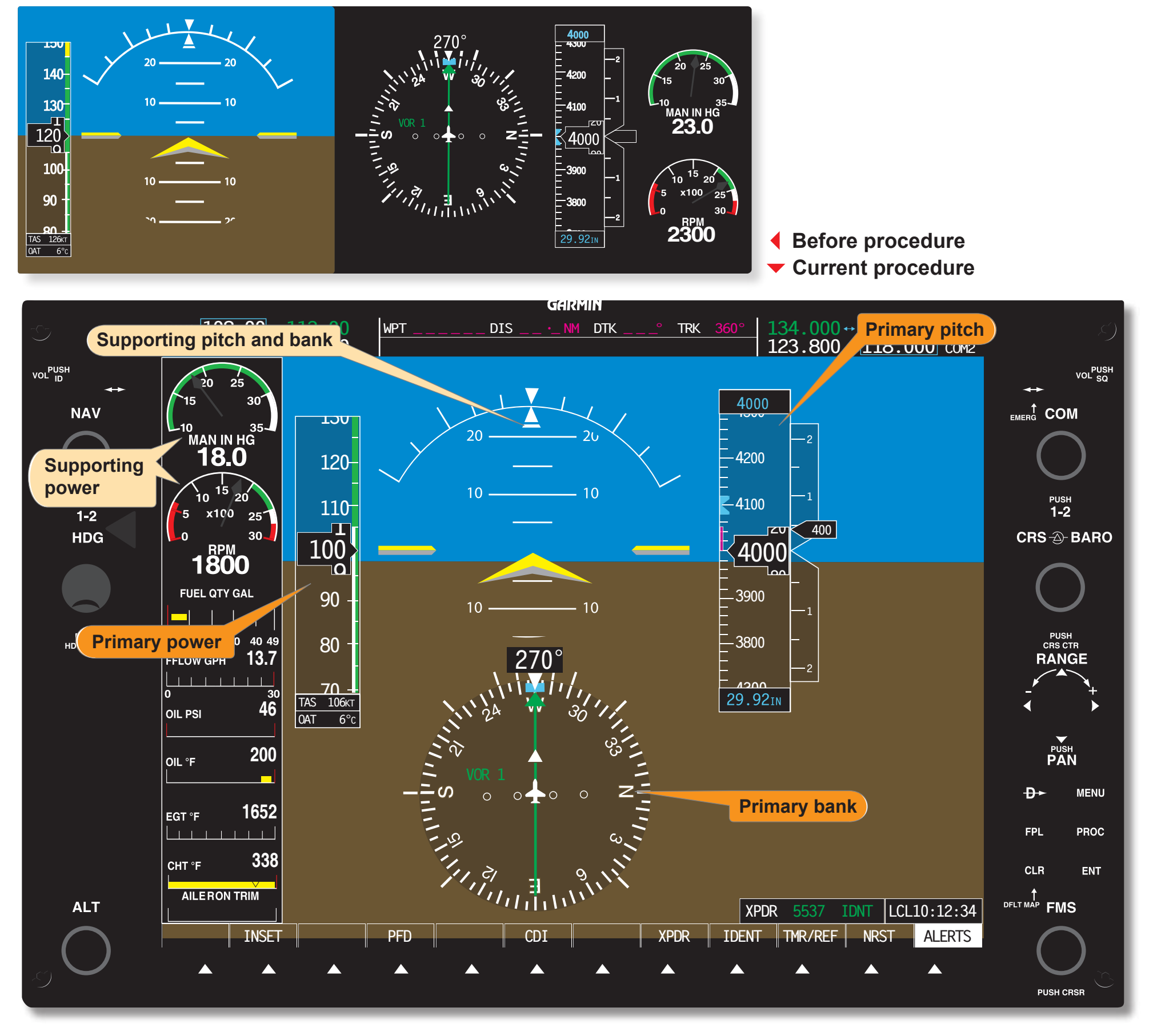
When making changes to compensate for deviations in performance, pitch, and power, pilot inputs need to be coordinated to maintain a stable flight attitude. For instance, if the vertical speed is lower than desired but the airspeed is correct, an increase in pitch momentarily increases the vertical speed. However, the increased drag quickly starts to degrade the airspeed if no increase in power is made. A change to any one variable mandates a coordinated change in the other.
Conversely, if the airspeed is low and the pitch is high, a reduction in the pitch attitude alone may solve the problem. Lower the nose of the aircraft very slightly to see if a power reduction is necessary. Being familiar with the pitch and power settings for the aircraft aids in achieving precise attitude instrument flying.