Chapter 7
Airplane Basic Flight Maneuvers
Power Settings
Power control and airspeed changes are much easier when approximate power settings necessary to maintain various airspeeds in straight-and-level flight are known in advance. However, to change airspeed by any appreciable amount, the common procedure is to underpower or overpower on initial power changes to accelerate the rate of airspeed change. (For small speed changes, or in airplanes that decelerate or accelerate rapidly, overpowering or underpowering is not necessary.)
Consider the example of an airplane that requires 23 inches of mercury ("Hg) to maintain a normal cruising airspeed of 120 knots, and 18 "Hg to maintain an airspeed of 100 knots. The reduction in airspeed from 120 knots to 100 knots while maintaining straight-and-level flight is discussed below and illustrated in Figures 7-57, 7-58, and 7-59.
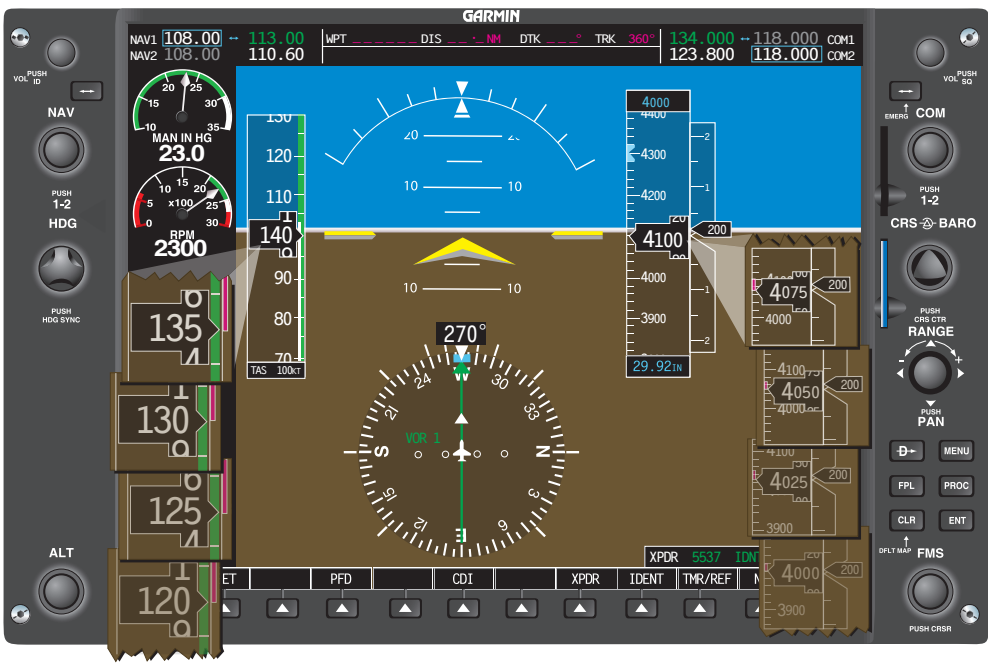
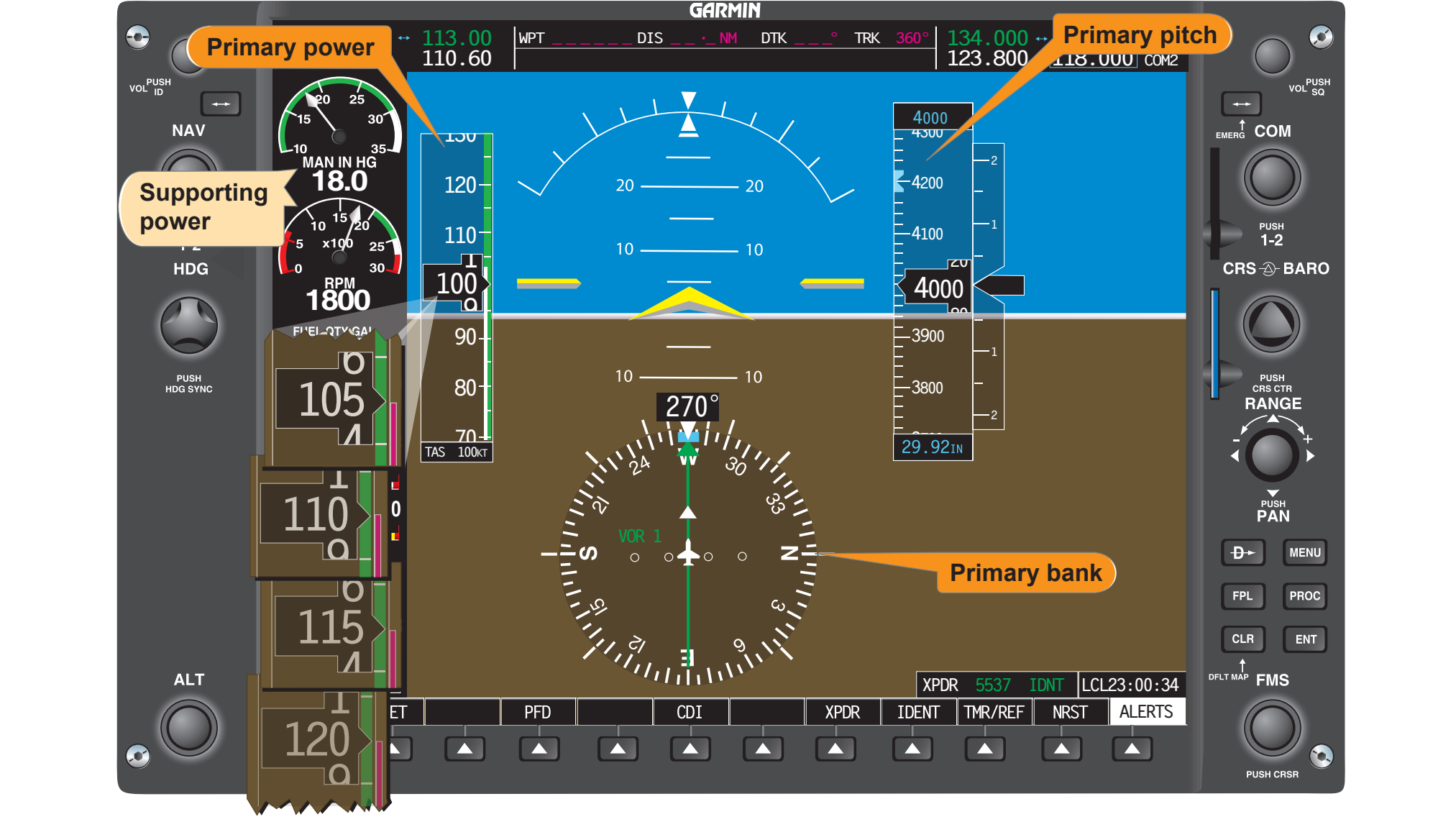
Instrument indications, prior to the power reduction, are shown in Figure 7-57. The basic attitude is established and maintained on the attitude indicator. The specific pitch, bank, and power control requirements are detected on these primary instruments:
Altimeter—Primary Pitch Heading Indicator—Primary Bank Airspeed Indicator—Primary Power
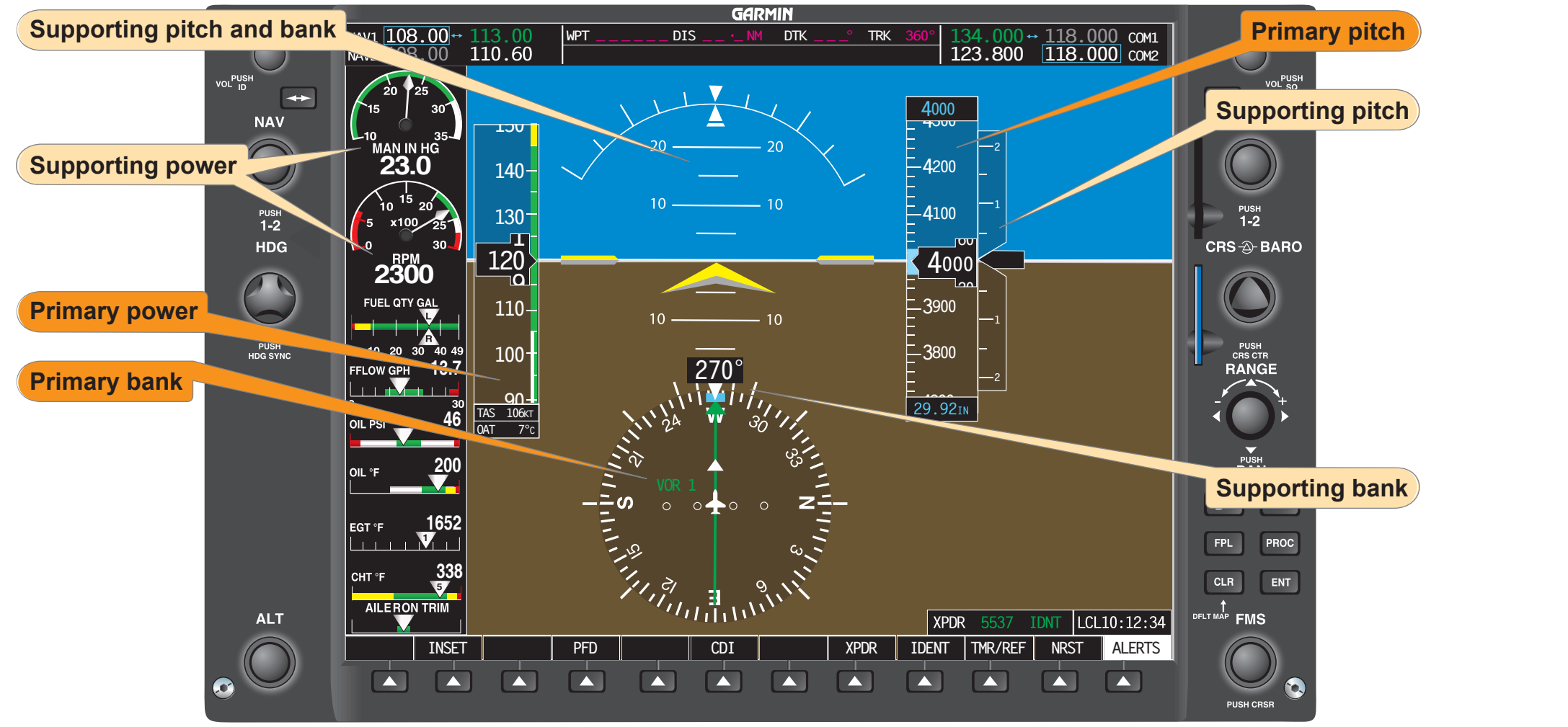
Supporting pitch and bank instruments are shown in Figure 7-57. Note that the supporting power instrument is the manifold pressure gauge (or tachometer if the propeller is fixed pitch). However, when a smooth power reduction to approximately 15 "Hg (underpower) is made, the manifold pressure gauge becomes the primary power instrument. [Figure 7-58] With practice, power setting can be changed with only a brief glance at the power instrument, by sensing the movement of the throttle, the change in sound, and the changes in the feel of control pressures.
As the thrust decreases, increase the speed of the cross-check and be ready to apply left rudder, back-elevator, and aileron control pressure the instant the pitch and bank instruments show a deviation from altitude and heading. As proficiency is obtained, a pilot will learn to cross-check, interpret, and control the changes with no deviation of heading and altitude. Assuming smooth air and ideal control technique, as airspeed decreases, a proportionate increase in airplane pitch attitude is required to maintain altitude. Similarly, effective torque control means counteracting yaw with rudder pressure.
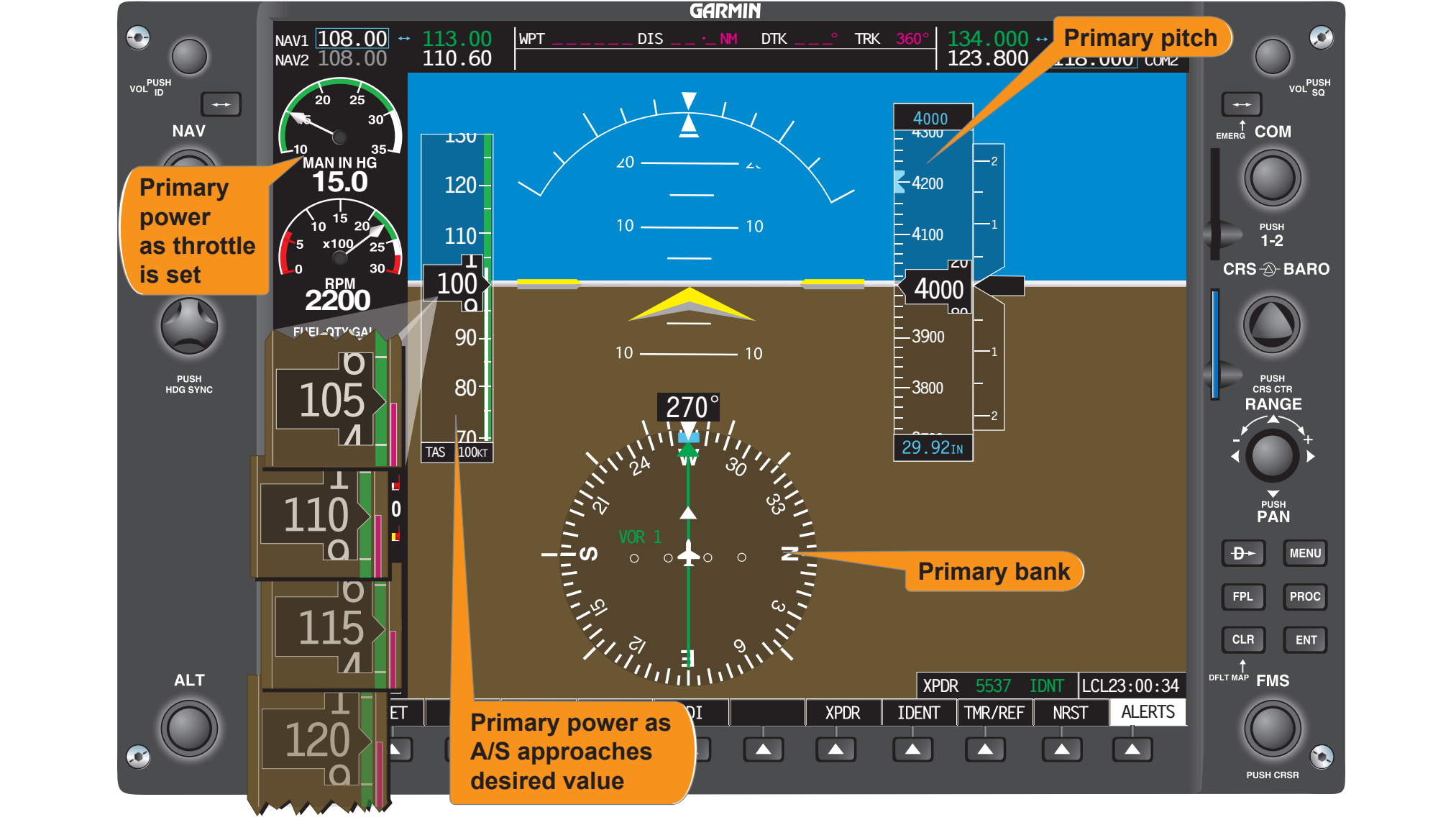
As the power is reduced, the altimeter is primary for pitch, the heading indicator is primary for bank, and the manifold pressure gauge is momentarily primary for power (at 15 "Hg in Figure 7-58). Control pressures should be trimmed off as the airplane decelerates. As the airspeed approaches the desired airspeed of 100 knots, the manifold pressure is adjusted to approximately 18 "Hg and becomes the supporting power instrument. The ASI again becomes primary for power. [Figure 7-59]
Airspeed Changes in Straight-and-Level Flight
Practice of airspeed changes in straight-and-level flight provides an excellent means of developing increased proficiency in all three basic instrument skills and brings out some common errors to be expected during training in straight-and-level flight. Having learned to control the airplane in a clean configuration (minimum drag conditions), increase proficiency in cross-check and control by practicing speed changes while extending or retracting the flaps and landing gear. While practicing, be sure to comply with the airspeed limitations specified in the POH/AFM for gear and flap operation.
Sudden and exaggerated attitude changes may be necessary in order to maintain straight-and-level flight as the landing gear is extended and the flaps are lowered in some airplanes. The nose tends to pitch down with gear extension, and when flaps are lowered, lift increases momentarily (at partial flap settings) followed by a marked increase in drag as the flaps near maximum extension.
Control technique varies according to the lift and drag characteristics of each airplane. Accordingly, knowledge of the power settings and trim changes associated with different combinations of airspeed, gear, and flap configurations reduces instrument cross-check and interpretation problems. [Figure 7-60]
For example, assume that in straight-and-level flight instruments indicate 120 knots with power at 23 "Hg manifold pressure/2,300 revolutions per minute (rpm), gear and flaps up. After reduction in airspeed, with gear and flaps fully extended, straight-and-level flight at the same altitude requires 25 "Hg manifold pressure/2,500 rpm. Maximum gear extension speed is 115 knots; maximum flap extension speed is 105 knots. Airspeed reduction to 95 knots, gear and flaps down, can be made in the following manner:
- Maintain rpm at 2,500, since a high power setting is used in full drag configuration.
- Reduce manifold pressure to 10 "Hg. As the airspeed decreases, increase cross-check speed.
- Make trim adjustments for an increased angle of attack and decrease in torque.
- Lower the gear at 115 knots. The nose may tend to pitch down and the rate of deceleration increases. Increase pitch attitude to maintain constant altitude and trim off some of the back-elevator pressures. If full flaps are lowered at 105 knots, cross-check, interpretation, and control must be very rapid. A simpler technique is to stabilize attitude with gear down before lowering the flaps.
- Since 18 "Hg manifold pressure holds level flight at 100 knots with the gear down, increase power smoothly to that setting as the ASI shows approximately 105 knots, and retrim. The attitude indicator now shows approximately two-and-a-half bar width nose-high in straight-and-level flight.
- Actuate the flap control and simultaneously increase power to the predetermined setting (25 "Hg) for the desired airspeed, and trim off the pressures necessary to hold constant altitude and heading. The attitude indicator now shows a bar width nose-low in straight-and-level flight at 95 knots.