
Chapter 7
Airplane Basic Flight Maneuvers
- Perform clearing turns.
- Roll left into a 45° bank turn and immediately begin to increase the pitch attitude by approximately 3° to 5°.
- As the bank rolls past 30°, increase power to maintain the entry airspeed.
- Apply trim to eliminate any aft control wheel forces.
- Begin rolling out of the steep turn approximately 20° prior to the desired heading.
- Apply forward control pressure and place the pitch attitude in the level cruise pitch attitude.
- Reduce power to the entry power setting to maintain the desired airspeed.
- Re-trim the aircraft as soon as practical or continue into a right hand steep turn and continue from step 3.
- Once the maneuver is complete, establish cruise flight and accomplish all appropriate checklist items.
Unusual Attitude Recovery Protection
Unusual attitudes are some of the most hazardous situations for a pilot to be in. Without proper recovery training on instrument interpretation and aircraft control, a pilot can quickly aggravate an abnormal flight attitude into a potentially fatal accident.
Analog gauges require the pilot to scan between instruments to deduce the aircraft attitude. Individually, these gauges lack the necessary information needed for a successful recovery.
EFDs have additional features to aid in recognition and recovery from unusual flight attitudes. The PFD displays all the flight instruments on one screen. Each instrument is superimposed over a full-screen representation of the attitude indicator. With this configuration, the pilot no longer needs to transition from one instrument to another.
The new unusual attitude recovery protection allows the pilot to be able to quickly determine the aircraft’s attitude and make a safe, proper, and prompt recovery. Situational awareness is increased by the introduction of the large full-width artificial horizon depicted on the PFD. This now allows for the attitude indicator to be in view during all portions of the scan.
One problem with analog gauges is that the attitude indicator displays a complete blue or brown segment when the pitch attitude is increased toward 90° nose-up or nose-down.
With the EFDs, the attitude indicator is designed to retain a portion of both sky and land representation at all times. This improvement allows the pilot to always know the quickest way to return to the horizon. Situational awareness is greatly increased.
It is imperative to understand that the white line on the attitude indicator is the horizon line. The break between the blue and brown symbols is only a reference and should not be thought of as the artificial horizon.
Another important advancement is the development of the unusual attitude recovery protection that is built into the PFD software and made capable by the AHRS. In the case of a nose-high unusual attitude, the unusual attitude recovery protection displays red chevrons that point back to the horizon line. These chevrons are positioned at 50° up on the attitude indicator. The chevrons appear when the aircraft approaches a nose-high attitude of 30°. The software automatically declutters the PFD leaving only airspeed, heading, attitude, altimeter, VSI tape, and the trend vectors. The decluttered information reappears when the pitch attitude falls below 25°.
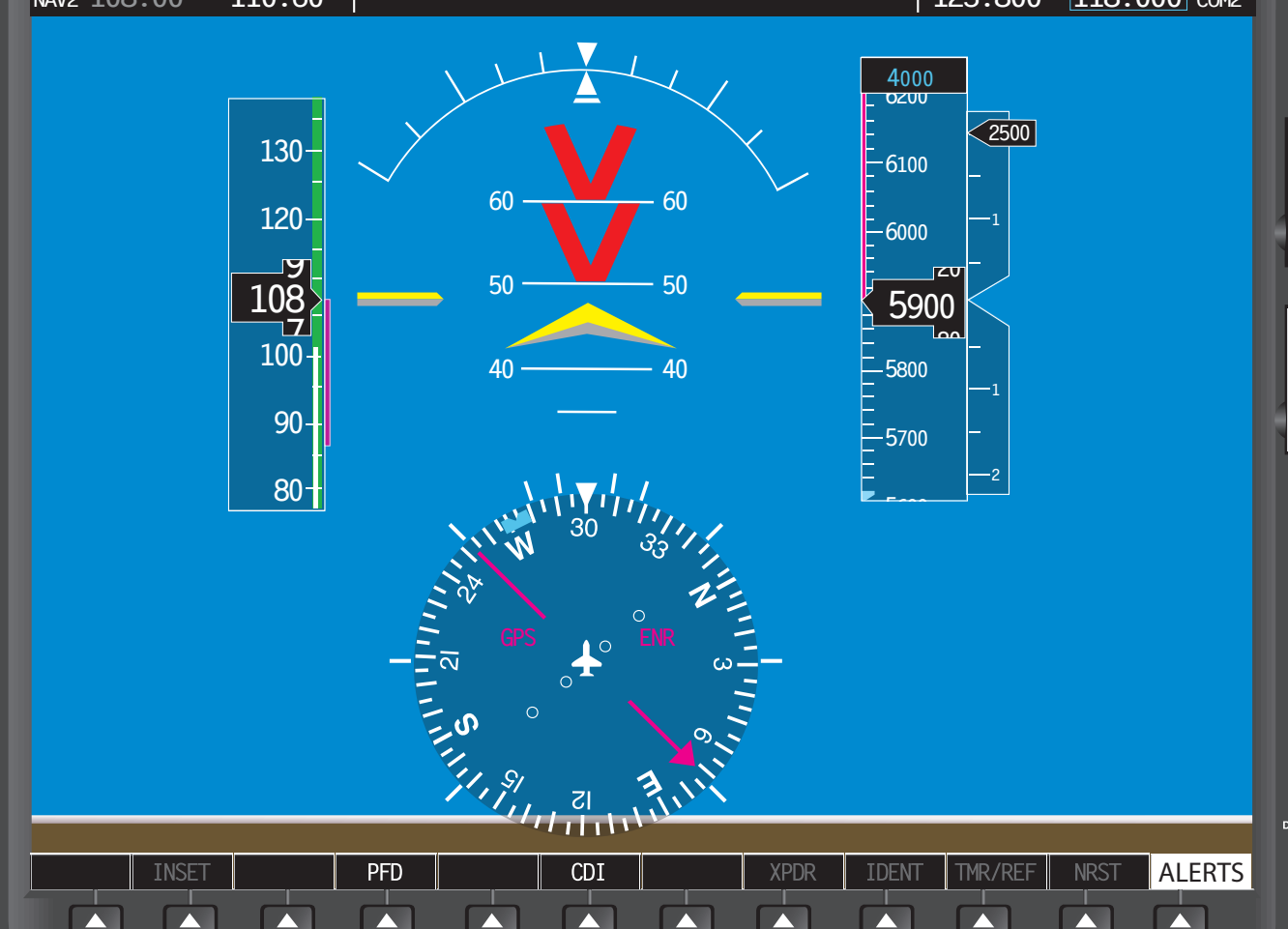
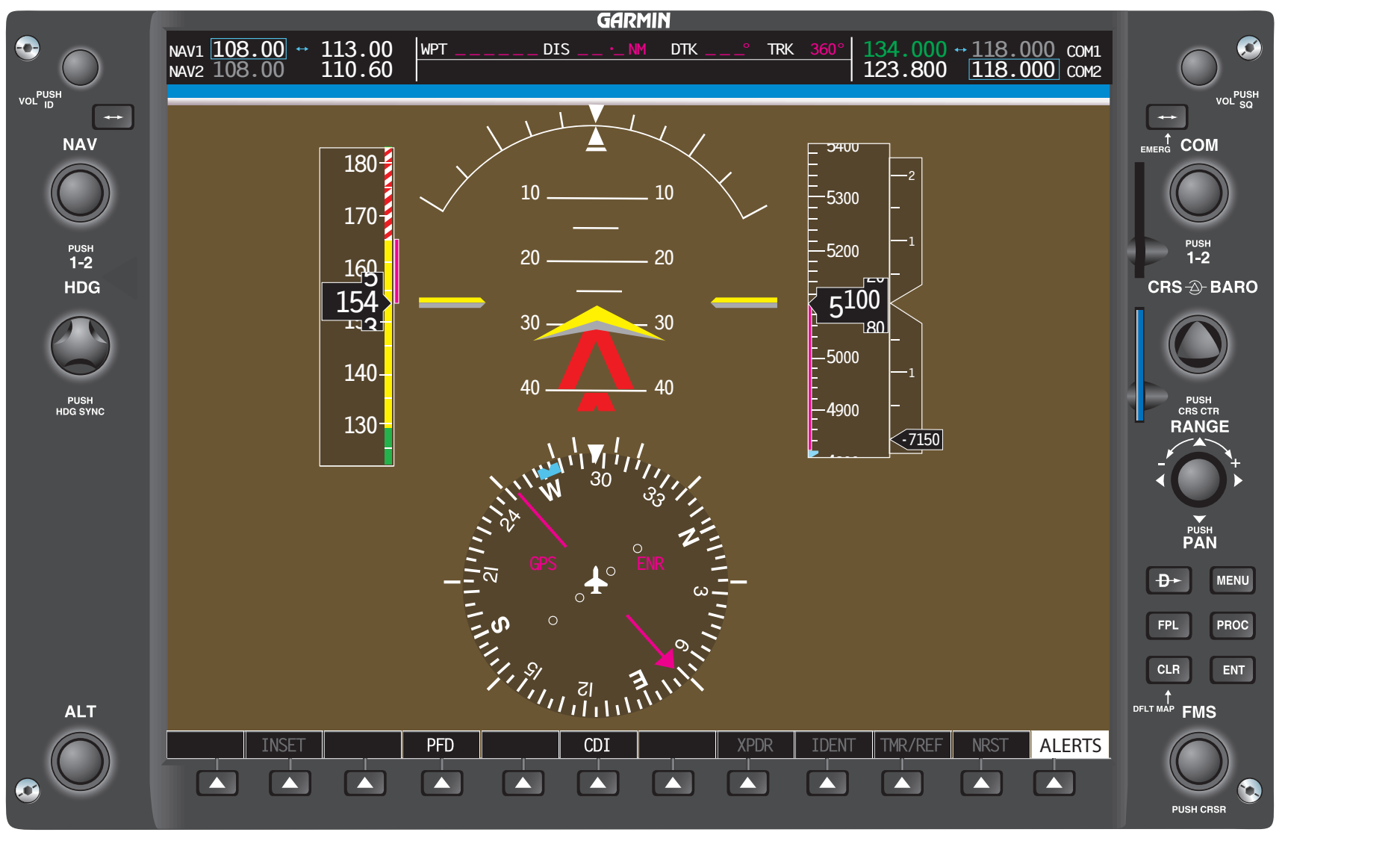
For nose-low unusual attitudes, the chevrons are displayed when the pitch exceeds 15° nose-down. If the pitch continues to decrease, the unusual attitude recovery protection de-clutters the screen at 20° nose-down. The decluttered information reappears when the pitch increases above 15°.
Additionally, there are bank limits that trigger the unusual attitude protection. If the aircraft’s bank increases beyond 60°, a continuation of the roll index occurs to indicate the shortest direction to roll the wings back to level. At 65°, the PFD de-clutters. All information reappears when the bank decreases below 60°.
In Figure 7-71, the aircraft has rolled past 60°. Observe the white line that continues from the end of the bank index. This line appears to indicate the shortest distance back to wings level.
When experiencing a failure of the AHRS unit, all unusual attitude protection is lost. The failure of the AHRS results in the loss of all heading and attitude indications on the PFD. In addition, all modes of the autopilot, except for roll and altitude hold, are lost.
The following picture series represents how important this technology is in increasing situational awareness, and how critical it is in improving safety.