
Chapter 8
Helicopter Attitude Instrument Flying
Power control is the application of collective pitch with corresponding throttle control, where applicable. In straight-and-level flight, changes of collective pitch are made to correct for altitude deviation if the error is more than 100 feet or the airspeed is off by more than 10 knots. If the error is less than that amount, a pilot should use a slight cyclic climb or descent.
In order to fly a helicopter by reference to the instruments, it is important to know the approximate power settings required for a particular helicopter in various load configurations and flight conditions.
Trim, in helicopters, refers to the use of the cyclic centering button, if the helicopter is so equipped, to relieve all possible cyclic pressures. Trim also refers to the use of pedal adjustment to center the ball of the turn indicator. Pedal trim is required during all power changes.
The proper adjustment of collective pitch and cyclic friction helps a pilot relax during instrument flight. Friction should be adjusted to minimize overcontrolling and to prevent creeping, but not applied to such a degree that control movement is limited. In addition, many helicopters equipped for instrument flight contain stability augmentation systems or an autopilot to help relieve pilot workload.
Straight-and-Level Flight
Straight-and-level unaccelerated flight consists of maintaining the desired altitude, heading, airspeed, and pedal trim.
Pitch Control
The pitch attitude of a helicopter is the angular relation of its longitudinal axis to the natural horizon. If available, the attitude indicator is used to establish the desired pitch attitude. In level flight, pitch attitude varies with airspeed and center of gravity (CG). At a constant altitude and a stabilized airspeed, the pitch attitude is approximately level. [Figure 8-2]
Attitude Indicator
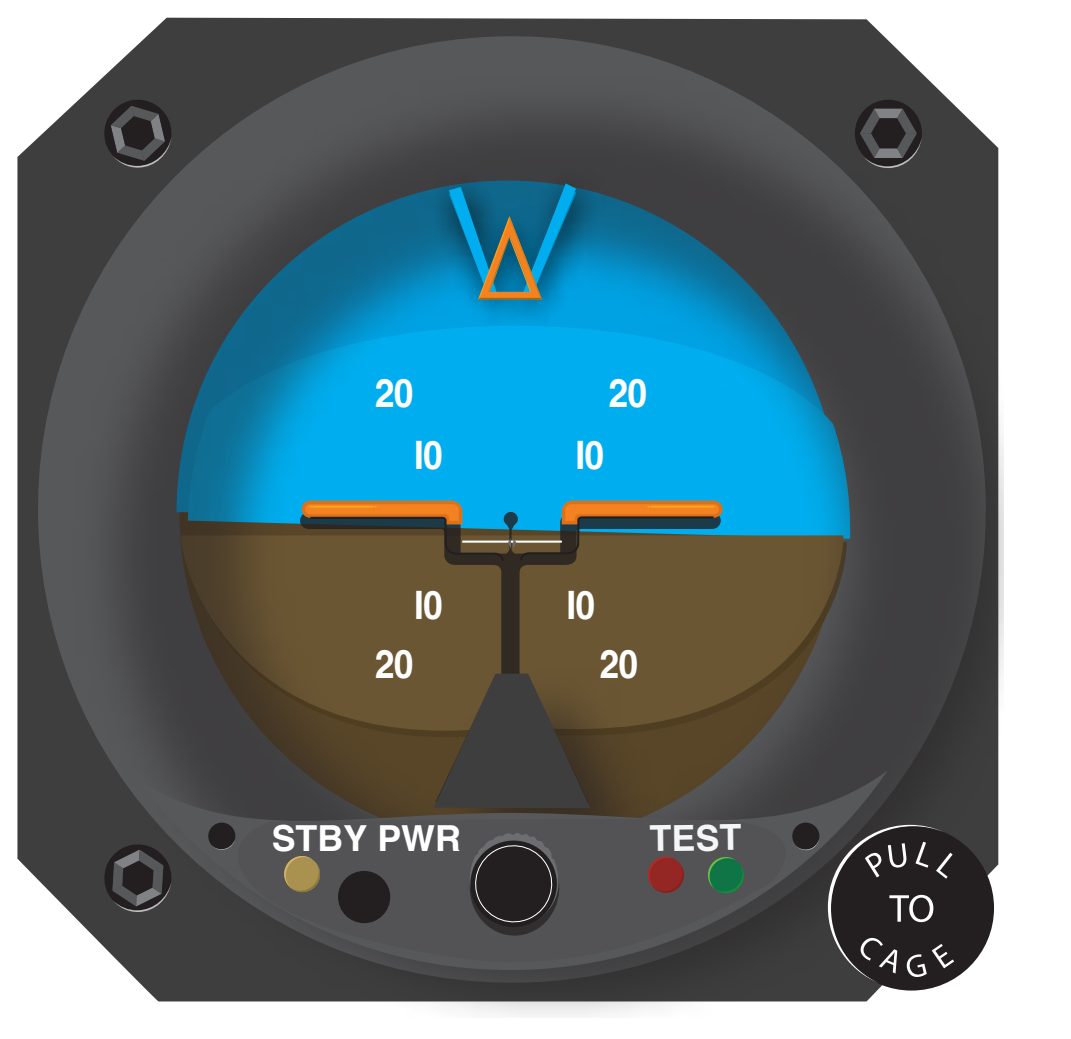
The attitude indicator gives a direct indication of the pitch attitude of the helicopter. In visual flight, attain the desired pitch attitude by using the cyclic to raise and lower the nose of the helicopter in relation to the natural horizon. During instrument flight, follow exactly the same procedure in raising or lowering the miniature aircraft in relation to the horizon bar.
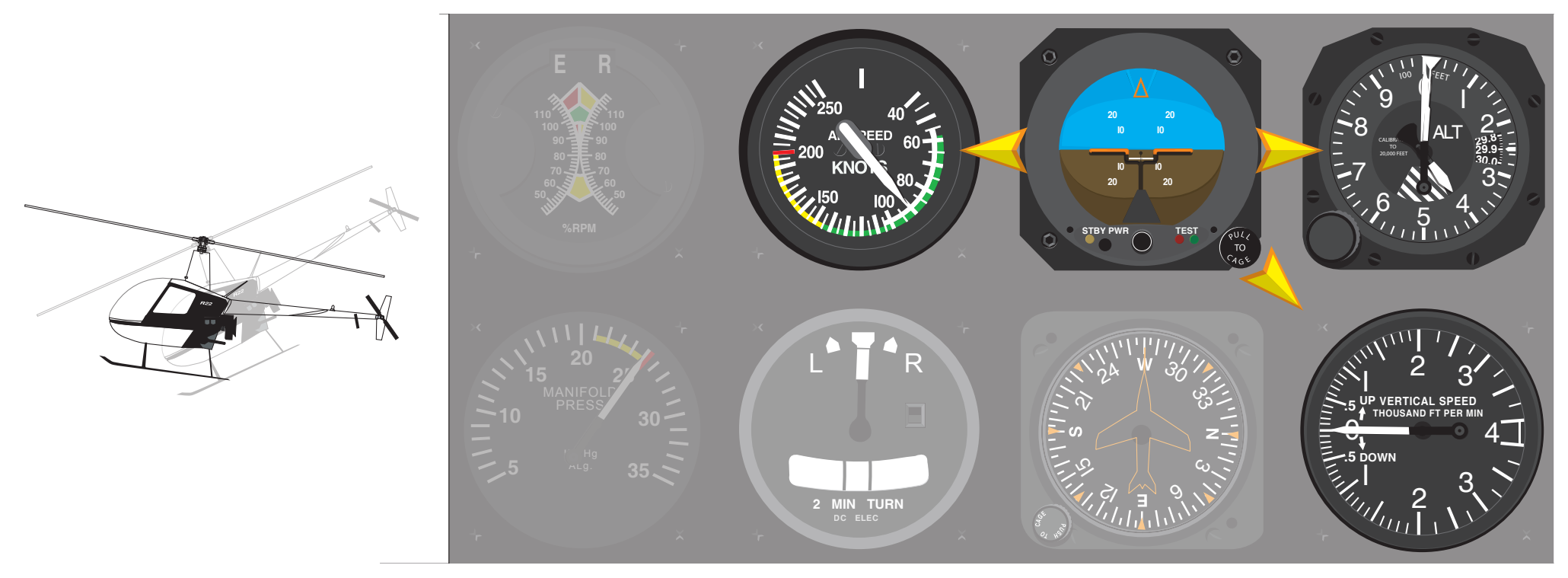
There is some delay between control application and resultant instrument change. This is the normal control lag in the helicopter and should not be confused with instrument lag. The attitude indicator may show small misrepresentations of pitch attitude during maneuvers involving acceleration, deceleration, or turns. This precession error can be detected quickly by cross-checking the other pitch instruments.
If the miniature aircraft is properly adjusted on the ground, it may not require readjustment in flight. If the miniature aircraft is not on the horizon bar after level off at normal cruising airspeed, adjust it as necessary while maintaining level flight with the other pitch instruments. Once the miniature aircraft has been adjusted in level flight at normal cruising airspeed, leave it unchanged so it gives an accurate picture of pitch attitude at all times.
When making initial pitch attitude corrections to maintain altitude, the changes of attitude should be small and smoothly applied. The initial movement of the horizon bar should not exceed one bar width high or low. [Figure 8-3] If a further adjustment is required, an additional correction of one-half bar normally corrects any deviation from the desired altitude. This one-and-one-half bar correction is normally the maximum pitch attitude correction from level flight attitude.
After making the correction, cross-check the other pitch instruments to determine whether the pitch attitude change is sufficient. If additional correction is needed to return to altitude, or if the airspeed varies more than 10 knots from that desired, adjust the power.
Altimeter
The altimeter gives an indirect indication of the pitch attitude of the helicopter in straight-and-level flight. Since the altitude should remain constant in level flight, deviation from the desired altitude indicates a need for a change in pitch attitude and power as necessary. When losing altitude, raise the pitch attitude and adjust power as necessary. When gaining altitude, lower the pitch attitude and adjust power as necessary. Indications for power changes are explained in the next paragraph.
The rate at which the altimeter moves helps to determine pitch attitude. A very slow movement of the altimeter indicates a small deviation from the desired pitch attitude, while a fast movement of the altimeter indicates a large deviation from the desired pitch attitude. Make any corrective action promptly with small control changes. Also, remember that movement of the altimeter should always be corrected by two distinct changes. The first is a change of attitude to stop the altimeter movement; the second is a change of attitude to return smoothly to the desired altitude. If altitude and airspeed are more than 100 feet and 10 knots low, respectively, apply power in addition to an increase of pitch attitude. If the altitude and airspeed are high by more than 100 feet and 10 knots, reduce power and lower the pitch attitude.
There is a small lag in the movement of the altimeter; however, for all practical purposes, consider that the altimeter gives an immediate indication of a change or a need for change in pitch attitude. Since the altimeter provides the most pertinent information regarding pitch in level flight, it is considered primary for pitch.