
Chapter 9
Navigation Systems
The TO/FROM indicator shows whether the selected course, if intercepted and flown, takes the aircraft TO or FROM the station. It does not indicate whether the aircraft is heading to or from the station.
Flags or Other Signal Strength Indicators
The device that indicates a usable or an unreliable signal may be an “OFF” flag. It retracts from view when signal strength is sufficient for reliable instrument indications. Alternately, insufficient signal strength may be indicated by a blank or OFF in the TO/FROM window.
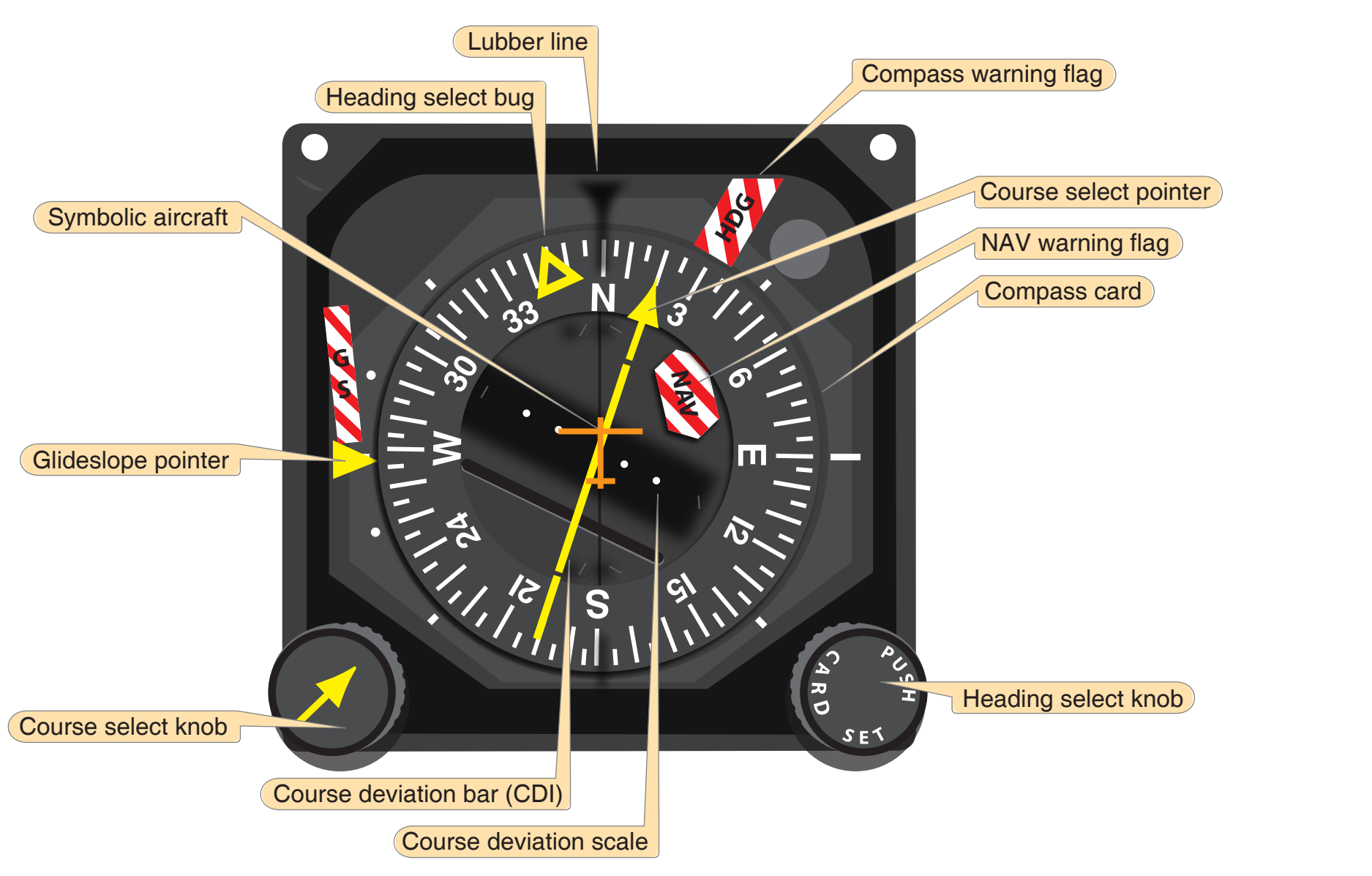
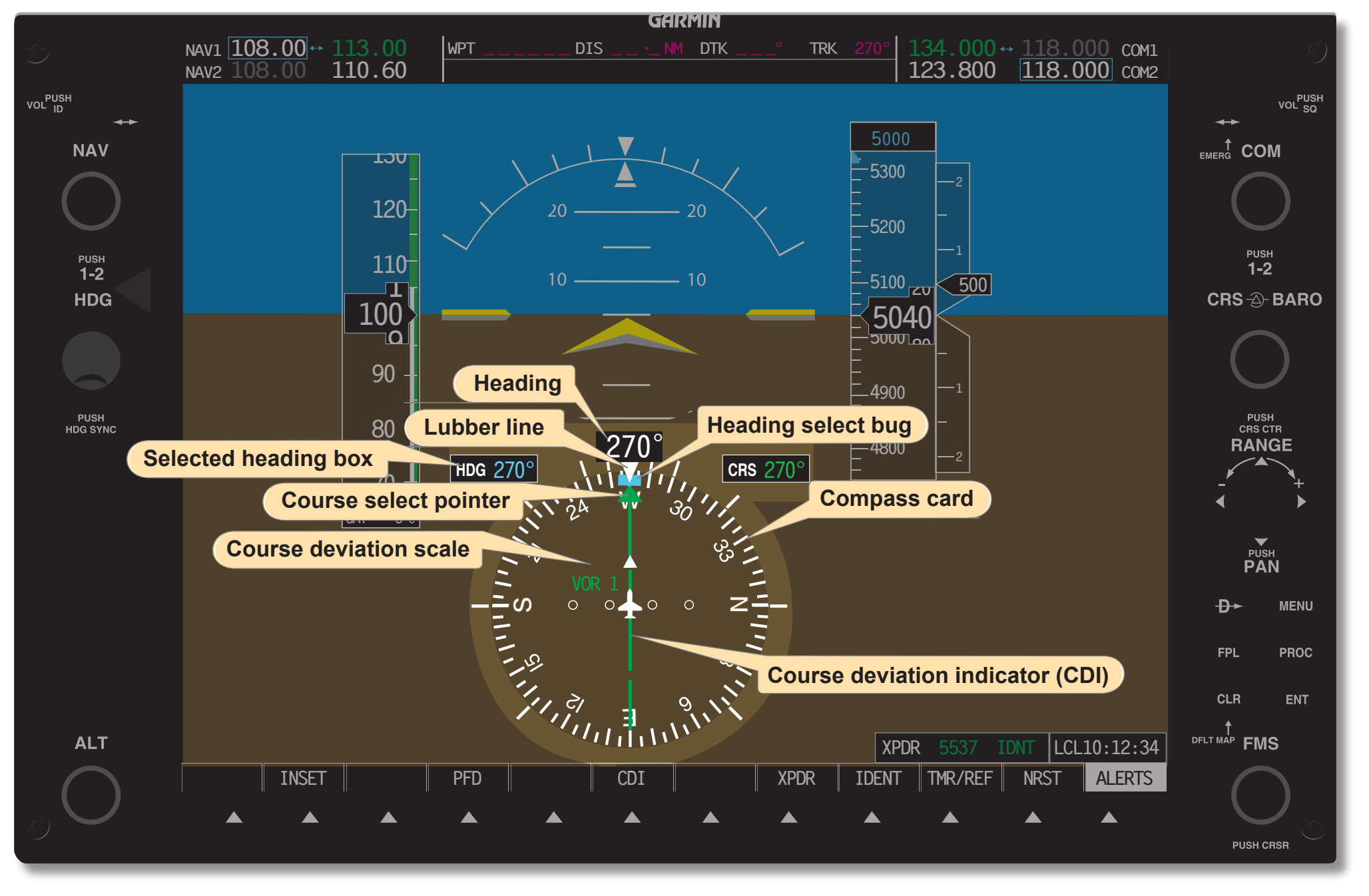
The indicator instrument may also be a horizontal situation indicator (HSI), which combines the heading indicator and CDI. [Figure 9-13] The combination of navigation information from VOR/Localizer (LOC) with aircraft heading information provides a visual picture of the aircraft’s location and direction. This decreases pilot workload especially with tasks such as course intercepts, flying a back-course approach, or holding pattern entry. (See Chapter 5, Flight Instruments, for operational characteristics.) [Figure 9-14]
Function of VOR
Orientation
The VOR does not account for the aircraft heading. It only relays the aircraft direction from the station and has the same indications regardless of which way the nose is pointing. Tune the VOR receiver to the appropriate frequency of the selected VOR ground station, turn up the audio volume, and identify the station’s signal audibly. Then, rotate the OBS to center the CDI needle and read the course under or over the index.
In Figure 9-12, 360° TO is the course indicated, while in Figure 9-15, 180° TO is the course. The latter indicates that the aircraft (which may be heading in any direction) is, at this moment, located at any point on the 360° radial (line from the station) except directly over the station or very close to it, as in Figure 9-15. The CDI deviates from side to side as the aircraft passes over or nearly over the station because of the volume of space above the station where the zone of confusion exists. This zone of confusion is caused by lack of adequate signal directly above the station due to the radiation pattern of the station’s antenna, and because the resultant of the opposing reference and variable signals is small and constantly changing.
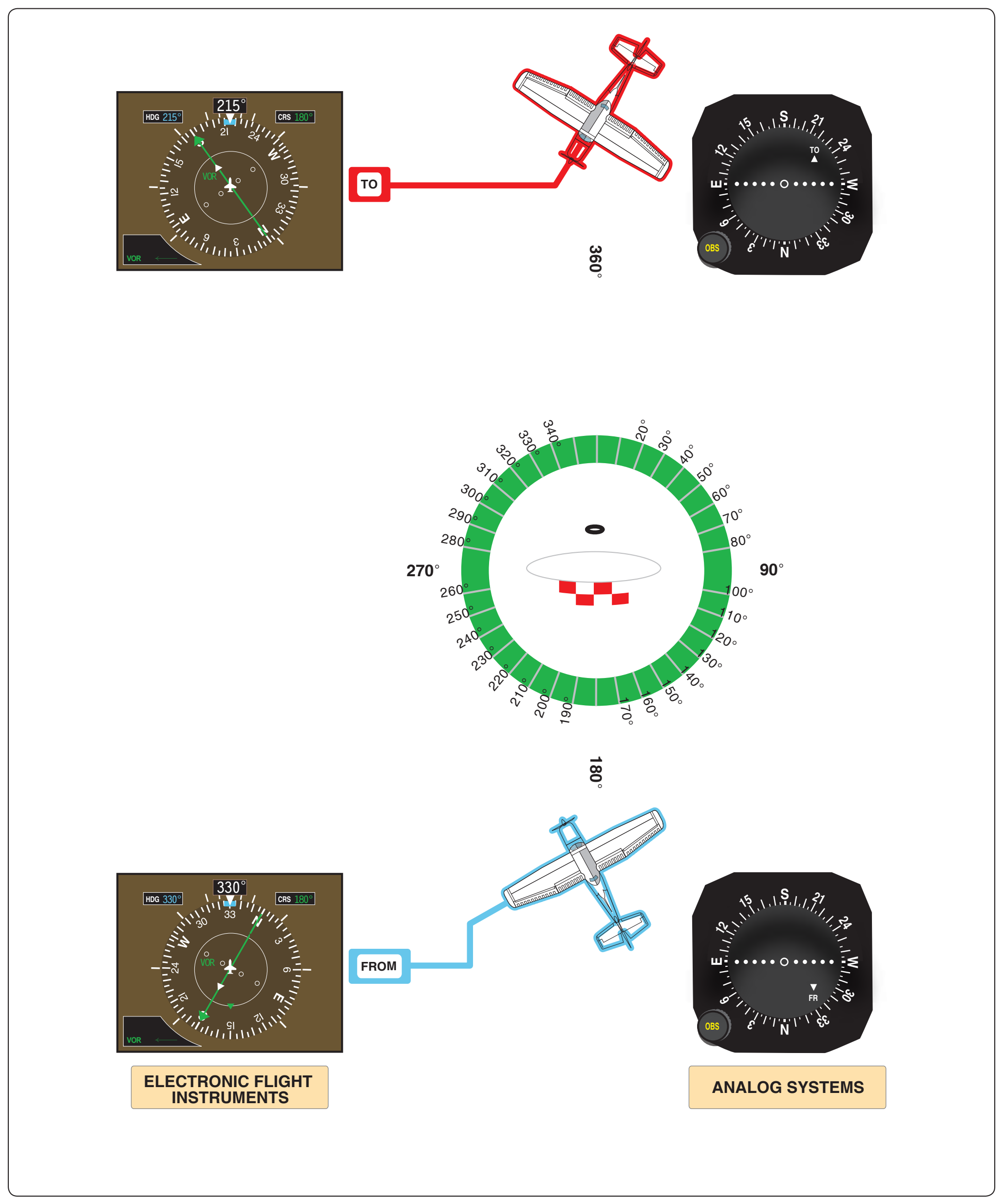
The CDI in Figure 9-15 indicates 180°, meaning that the aircraft is on the 180° or the 360° radial of the station. The TO/FROM indicator resolves the ambiguity. If the TO indicator is showing, then it is 180° TO the station. The FROM indication indicates the radial of the station the aircraft is presently on. Movement of the CDI from center, if it occurs at a relatively constant rate, indicates the aircraft is moving or drifting off the 180°/360° line. If the movement is rapid or fluctuating, this is an indication of impending station passage (the aircraft is near the station). To determine the aircraft’s position relative to the station, rotate the OBS until FROM appears in the window, and then center the CDI needle. The index indicates the VOR radial where the aircraft is located. The inbound (to the station) course is the reciprocal of the radial.
If the VOR is set to the reciprocal of the intended course, the CDI reflects reverse sensing. To correct for needle deflection, turn away from the needle. To avoid this reverse sensing situation, set the VOR to agree with the intended course.
A single NAVAID allows a pilot to determine the aircraft’s position relative to a radial. Indications from a second NAVAID are needed in order to narrow the aircraft’s position down to an exact location on this radial.
Tracking TO and FROM the Station
To track to the station, rotate the OBS until TO appears, then center the CDI. Fly the course indicated by the index. If the CDI moves off center to the left, follow the needle by correcting course to the left, beginning with a 20° correction.
When flying the course indicated on the index, a left deflection of the needle indicates a crosswind component from the left. If the amount of correction brings the needle back to center, decrease the left course correction by half. If the CDI moves left or right now, it should do so much more slowly, and smaller heading corrections can be made for the next iteration.
Keeping the CDI centered takes the aircraft to the station. To track to the station, the OBS value at the index is not changed. To home to the station, the CDI needle is periodically centered, and the new course under the index is used for the aircraft heading. Homing follows a circuitous route to the station, just as with ADF homing.
To track FROM the station on a VOR radial, you should first orient the aircraft’s location with respect to the station and the desired outbound track by centering the CDI needle with a FROM indication. The track is intercepted by either flying over the station or establishing an intercept heading. The magnetic course of the desired radial is entered under the index using the OBS and the intercept heading held until the CDI centers. Then the procedure for tracking to the station is used to fly outbound on the specified radial.