
Chapter 9
Navigation Systems
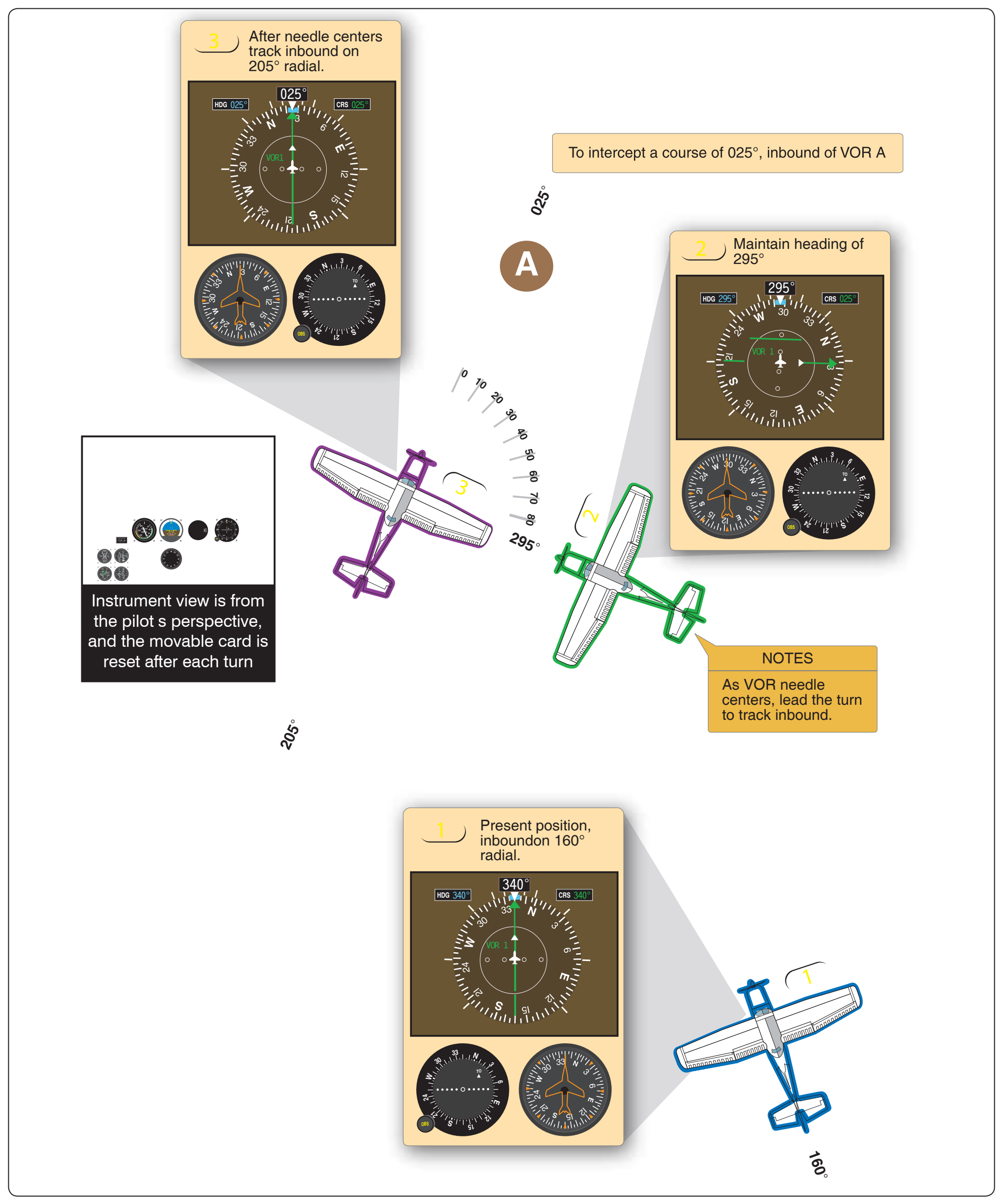
If the desired course is not the one being flown, first orient the aircraft’s position with respect to the VOR station and the course to be flown, and then establish an intercept heading. The following steps may be used to intercept a predetermined course, either inbound or outbound. Steps 1–3 may be omitted when turning directly to intercept the course without initially turning to parallel the desired course.
- Determine the difference between the radial to be intercepted and the radial on which the aircraft is located (205° – 160° = 045°).
- Double the difference to determine the interception angle, which will not be less than 20° nor greater than 90° (45° 2 = 090°). 205° + 090° = 295° for the intercept).
- Rotate the OBS to the desired radial or inbound course.
- Turn to the interception heading.
- Hold this heading constant until the CDI center, which indicates the aircraft is on course. (With practice in judging the varying rates of closure with the course centerline, pilots learn to lead the turn to prevent overshooting the course.)
- Turn to the MH corresponding to the selected course, and follow tracking procedures inbound or outbound.
Course interception is illustrated in Figure 9-16.
VOR Operational Errors
Typical pilot-induced errors include:
- Careless tuning and identification of station.
- Failure to check receiver for accuracy/sensitivity.
- Turning in the wrong direction during an orientation. This error is common until visualizing position rather than heading.
- Failure to check the ambiguity (TO/FROM) indicator, particularly during course reversals, resulting in reverse sensing and corrections in the wrong direction.
- Failure to parallel the desired radial on a track interception problem. Without this step, orientation to the desired radial can be confusing. Since pilots think in terms of left and right of course, aligning the aircraft position to the radial/course is essential.
- Overshooting and undershooting radials on interception problems.
- Overcontrolling corrections during tracking, especially close to the station.
- Misinterpretation of station passage. On VOR receivers not equipped with an ON/OFF flag, a voice transmission on the combined communication and navigation radio (NAV/COM) in use for VOR may cause the same TO/FROM fluctuations on the ambiguity meter as shown during station passage. Read the whole receiver—TO/FROM, CDI, and OBS—before you make a decision. Do not utilize a VOR reading observed while transmitting.
- Chasing the CDI, resulting in homing instead of tracking. Careless heading control and failure to bracket wind corrections make this error common.
VOR Accuracy
The effectiveness of the VOR depends upon proper use and adjustment of both ground and airborne equipment.
The accuracy of course alignment of the VOR is generally plus or minus 1°. On some VORs, minor course roughness may be observed, evidenced by course needle or brief flag alarm. At a few stations, usually in mountainous terrain, the pilot may occasionally observe a brief course needle oscillation similar to the indication of “approaching station.” Pilots flying over unfamiliar routes are cautioned to be on the alert for these vagaries, and in particular, to use the TO/FROM indicator to determine positive station passage.
Certain propeller revolutions per minute (rpm) settings or helicopter rotor speeds can cause the VOR CDI to fluctuate as much as plus or minus 6°. Slight changes to the RPM setting normally smooths out this roughness. Pilots are urged to check for this modulation phenomenon prior to reporting a VOR station or aircraft equipment for unsatisfactory operation.
VOR Receiver Accuracy Check
VOR system course sensitivity may be checked by noting the number of degrees of change as the OBS is rotated to move the CDI from center to the last dot on either side. The course selected should not exceed 10° or 12° either side. In addition, Title 14 of the Code of Federal Regulations (14 CFR) part 91 provides for certain VOR equipment accuracy checks, and an appropriate endorsement, within 30 days prior to flight under IFR. To comply with this requirement and to ensure satisfactory operation of the airborne system, use the following means for checking VOR receiver accuracy:
- VOR test facility (VOT) or a radiated test signal from an appropriately rated radio repair station.
- Certified checkpoints on the airport surface.
- Certified airborne checkpoints.
VOR Test Facility (VOT)
The Federal Aviation Administration (FAA) VOT transmits a test signal that provides users a convenient means to determine the operational status and accuracy of a VOR receiver while on the ground where a VOT is located. Locations of VOTs are published in the A/FD. Two means of identification are used: one is a series of dots and the other is a continuous tone. Information concerning an individual test signal can be obtained from the local flight service station (FSS.) The airborne use of VOT is permitted; however, its use is strictly limited to those areas/altitudes specifically authorized in the A/FD or appropriate supplement.
To use the VOT service, tune in the VOT frequency 108.0 MHz on the VOR receiver. With the CDI centered, the OBS should read 0° with the TO/FROM indication showing FROM or the OBS should read 180° with the TO/FROM indication showing TO. Should the VOR receiver operate an RMI, it would indicate 180° on any OBS setting.
A radiated VOT from an appropriately rated radio repair station serves the same purpose as an FAA VOT signal, and the check is made in much the same manner as a VOT with some differences.
The frequency normally approved by the Federal Communications Commission (FCC) is 108.0 MHz; however, repair stations are not permitted to radiate the VOR test signal continuously. The owner or operator of the aircraft must make arrangements with the repair station to have the test signal transmitted. A representative of the repair station must make an entry into the aircraft logbook or other permanent record certifying to the radial accuracy and the date of transmission.