
Chapter 1
Departure Procedures
A radar departure is another option for departing an airport on an IFR flight. You might receive a radar departure if the airport does not have an established departure procedure, if you are unable to comply with a departure procedure, or if you request “No SIDs” as a part of your flight plan. Expect ATC to issue an initial departure heading if you are being radar vectored after takeoff; however, do not expect to be given a purpose for the specific vector heading. Rest assured that the controller knows your flight route and will vector you into position. By nature of the departure type, once you are issued your clearance, the responsibility for coordination of your flight rests with ATC, including the tower controller and, after handoff, the departure controller who will remain with you until you are released on course and allowed to “resume own navigation.”
For all practical purposes, a radar departure is the easiest type of departure to use. It is also a good alternative to a published departure procedure, particularly when none of the available departure procedures are conducive to your flight route. However, it is advisable to always maintain a detailed awareness of your location while you are being radar vectored by ATC. If for some reason radar contact is lost, you will be asked to provide position reports in order for ATC to monitor your flight progress. Also, ATC may release you to “resume own navigation” after vectoring you off course momentarily for a variety of reasons, including weather or traffic.
Upon initial contact, state your aircraft or flight number, the altitude you are climbing through, and the altitude to which you are climbing. The controller will verify that your reported altitude matches that emitted by your transponder. If your altitude does not match, or if you do not have Mode C capabilities, you will be continually required to report your position and altitude for ATC.
The controller is not required to provide terrain and obstacle clearance just because ATC has radar contact with your aircraft. It remains your responsibility until the controller begins to provide navigational guidance in the form of radar vectors. Once radar vectors are given, you are expected to promptly comply with headings and altitudes as assigned. Question any assigned heading if you believe it to be incorrect or if it would cause a violation of a regulation, then advise ATC immediately and obtain a revised clearance.
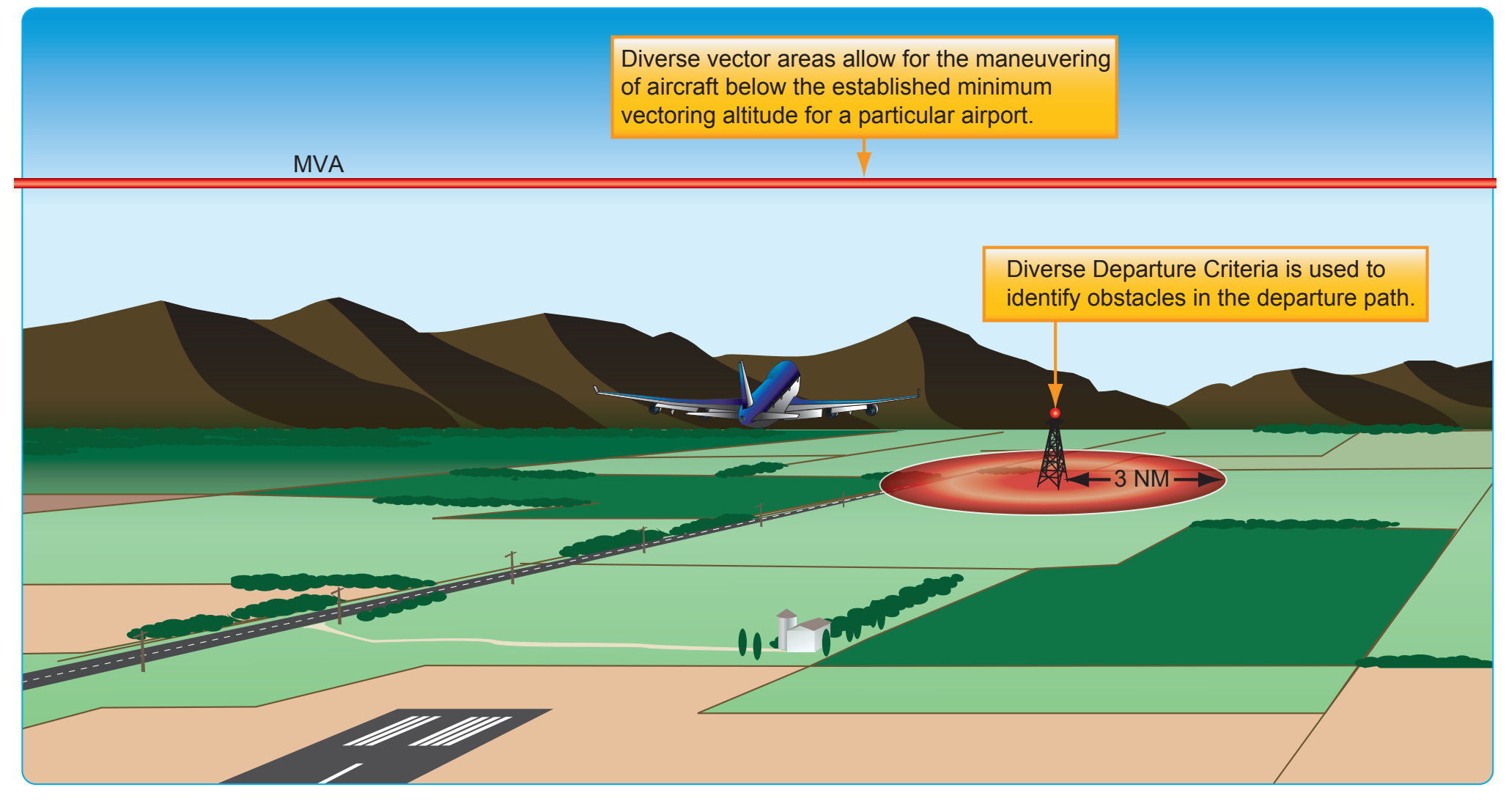
Diverse Vector Area
ATC may establish a minimum vectoring altitude (MVA) around certain airports. This altitude, based on terrain and obstruction clearance, provides controllers with minimum altitudes to vector aircraft in and around a particular location. However, at times, it may be necessary to vector aircraft below this altitude to assist in the efficient flow of departing traffic. For this reason, an airport may have an established Diverse Vector Area (DVA). This DVA may be established below the MVA or Minimum IFR Altitude (MIA) in a radar environment at the request of Air Traffic. This type of DP meets the TERPs criteria for diverse departures, obstacles and terrain avoidance in which random radar vectors below the MVA/MIA may be issued to departing traffic.
The existence of a DVA will be noted in the Takeoff Minimums and Obstacle Departure Procedures section of the U.S. Terminal Procedure Publication (TPP). The Takeoff Departure procedure will be listed first, followed by any applicable DVA. Pilots should be aware that Air Traffic facilities may utilize a climb gradient greater than the standard 200 ft/NM within a DVA. This information will be identified in the DVA text for pilot evaluation against the aircraft's performance. Pilots should note that the DVA has been assessed for departures which do not follow a specified ground track, but will remain within the specified area. ATC may also vector an aircraft off a previously assigned DP. In all cases, the minimum 200 ft/NM climb gradient is assumed unless a higher is specified on the departure, and obstacle clearance is not provided by ATC until the controller begins to provide navigational guidance (vectors). Lastly, pilots should understand ATC instructions take precedence over an ODP [Figure 1-35].
Visual Climb Over Airport (VCOA)
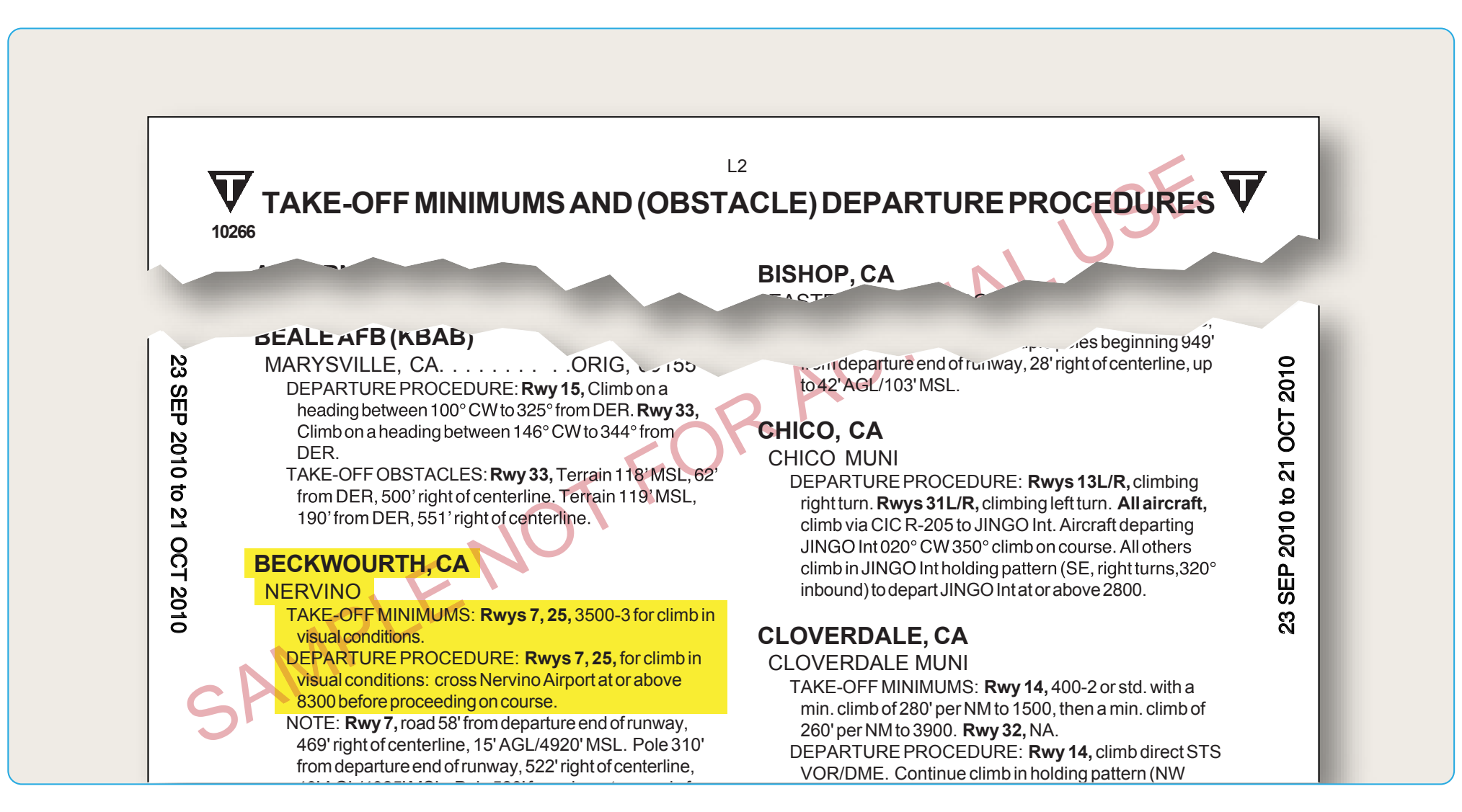
A visual climb over airport (VCOA) is a departure option for an IFR aircraft, operating in VMC equal to or greater than the specified visibility and ceiling, to visually conduct climbing turns over the airport to the published "climb-to" altitude from which to proceed with the instrument portion of the departure. A VCOA is a departure option developed when obstacles farther than 3 SM from the airport require a CG of more than 200 ft/NM.
These procedures are published in the Take-Off Minimums and (Obstacle) Departure Procedures section of the TPP. [Figure 1-36] Prior to departure, pilots are required to notify ATC when executing the VCOA.
Noise Abatement Procedures
As the aviation industry continues to grow and air traffic increases, so does the population of people and businesses around airports. As a result, noise abatement procedures have become commonplace at most of the nation’s airports. 14 CFR Part 150 specifies the responsibilities of the FAA to investigate the recommendations of the airport operator in a noise compatibility program and approve or disapprove the noise abatement suggestions. This is a crucial step in ensuring that the airport is not unduly inhibited by noise requirements and that air traffic workload and efficiency are not significantly impacted, all while considering the noise problems addressed by the surrounding community.
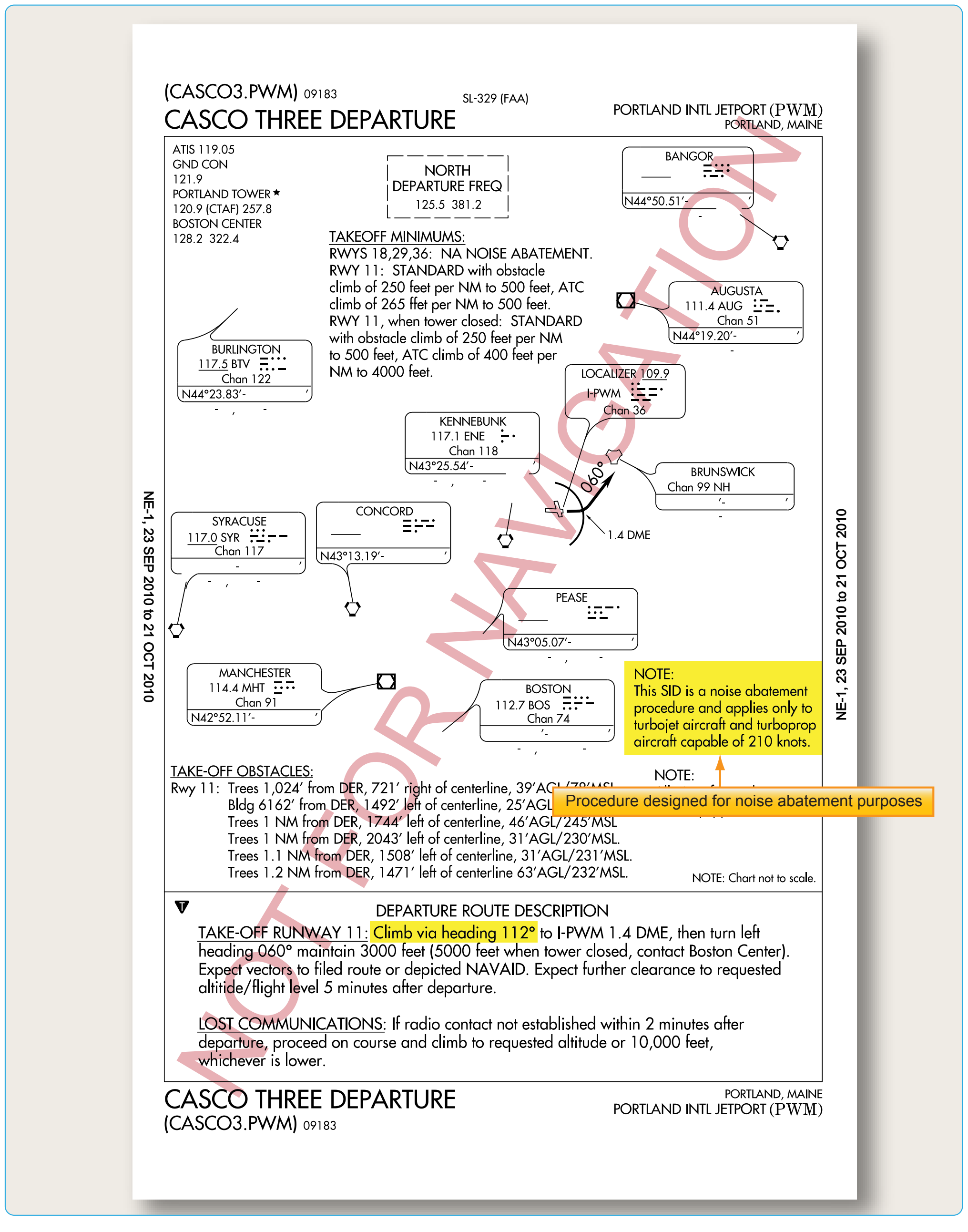
While most DPs are designed for obstacle clearance and workload reduction, there are some SIDs that are developed solely to comply with noise abatement requirements. Portland International Jetport is an example of an airport where a SID was created strictly for noise abatement purposes as noted in the DP. [Figure 1-36] Typically, noise restrictions are incorporated into the main body of the SID. These types of restrictions require higher departure altitudes, larger climb gradients, reduced airspeeds, and turns to avoid specific areas. Noise restrictions may also be evident during a radar departure. ATC may require you to turn away from your intended course or vector you around a particular area. While these restrictions may seem burdensome, it is important to remember that it is your duty to comply with written and spoken requests from ATC.
Additionally, when required, departure instructions specify the actual heading to be flown after takeoff, as is the case in Figure 1-37 under the departure route description, “Climb via heading 112 degrees...” Some existing procedures specify, “Climb runway heading.” Over time, both of these departure instructions will be updated to read, “Climb heading 112 degrees....” Runway heading is the magnetic direction that corresponds with the runway centerline extended (charted on the airport diagram), not the numbers painted on the runway. Pilots cleared to “fly or maintain runway heading” are expected to fly or maintain the published heading that corresponds with the extended centerline of the departure runway (until otherwise instructed by ATC), and are not to apply drift correction (e.g., RWY 11, actual magnetic heading of the runway centerline 112.2 degrees, “fly heading 112 degrees”). In the event of parallel departures, this prevents a loss of separation caused by only one aircraft applying a wind drift.
Procedural Notes
An important consideration to make during your flight planning is whether or not you are able to fly your chosen departure procedure as charted.