
Chapter 1
Departure Procedures
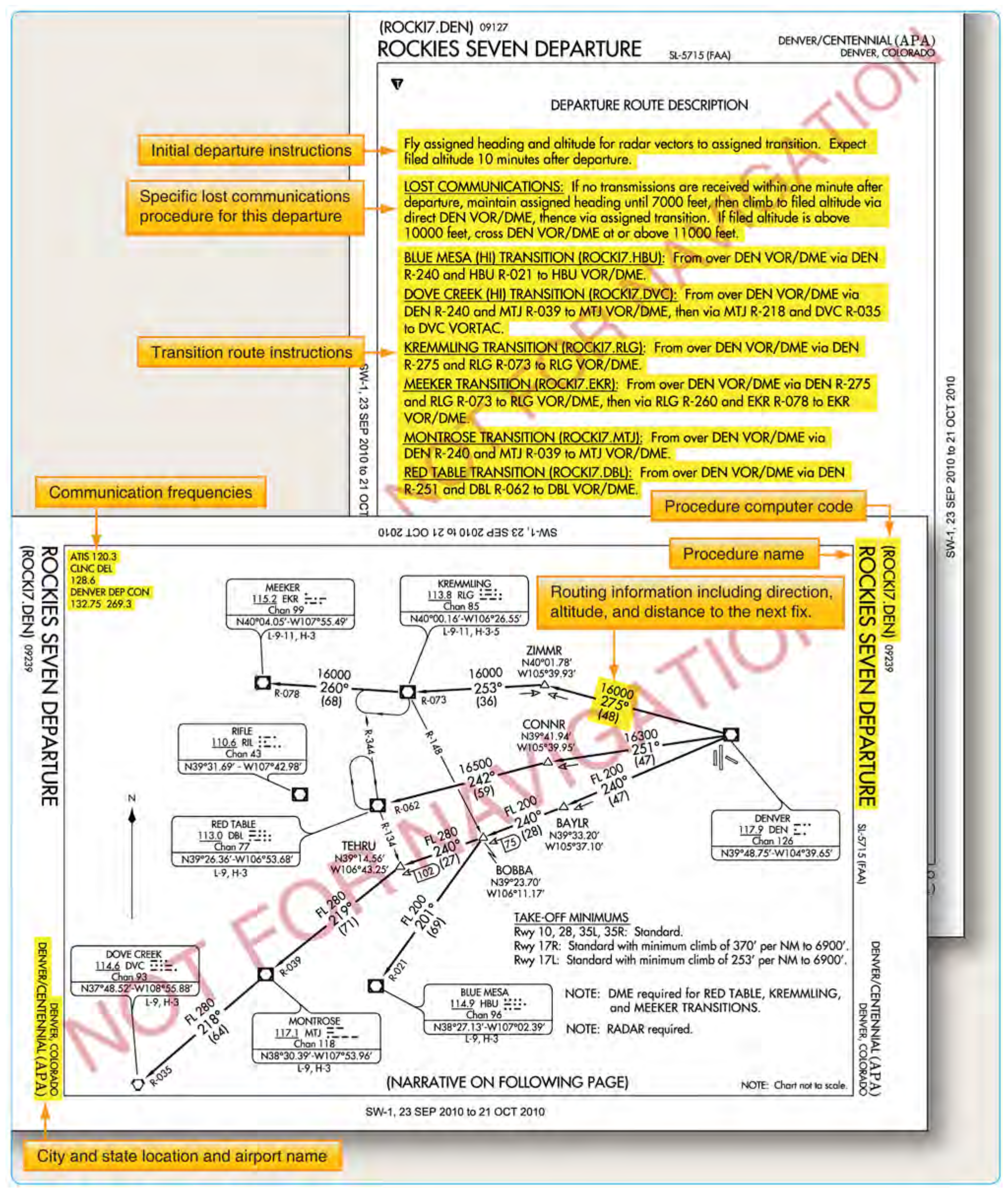
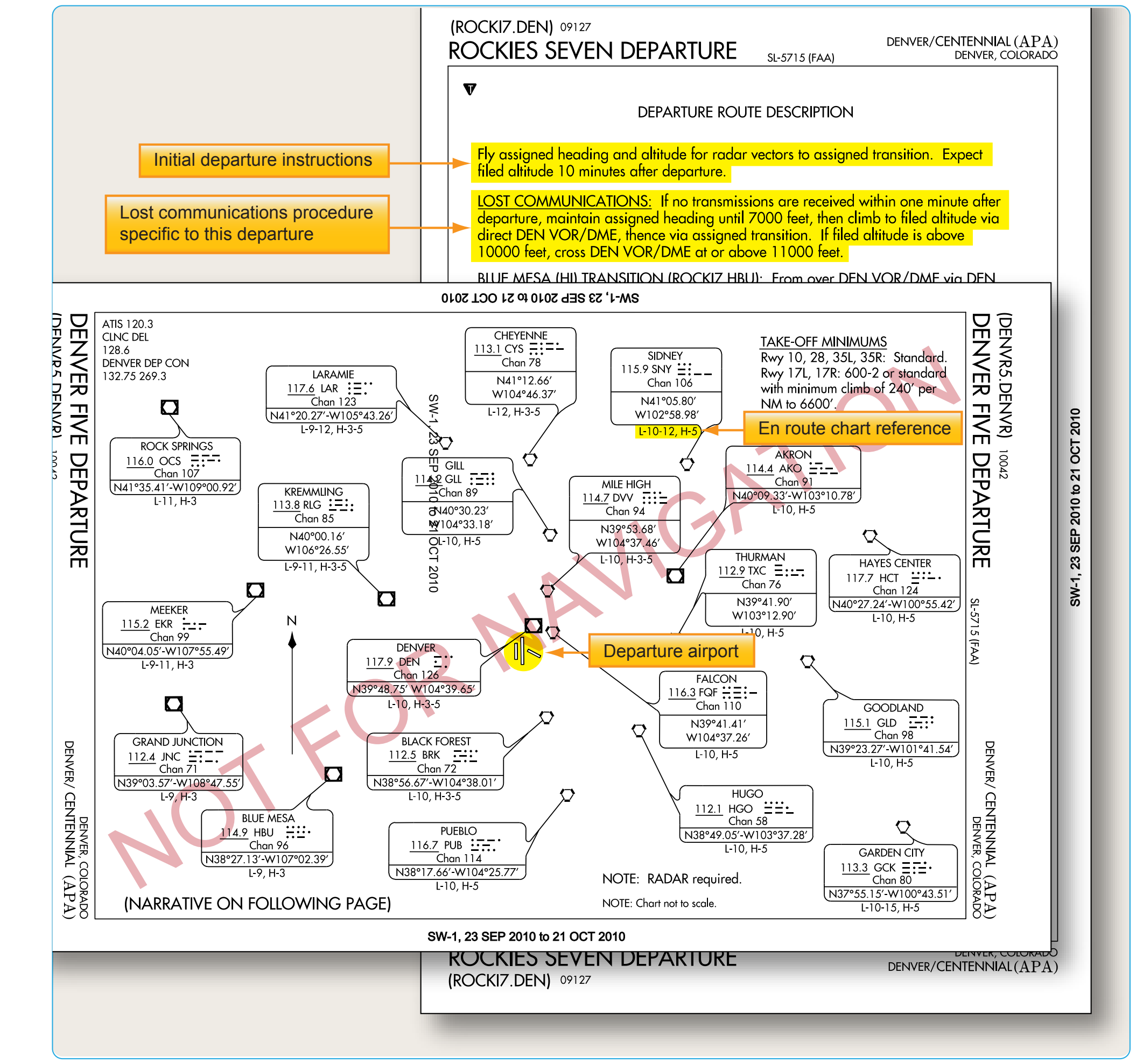
SID Flight Planning Considerations
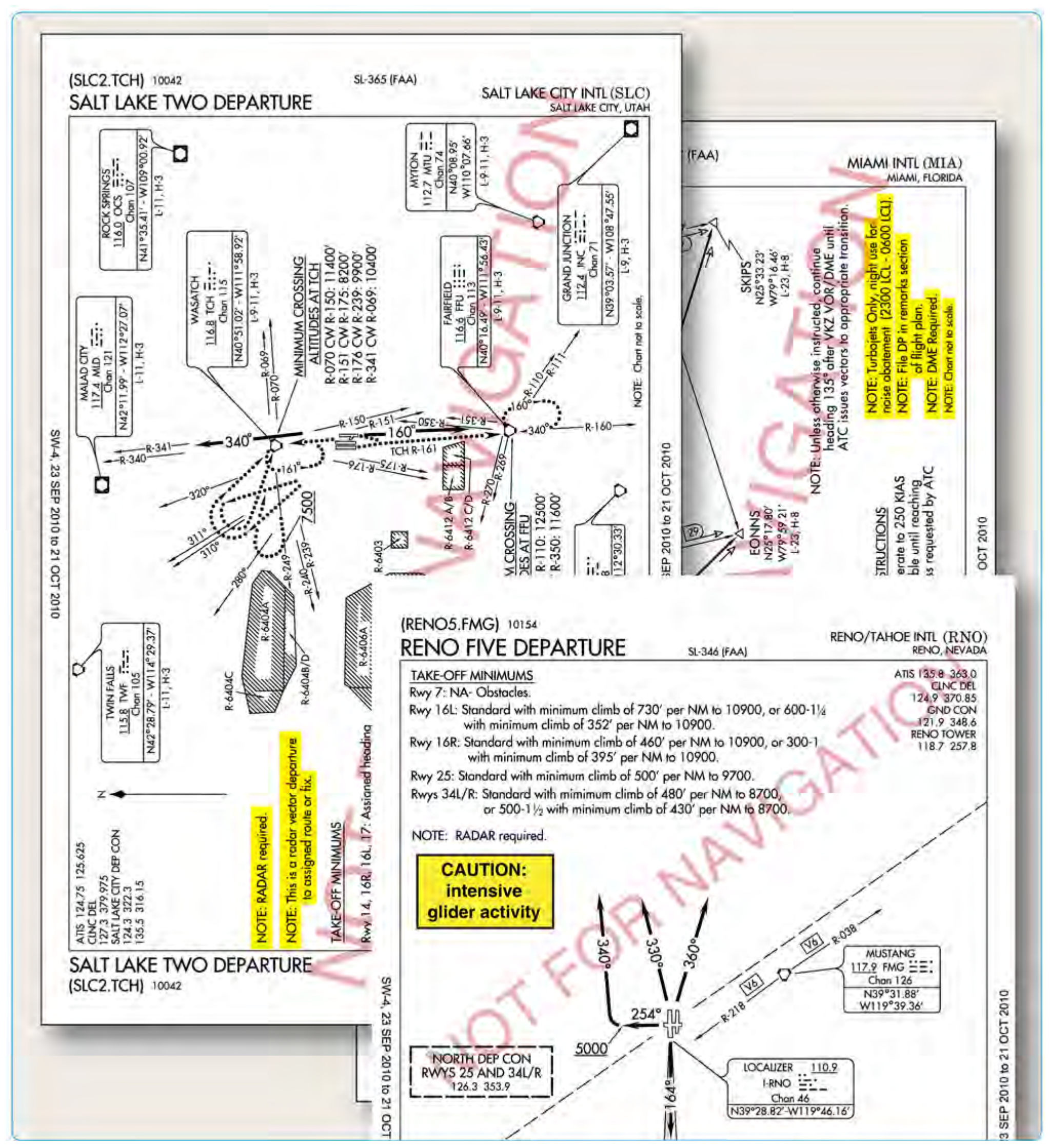
Take into consideration the departure paths included in the SIDs, and determine if you can use a standardized departure procedure. You have the opportunity to choose the SID that best suits your flight plan. During the flight planning phase, you can investigate each departure, and determine which procedure allows you to depart the airport in the direction of your intended flight. Also consider how a climb gradient to a specific altitude affects the climb time and fuel burn portions of the flight plan. Notes giving procedural requirements are listed on the graphic portion of a departure procedure, and they are mandatory in nature. [Figure 1-26] Mandatory procedural notes may include:
- Aircraft equipment requirements (DME, ADF, etc.)
- ATC equipment in operation (radar)
- Minimum climb requirements
- Restrictions for specific types of aircraft (turbojet only)
- Limited use to certain destinations
Cautionary statements may also be included on the procedure to notify you of specific activity, but these are strictly advisory. [Figure 1-26] If you are unable to comply with a specific requirement, you must not file the procedure as part of your flight plan. If ATC assigns you a SID, you may need to quickly recalculate your all-engines-operating performance numbers. If you cannot comply with the climb gradient in the SID, you should not accept a clearance for that SID and furthermore, you must not accept the procedure if ATC assigns it.
A clearance for a SID which contains published altitude restrictions may be issued using the phraseology “climb via.” Climb via is an abbreviated clearance that requires compliance with the procedure lateral path, associated speed and altitude restrictions along the cleared route or procedure. Expanded procedures for "Climb via" can be found in the AIM.
ATC can assign SIDs or radar vectors as necessary for traffic management and convenience. To fly a SID, you must receive approval to do so in a clearance. In order to accept a clearance that includes a SID, you must have the charted SID procedure in your possession at the time of departure. It is your responsibility as pilot in command to accept or reject the issuance of a SID by ATC. You must accept or reject the clearance based on:
- The ability to comply with the required performance.
- The ability to navigate to the degree of accuracy required for the procedure.
- Possession of the charted SID procedure.
- Personal understanding of the SID in its entirety.
When you accept a clearance to depart using a SID or radar vectors, ATC is responsible for traffic separation. When departing with a SID, ATC expects you to fly the procedure as charted because the procedure design considers obstacle clearance. It is also expected that you will remain vigilant in scanning for traffic when departing in visual conditions. Furthermore, it is your responsibility to notify ATC if your clearance would endanger your safety or the safety of others. DPs are also categorized by equipment requirements as follows:
- Non-RNAV DP—established for aircraft equipped with conventional avionics using ground-based NAVAIDs. These DPs may also be designed using dead reckoning navigation. Some flight management systems (FMS) are certified to fly a non-RNAV DP if the FMS unit accepts inputs from conventional avionics sources, such as DME, VOR, and localizer (LOC). These inputs include radio tuning and may be applied to a navigation solution one at a time or in combination. Some FMS provide for the detection and isolation of faulty navigation information.
- RNAV DP—established for aircraft equipped with RNAV avionics (e.g., GPS, VOR/DME, DME/DME). Automated vertical navigation is not required, and all RNAV procedures not requiring GPS must be annotated with the note: “RADAR REQUIRED.” Prior to using TSO-C129 GPS equipment for RNAV departures, approach receiver autonomous integrity monitoring (RAIM) availability should be checked for that location.
- Radar DP—radar may be used for navigation guidance for SID design. Radar SIDs are established when ATC has a need to vector aircraft on departure to a particular ATS Route, NAVAID, or fix. A fix may be a ground-based NAVAID, a waypoint, or defined by reference to one or more radio NAVAIDs. Not all fixes are waypoints since a fix could be a VOR or VOR/DME, but all waypoints are fixes. Radar vectors may also be used to join conventional or RNAV navigation SIDs. SIDs requiring radar vectors must be annotated “RADAR REQUIRED.”
Area Navigation (RNAV) Departures
Historically, departure procedures were built around existing ground-based technology and were typically designed to accommodate lower traffic volumes. Often, departure and arrival routes use the same NAVAIDs creating interdependent, capacity diminishing routes. RNAV is a method of navigation that permits aircraft operation on any desired flight path within the coverage of ground- or spaced- based NAVAIDs or within the limits of the capability of self-contained aids or a combination of these. In the future, there will be an increased dependence on the use of RNAV in lieu of routes defined by ground-based NAVAIDs. As a part of the evolving RNAV structure, the FAA has developed departure procedures for pilots flying aircraft equipped with some type of RNAV technology. RNAV allows for the creation of new departure routes that are independent of present fixes and NAVAIDs. RNAV routing is part of the National Airspace Redesign (NAR) and is expected to reduce complexity and increase efficiency of terminal airspace.
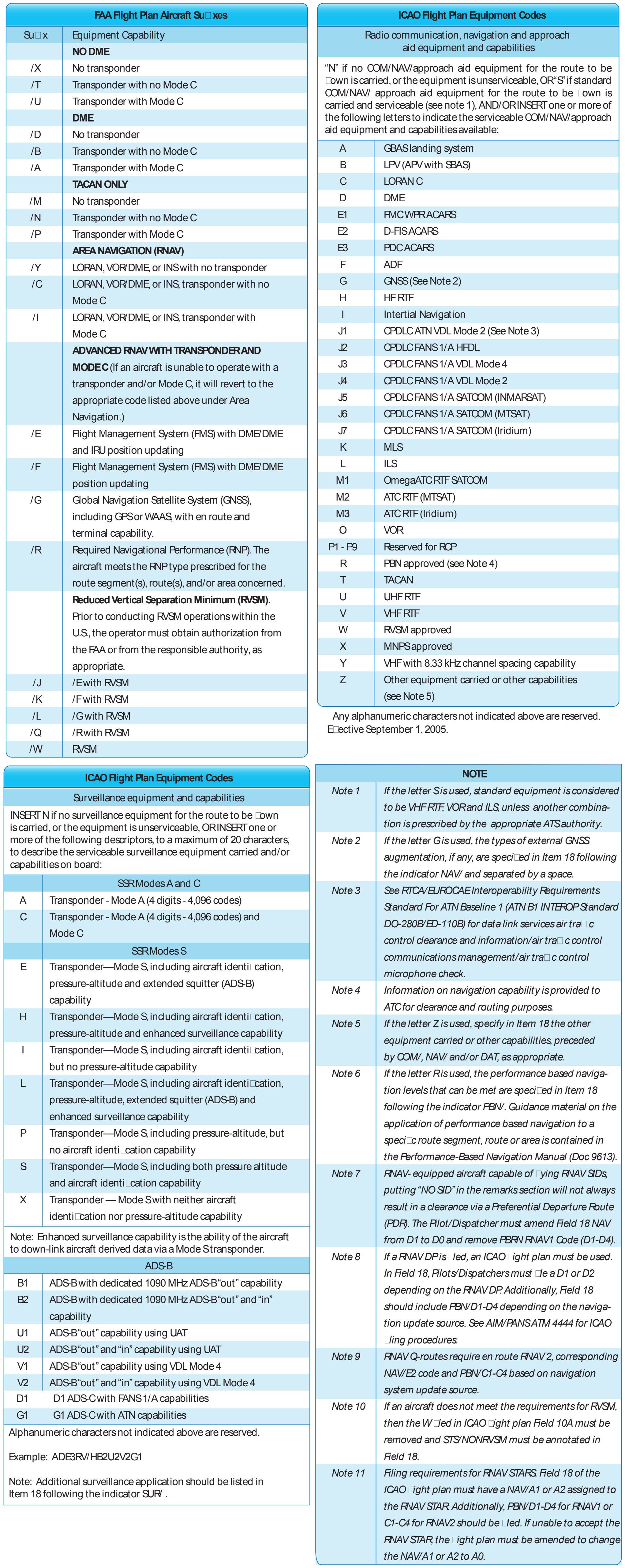
When new RNAV departure procedures are designed, they will require minimal vectoring and communications between pilots and ATC. Usually, each departure procedure includes position, time, and altitude, which increase the ability to predict what the pilot will actually do. RNAV departure procedures have the ability to increase the capacity of terminal airspace by increasing on-time departures, airspace utilization, and improved predictability.
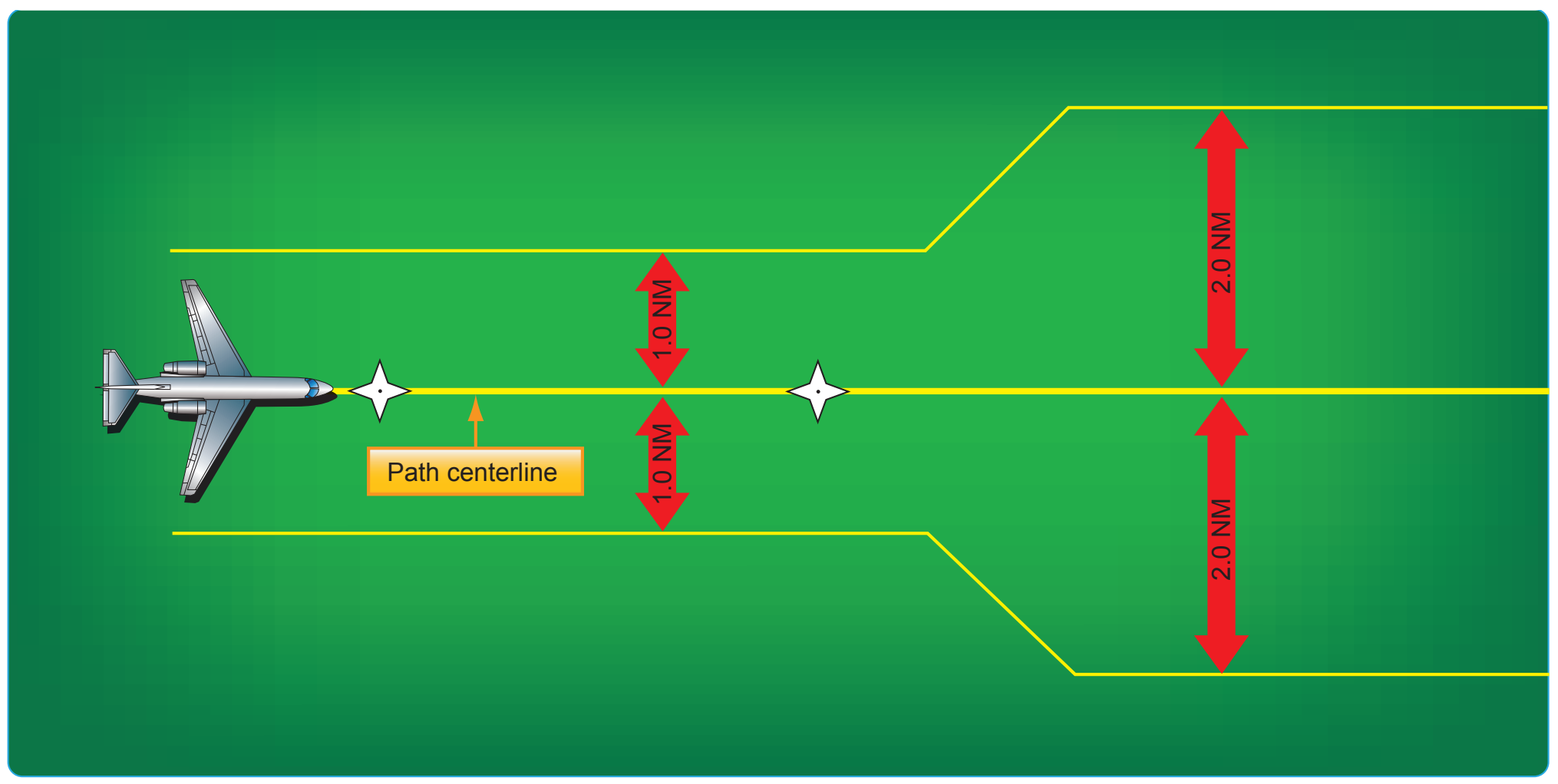
All public RNAV SIDs and graphic ODPs are RNAV 1. These procedures generally start with an initial RNAV or heading leg near the departure end runway. In addition, these procedures require system performance currently met by GPS, DME/DME/Inertial Reference Unit (IRU) RNAV systems that satisfy the criteria discussed in AC 90-100, U.S. Terminal and En Route Area Navigation (RNAV) Operations. RNAV departures are identifiable by the inclusion of the term RNAV in the title of the departure. From a required navigation performance (RNP) standpoint, RNAV departure routes are designed with 1 or 2 NM performance standards as listed below. This means you as the pilot and your aircraft equipment must be able to maintain the aircraft within 1 or 2 NM either side of route centerline. [Figure 1-27]
- RNAV 1 procedures require that the aircraft’s total system error remain bounded by ±1 NM for 95 percent of the total flight time.
- RNAV 2 requires a total system error of not more than 2 NM for 95 percent of the total flight time.
RNP is RNAV with on-board monitoring and alerting; RNP is also a statement of navigation performance necessary for operation within defined airspace. RNP 1 (in-lieu-of RNAV