Chapter 1
Departure Procedures
- is used when a DP that contains a constant radius to a fix (RF) leg or when surveillance (radar) monitoring is not desired for when DME/DME/IRU is used. These procedures are annotated with a standard note: “RNP 1.”
If unable to comply with the requirements of an RNAV or RNP procedure, pilots need to advise ATC as soon as possible. For example, “N1234, failure of GPS system, unable RNAV, request amended clearance.” Pilots are not authorized to fly a published RNAV or RNP procedure unless it is retrievable by the procedure name from the navigation database and conforms to the charted procedure. No other modification of database waypoints or creation of user-defined waypoints on published RNAV or RNP procedures is permitted, except to change altitude and/or airspeed waypoint constraints to comply with an ATC clearance/instruction, or to insert a waypoint along the published route to assist in complying with an ATC instruction. For example, “Climb via the WILIT departure except cross 30 north of CHUCK at/ or above FL 210.” This is limited only to systems that allow along track waypoint construction.
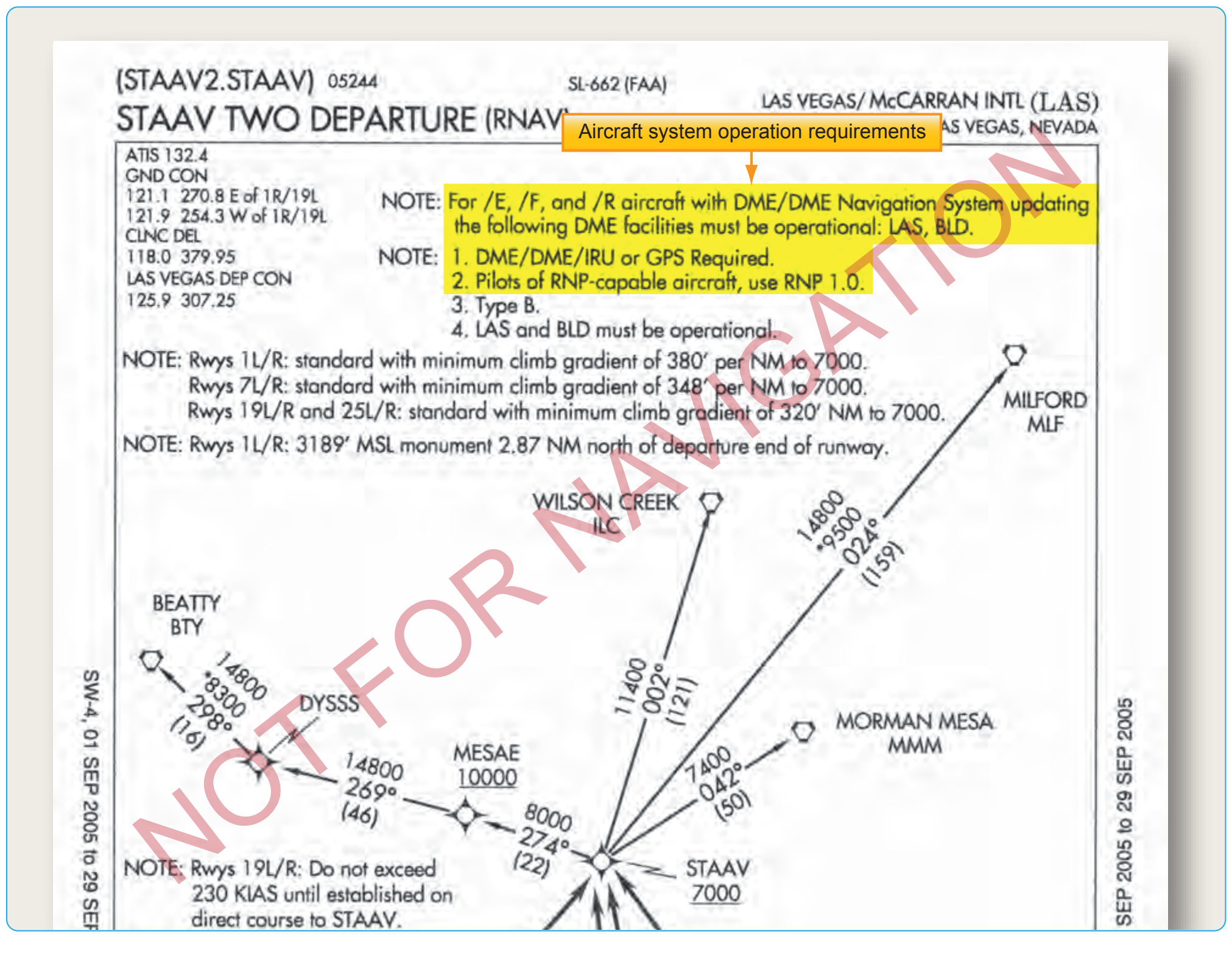
Pilots of aircraft utilizing DME/DME for primary navigation updating should ensure any required DME stations are in service as determined by NOTAM, ATIS, or ATC advisory. DME/DME navigation system updating may require specific DME facilities to meet performance standards. Based on DME availability evaluations at the time of publication, current DME coverage is not sufficient to support DME/DME RNAV operations everywhere without IRU augmentation or use of GPS. [Figure 1-28] DP chart notes may also include operational information for certain types of equipment, systems, and performance requirements, in addition to the type of RNAV departure procedure.
While operating on RNAV segments, pilots are encouraged to use the flight director in lateral navigation mode. RNAV terminal procedures may be amended by ATC issuing radar vectors and/or clearances direct to a waypoint. Pilots should avoid premature manual deletion of waypoints from their active “legs” page to allow for rejoining procedures. While operating on RNAV segments, pilots operating /R aircraft should adhere to any flight manual limitation or operating procedure required to maintain the RNP value specified for the procedure. In 2008, the FAA implemented the use of en route host automation ICAO flight plan (FP) processing for requesting assignment of RNAV SID, Standard Terminal Arrivals (STARs), or RNAV routes U.S. domestic airspace. This is part of a risk reduction strategy for introduction of the En Route Automation Modernization (ERAM) system in October 2008. ERAM also will use ICAO FP processing and as a result aircrews should be aware that as the FAA updates to ERAM the standard FAA flight plan equipment suffix codes will change to the ICAO flight plan equipment suffix codes.
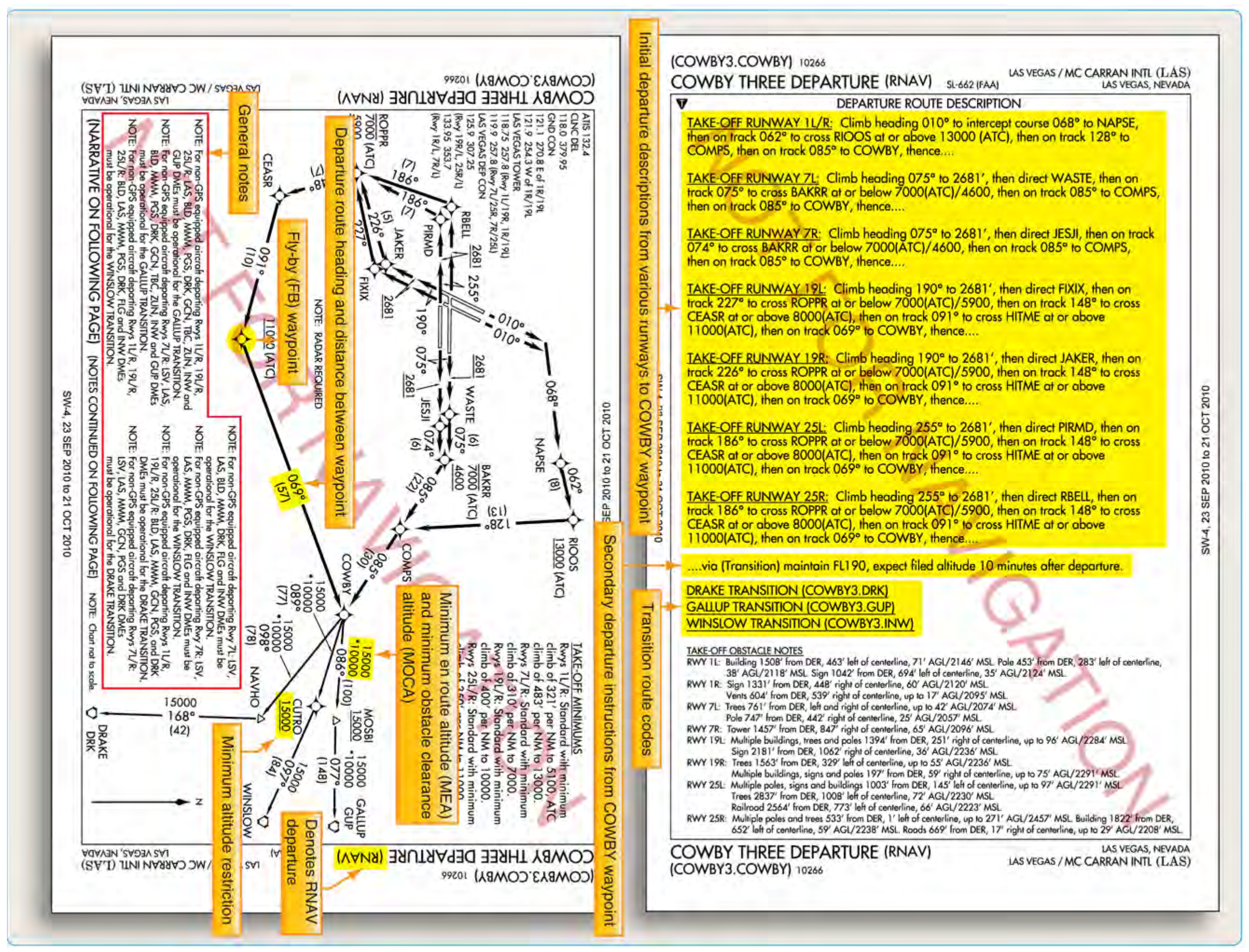
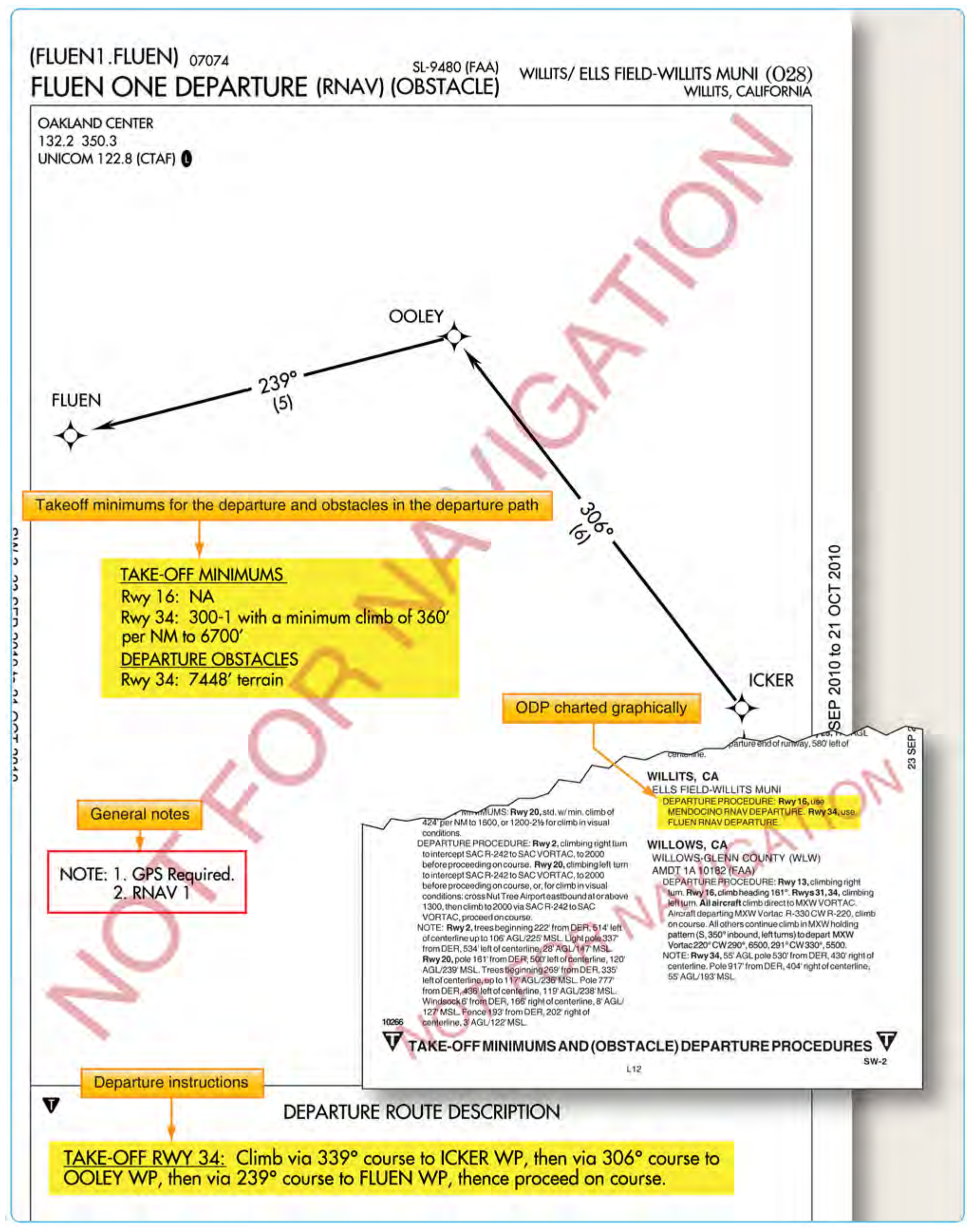
For procedures requiring GPS and/or aircraft approvals requiring GPS, if the navigation system does not automatically alert the flight crew of a loss of GPS, aircraft operators must develop procedures to verify correct GPS operation. If not equipped with GPS, or for multi-sensor systems with GPS that do not alert upon loss of GPS, aircraft must be capable of navigation system updating using DME/DME or DME/DME/ IRU for type 1 and 2 procedures. AC 90-100 may be used as operational guidance for RNAV ODPs. Pilots of FMS-equipped aircraft who are assigned an RNAV DP procedure and subsequently receive a change of runway, transition, or procedure, must verify that the appropriate changes are loaded and available for navigation. [Figures 1-29 and 1-30]
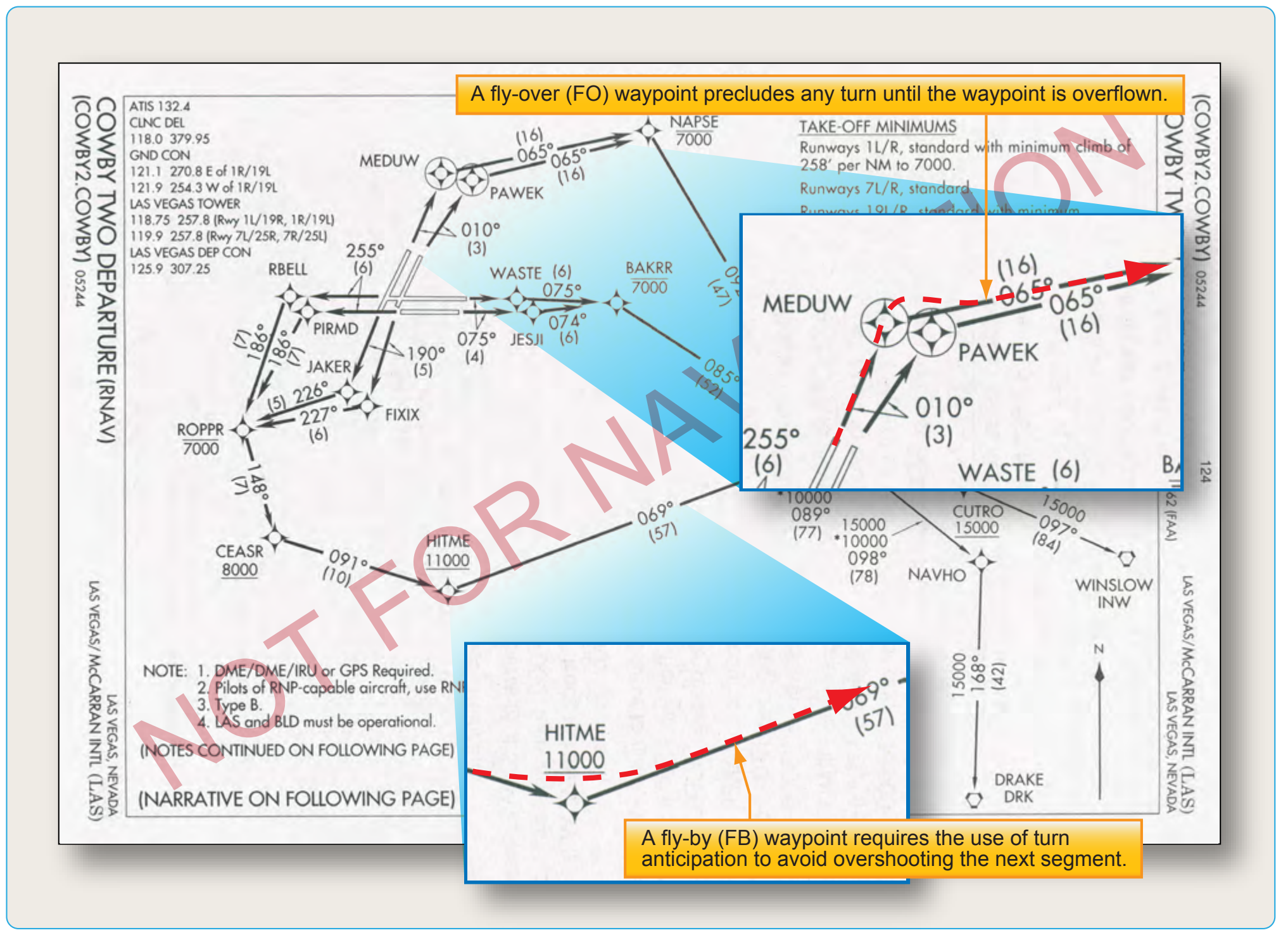
Additionally, new waypoint symbols are used in conjunction with RNAV charts. There are two types of waypoints currently in use: fly-by (FB) and fly-over (FO). A FB waypoint typically is used in a position at which a change in the course of procedure occurs. Charts represent them with four-pointed stars. This type of waypoint is designed to allow you to anticipate and begin your turn prior to reaching the waypoint, thus providing smoother transitions. Conversely, RNAV charts show a FO waypoint as a four-pointed star enclosed in a circle. This type of waypoint is used to denote a missed approach point, a missed approach holding point, or other specific points in space that must be flown over. [Figure 1-31] Pilots should not change any database waypoint type from a FB to FO, or vice versa.
There are specific requirements; however, that must be met before using RNAV procedures. Every RNAV departure chart lists general notes and may include specific equipment and performance requirements, as well as the type of RNAV departure procedure in the chart plan view. New aircraft equipment suffix codes are used to denote capabilities for advanced RNAV navigation for flight plan filing purposes. [Figure 1-32]
SID Altitudes
SID altitudes can be charted in four different ways. The first are mandatory altitudes, the second, minimum altitudes, the third, maximum altitudes and the fourth is a combination of minimum and maximum altitudes or also referred to as block altitudes. Below are examples of how each will be shown on a SID chart.
- Mandatory altitudes – 5500
- Minimum altitudes – 2300
- Maximum altitudes – 3300
- Combination of minimum and maximum – 7000 4600
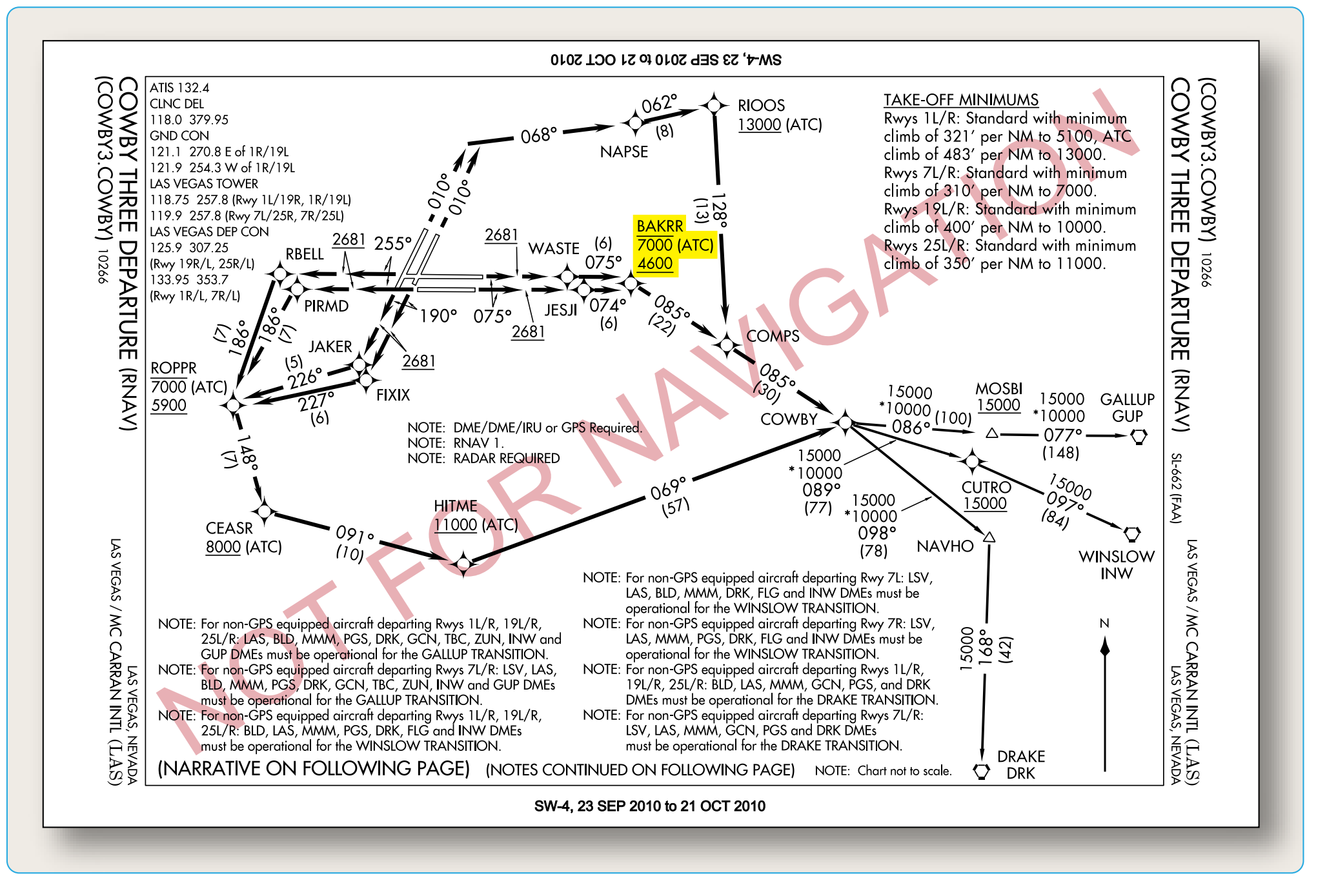
Some SIDs may still have “(ATC)” adjacent to a crossing altitude as shown in Figure 1-33 which implies that the crossing altitude is there to support an ATC requirement. A new charting standard has begun a process to remove, over a period of time, the ATC annotation. The Cowboy Four Departure (RNAV) shown in Figure 1-34 depicts the new charting standard without ATC annotations. When necessary, ATC may amend or delete SID crossing altitude restrictions; when doing so, ATC assumes responsibility for obstacle clearance until the aircraft is re-established laterally and vertically on the published SID route.
Pilot Responsibility for Use of RNAV Departures
RNAV usage brings with it multitudes of complications as it is being implemented. It takes time to transition, to disseminate information, and to educate current and potential users. As a current pilot using the NAS, you need to have a clear understanding of the aircraft equipment requirements for operating in a given RNP environment. You must understand the type of navigation system installed in your aircraft, and furthermore, you must know how your system operates to ensure that you can comply with all RNAV requirements. Operational information should be included in your AFM or its supplements. Additional information concerning how to use your equipment to its fullest capacity, including “how to” training, may be gathered from your avionics manufacturer. If you are in doubt about the operation of your avionics system and its ability to comply with RNAV requirements, contact the FAA directly through your local Flight Standards District Office (FSDO). RNAV departure procedures are being developed at a rapid pace to provide RNAV capabilities at all airports. With every chart revision cycle, new RNAV departures are being added for small and large airports. These departures are flown in the same manner as traditional navigation-based departures; pilots are provided headings, altitudes, navigation waypoint, and departure descriptions. RNAV SIDs are found in the TPP with traditional departure procedures.