
Chapter 3
Arrivals
For STARs based on conventional NAVAIDs, the procedure design and obstacle clearance criteria are essentially the same as that for en route criteria, covered in Chapter 2, En Route Operations. STAR procedures typically include a descent gradient of about 318 ft/NM, or about three degrees. The descent gradient on a STAR will have to vary to meet altitude restrictions, if any, along the particular route. Altitude restrictions are frequently necessary for airspace and air traffic restrictions. The design guidance for a new or revised STAR is in FAA Order 8260.3, published in March 2016. Some published STARs were designed under the previous guidance in FAA Order JO 7110.9. The new guidance requires a more shallow descent gradient for the last part of the STAR. In addition to descent gradients, STARs allow for deceleration segments at any waypoint that has a speed restriction. As a general guideline, deceleration considerations typically add 1 NM of distance for each 10 knots of speed reduction required.
RNAV STARs or STAR Transitions
STARs designated RNAV serve the same purpose as conventional STARs, but are only used by aircraft equipped with FMS or GPS. An RNAV STAR or STAR transition typically includes flyby waypoints, with fly over waypoints used only when operationally required. These waypoints may be assigned crossing altitudes and speeds to optimize the descent and deceleration profiles. RNAV STARs often are designed, coordinated, and approved by a joint effort between air carriers, commercial operators, and the ATC facilities that have jurisdiction for the affected airspace.
RNAV STAR procedure design, such as minimum leg length, maximum turn angles, obstacle assessment criteria, including widths of the primary and secondary areas, use similar design criteria as other RNAV procedures. Likewise, RNAV STAR procedures are designated as either RNAV 1 or RNAV 2, based on the aircraft navigation equipment required, flight crew procedures, and the process and criteria used to develop the STAR. The RNAV 1 or RNAV 2 designation appears in the notes on the chart. RNAV 1 STARs have higher equipment requirements and, often, tighter required navigation performance (RNP) tolerances than RNAV 2. For RNAV 1 STARS, pilots are required to use a course deviation indicator (CDI)/flight director, and/or autopilot in LNAV mode while operating on RNAV courses. (These requirements are detailed in Chapter 1 of this book, under RNAV Departures.) RNAV 1 STARs are generally designated for high-traffic areas. Controllers may clear a pilot to use an RNAV STAR in various ways.
If the pilots clearance simply states, “cleared HADLY ONE arrival,” the pilot is to use the arrival for lateral routing only.
- A clearance such as “cleared HADLY ONE arrival, descend and maintain flight level two four zero,” clears the pilot to descend only to the assigned altitude, and then should maintain that altitude until cleared for further descent.
- If the pilot is cleared using the phrase “descend via,” the controller expects the pilot to use the equipment for both lateral guidance and altitude restrictions, as published on the chart.
- The controller may also clear the pilot to use the arrival with specific exceptions—for example, “Descend via the HARIS ONE arrival, except cross BRUNO at one three thousand then maintain one zero thousand.” In this case, the pilot should track the arrival both laterally and vertically, descending so as to comply with all altitude and airspeed restrictions until reaching BRUNO, and then maintain 10,000 feet until cleared by ATC to continue to descend.
- Pilots might also be given direct routing to intercept a STAR and then use it for both lateral guidance and altitude restrictions. For example, “Proceed direct MAHEM, descend via the MAHEM TWO arrival.”
Interpreting the STAR
STARs use much of the same symbology as departure and approach charts. In fact, a STAR may at first appear identical to a similar graphic DP, except the direction of flight is reversed and the procedure ends at a fix. The STAR arrival route, also called the basic STAR procedure or the common route or common point, begins at the common NAVAID, intersection, or fix where all the various (en route) transitions to the arrival come together. A STAR en route transition is a published segment used to connect one or more en route airways, jet routes, or RNAV routes to the basic STAR procedure. It is one of several routes that bring traffic from different directions into one STAR. This way, arrivals from several directions can be accommodated on the same chart, and traffic flow is routed appropriately within the congested airspace.
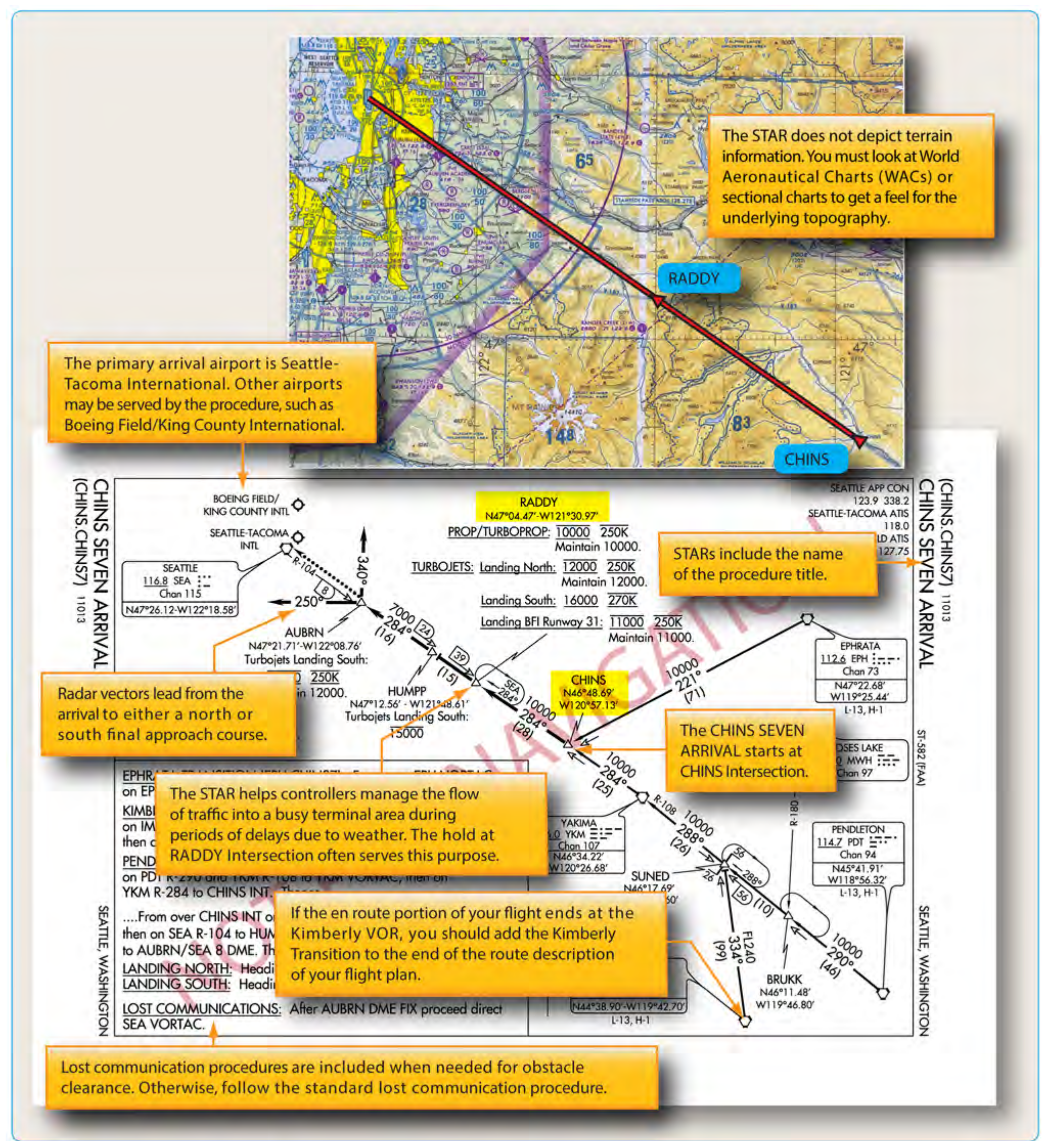
To illustrate how STARs can be used to simplify a complex clearance and reduce frequency congestion, consider the following arrival clearance issued to a pilot flying to Seattle, Washington, depicted in Figure 3-11: “Cessna 32G, cleared to the Seattle/Tacoma International Airport as filed. Maintain 12,000. At the Ephrata VOR, intercept the 221° radial to CHINS Intersection. Intercept the 284° radial of the Yakima VOR to RADDY Intersection. Cross RADDY at 10,000.
Continue via the Yakima 284° radial to AUBRN Intersection. Expect radar vectors to the final approach course.”
Now consider how this same clearance is issued when a STAR exists for this terminal area. “Cessna 32G, cleared to Seattle/Tacoma International Airport as filed, then CHINS EIGHT ARRIVAL, Ephrata Transition. Maintain 10,000 feet.” A shorter transmission conveys the same information.
Safety is enhanced when both pilots and controllers know what to expect. Effective communication increases with the reduction of repetitive clearances, decreasing congestion on control frequencies. To accomplish this, STARs are developed according to the following criteria:
- STARs must be simple, easily understood and, if possible, limited to one page.
- A STAR transition should be able to accommodate as many different types of aircraft as possible.
- VHF Omnidirectional Range/Tactical Aircraft Control (VORTACs) are used wherever possible, with some exceptions on RNAV STARs, so that military and civilian aircraft can use the same arrival.
- DME arcs within a STAR should be avoided since not all aircraft operating under IFR are equipped to navigate them.
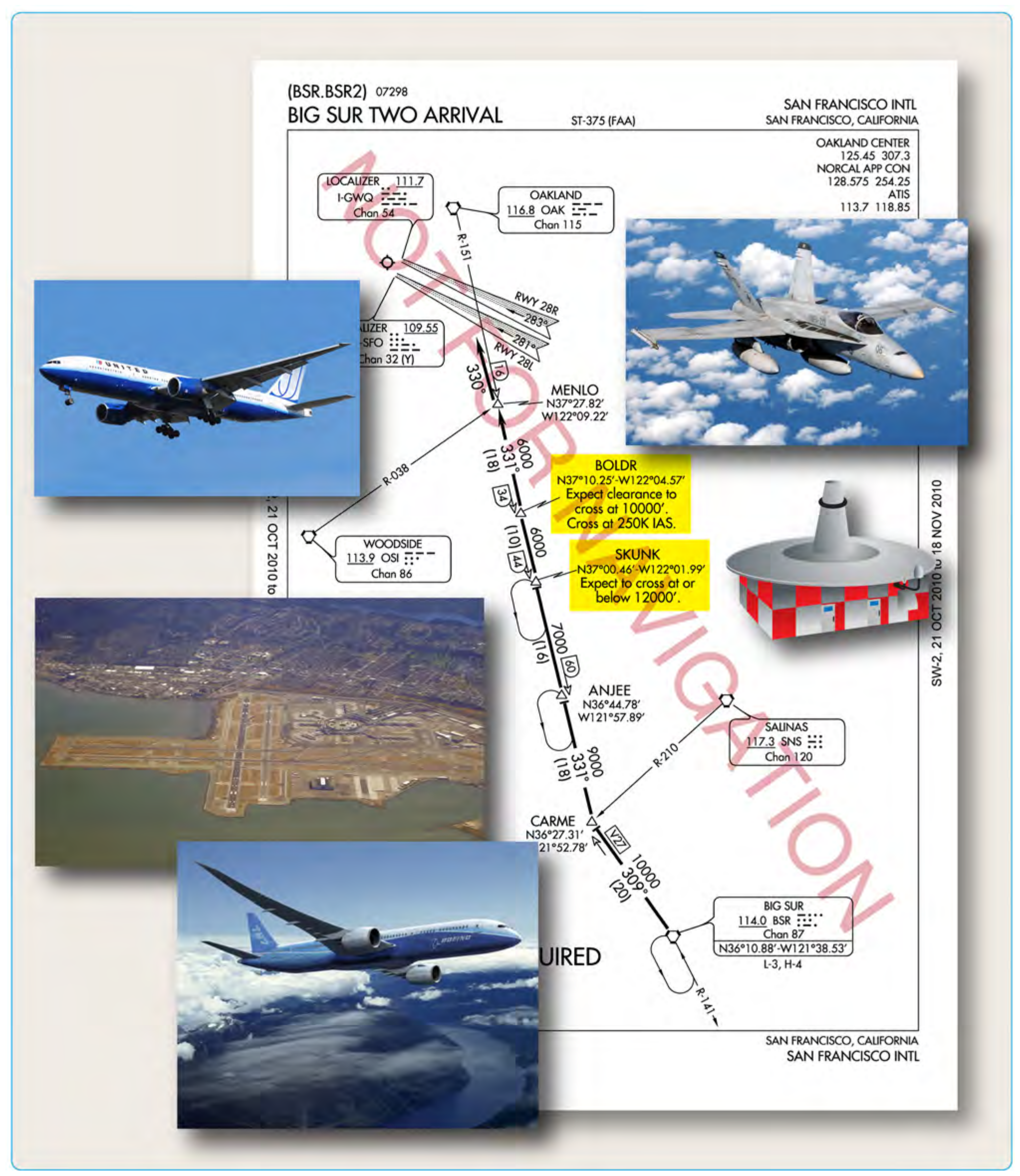
- Altitude crossing and airspeed restrictions are
included when they are assigned by ATC a majority of the time. [Figure 3-12]
STARs usually are named according to the point at which the procedure begins. In the United States, typically there are en route transitions before the STAR itself. So the STAR name is usually the same as the last fix on the en route transitions where they come together to begin the basic STAR procedure. A STAR that commences at the CHINS Intersection becomes the CHINS SEVEN ARRIVAL. When a significant portion of the arrival is revised, such as an altitude, a route, or data concerning the NAVAID, the number of the arrival changes. For example, the CHINS SEVEN ARRIVAL is now the CHINS EIGHT ARRIVAL due to modifications in the procedure.
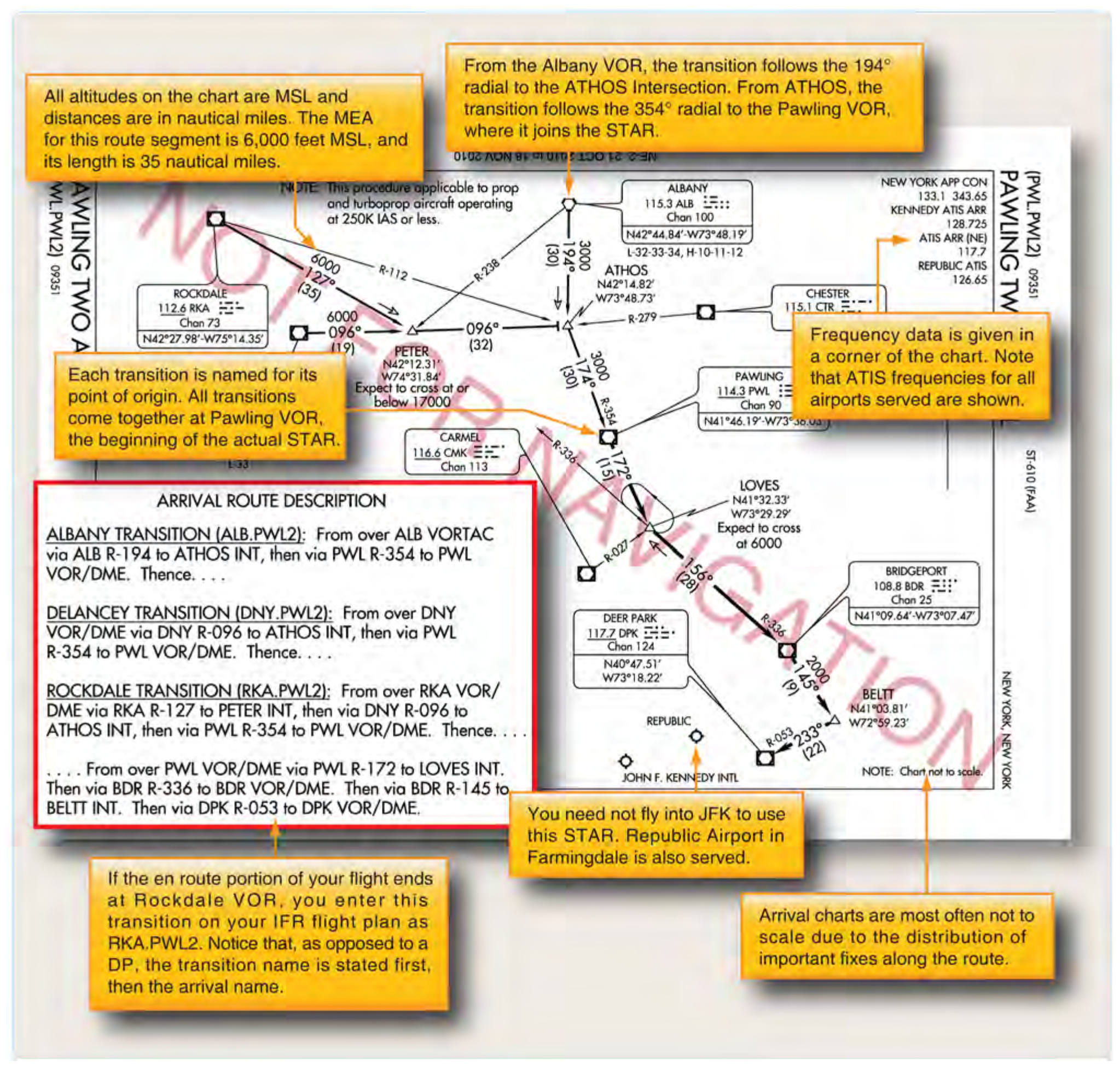
Studying the STARs for an airport may allow pilots to perceive the specific topography of the area. Note the initial fixes and where they correspond to fixes on the Aeronautical Information Services en route or area chart. Arrivals may incorporate step-down fixes when necessary to keep aircraft within airspace boundaries or for obstacle clearance. Routes between fixes contain courses, distances, and minimum altitudes, alerting aircrews to possible obstructions or terrain under their arrival path. Airspeed restrictions also appear where they aid in managing the traffic flow. In addition, some STARs require that pilots use DME and/or ATC radar. Aircrews can decode the symbology on the PAWLING TWO ARRIVAL by referring to the legend at the beginning of the TPP. [Figure 3-13]