
Chapter 4
Approaches
Circling approaches conducted at faster-than-normal, straight-in approach speeds also require a pilot to consider the larger circling approach area, since published circling minimums provide obstacle clearance only within the appropriate area of protection and is based on the approach category speed. [Figure 4-2] The circling approach area is the obstacle clearance area for aircraft maneuvering to land on a runway that does not meet the criteria for a straight- in approach. The size of the circling area varies with the approach category of the aircraft, as shown in Figure 4-2.
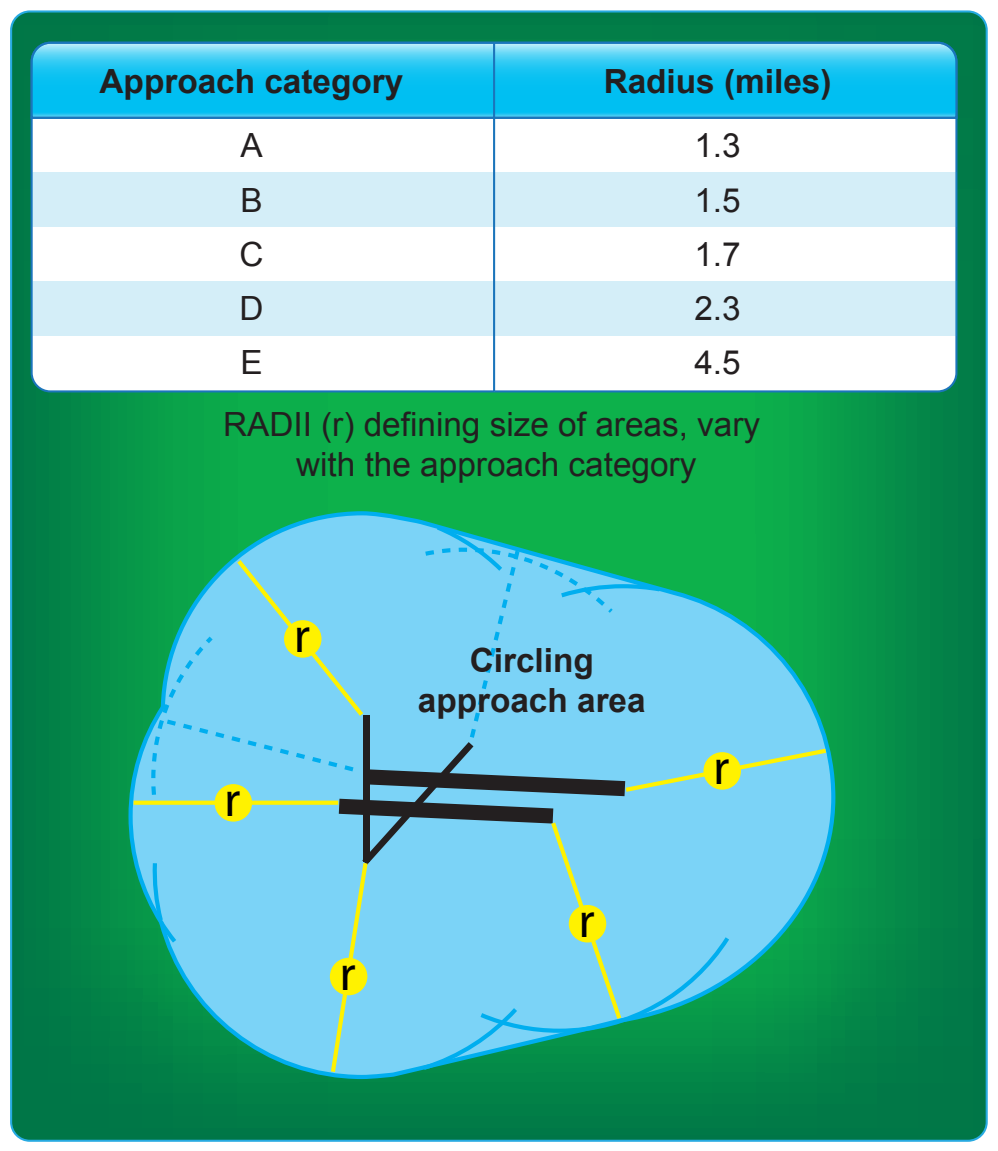
A minimum of 300 feet of obstacle clearance is provided in the circling segment. Pilots should remain at or above the circling altitude until the aircraft is continuously in a position from which a descent to a landing on the intended runway can be made at a normal rate of descent and using normal maneuvers. Since an approach category can make a difference in the approach and weather minimums and, in some cases, prohibit flight crews from initiating an approach, the approach speed should be calculated and the effects on the approach determined and briefed in the preflight planning phase, as well as reviewed prior to commencing an approach.
Prior to FAA Order 8260.3 Change 21, pilots were often faced with the challenge of descending using a stabilized approach concept if the CMDA height above airport (HAA) exceeded 1,200 feet. Once the HAA approached 1,200 feet, pilots were often forced to increase their rates of descent in order to arrive at the appropriate “in-slot” position. “In-slot” being defined as at a minimum, a CAT C or CAT D turbine-powered airplane should be wings level on a three degree - 318 ft/NM descent path not less than 1 NM from the touchdown point (1,000 feet beyond runway threshold). This was due to the small size of the circling protected airspace that the aircrews must remain within to ensure obstacle clearance.
The FAA Order 8260.3 Change 21 to the circling protected airspace afforded much greater obstacle protection.
However, it also afforded the pilot the opportunity to use the extra protected airspace to mitigate the need to conduct a high descent rate, unstabilized approach that was often necessary as a result of the previous criteria for the Circling Approach Radius (CAR). For example, under FAA Order 8260.3 Change 21, a sea level airport with a 1,500 ft HAA will have CAT C CAR of 2.86 NM, a 1.16 NM (68.5%) increase over pre-Change 21 CAR for CAT C. This extra protected airspace can be used by the pilot to maneuver the aircraft instead of being forced to use high descent rates which are often necessary for high HAA circling approaches.
Most commercial operators dictate standard procedures for conducting instrument approaches in their FAA-approved manuals. These standards designate company callouts, flight profiles, configurations, and other specific duties for each flight deck crewmember during the conduct of an instrument approach.
Instrument Approach Charts
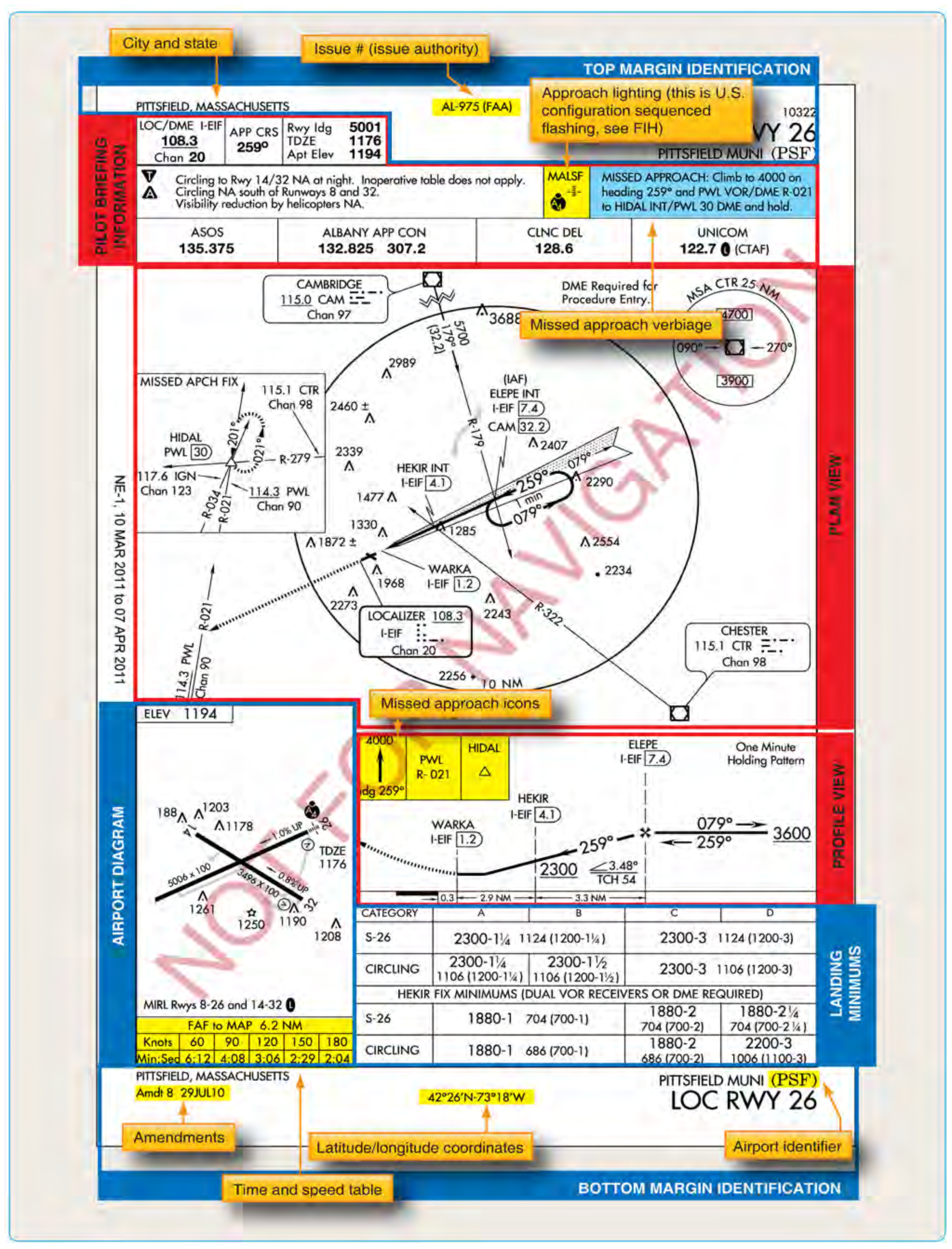
Beginning in February 2000, the FAA began issuing the current format for instrument approach charts. This chart was developed by the Department of Transportation (DOT), Volpe National Transportation Systems Center and is commonly referred to as the Pilot Briefing Information format. The FAA chart format is presented in a logical order, facilitating pilot briefing of the procedures. [Figure 4-3]
Approach Chart Naming Conventions
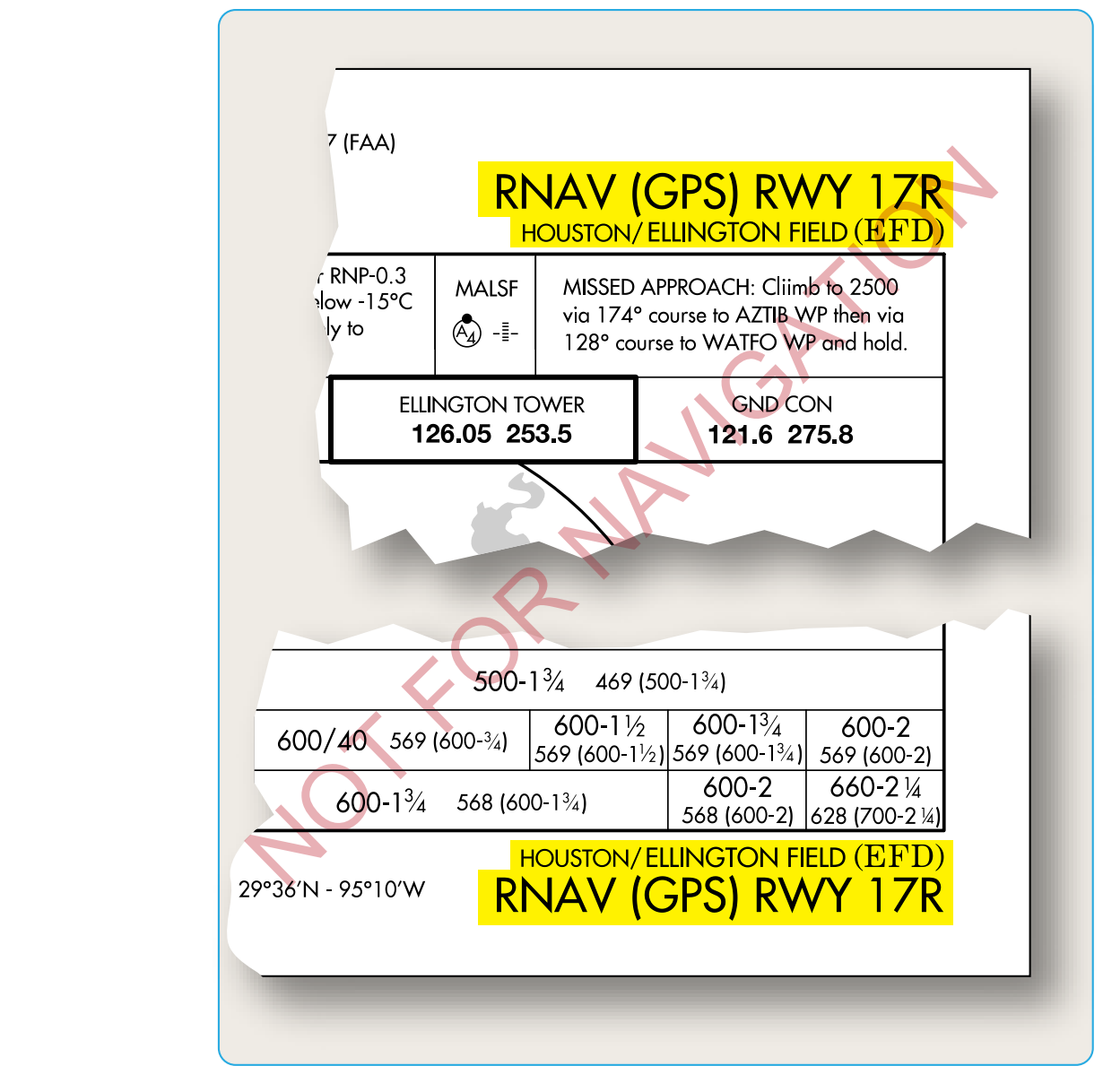
Individual FAA charts are identified on both the top and bottom of the page by their procedure name (based on the NAVAIDs required for the final approach), runway served, and airport location. The identifier for the airport is also listed immediately after the airport name. [Figure 4-4]
There are several types of approach procedures that may cause some confusion for flight crews unfamiliar with the naming conventions. Although specific information about each type of approach is covered later in this chapter, listed below are a few procedure names that can cause confusion.
Straight-In Procedures
When two or more straight-in approaches with the same type of guidance exist for a runway, a letter suffix is added to the title of the approach so that it can be more easily identified. These approach charts start with the letter Z and continue in reverse alphabetical order. For example, consider the (RNAV) (GPS) Z RWY 13C and RNAV (RNP) Y RWY 13C approaches at Chicago Midway International Airport. [Figure 4-5] Although these two approaches can be flown with a global positioning system (GPS) to the same runway, they are significantly different (e.g., one is a Required Navigation Performance (RNP) Authorization Required (AR) formally known as SPECIAL AIRCRAFT & AIRCREW AUTHORIZATION REQUIRED (SAAAR);” one has circling minimums and the other does not; the minimums are different; and the missed approaches are not the same). The approach procedure labeled Z has lower landing minimums than Y (some older charts may not reflect this).
In this example, the LNAV MDA for the RNAV (GPS) Z RWY 13C has the lowest minimums of either approach due to the differences in the final approach required obstacle clearance (ROC) evaluation. This convention also eliminates any confusion with approach procedures labeled A and B, where only circling minimums are published. The designation of two area navigation (RNAV) procedures to the same runway can occur when it is desirable to accommodate panel mounted GPS receivers and flight management systems (FMSs), both with and without vertical navigation (VNAV). It is also important to note that only one of each type of approach for a runway, including ILS, VHF omnidirectional range (VOR), and non-directional beacon (NDB) can be coded into a database.
Circling-Only Procedures
Approaches that do not have straight-in landing minimums are identified by the type of approach followed by a letter. Examples in Figure 4-6 show four procedure titles at the same airport that have only circling minimums.
As can be seen from the example, the first approach of this type created at the airport is labeled with the letter A, and the lettering continues in alphabetical order. Typically, circling only approaches are designed for one of the following reasons: