Chapter 4
Approaches
- The final approach course alignment with the runway centerline exceeds 30°.
- The descent gradient is greater than 400 ft/NM from the FAF to the threshold crossing height (TCH). When this maximum gradient is exceeded, the circling only approach procedure may be designed to meet the gradient criteria limits. This does not preclude a straight-in landing if a normal descent and landing can be made in accordance with the applicable CFRs.
- A runway is not clearly defined on the airfield.
Communications
The communication strip provided near the top of FAA approach charts gives flight crews the frequencies that they can expect to be assigned during the approach. The frequencies are listed in the logical order of use from arrival to touchdown. Having this information immediately available during the approach reduces the chances of a loss of contact between ATC and flight crews during this critical phase of flight.
It is important for flight crews to understand their responsibilities with regard to communications in the various approach environments. There are numerous differences in communication responsibilities when operating into and out of airports without ATC towers as compared to airports with control towers. Today’s pilots face an increasing range of ATC environments and conflicting traffic dangers, making approach briefing and preplanning more critical. Individual company operating manuals and SOPs dictate the duties for each crewmember.
FAA AC 120-71, Standard Operating Procedures for Flight Deck Crewmembers, contains the following concerning ATC communications: SOPs should state who (Pilot Flying (PF), Pilot Monitoring (PM), Flight Engineer (FE/SO)) handles the radios for each phase of flight, as follows:
- PF makes input to aircraft/autopilot and/or verbally states clearances while PM confirms input is what he or she read back to ATC.
- Any confusion in the flight deck is immediately cleared up by requesting ATC confirmation.
- If any crewmember is off the flight deck, all ATC instructions are briefed upon his or her return. Or,
if any crewmember is off the flight deck, all ATC instructions are written down until his or her return and then passed to that crewmember upon return. Similarly, if a crewmember is off ATC frequency when making a precision approach (PA) announcement or when talking on company frequency, all ATC instructions are briefed upon his or her return.
- Company policy should address use of speakers, headsets, boom microphone, and/or hand-held microphone.
- SOPs should state the altitude awareness company policy on confirming assigned altitude.
Example: The PM acknowledges ATC altitude clearance. If the aircraft is on the autopilot, then the PF makes input into the autopilot/altitude alerter. PF points to the input while stating the assigned altitude as he or she understands it. The PM then points to the input stating aloud what he or she understands the ATC clearance to be confirming that the input and clearance match. If the aircraft is being hand-flown, then the PM makes the input into the altitude alerter/autopilot, then points to the input and states clearance. PF then points to the alerter stating aloud what he or she understands the ATC clearance to be confirming that the alerter and clearance match.
Example: If there is no altitude alerter in the aircraft, then both pilots write down the clearance, confirm that they have the same altitude, and then cross off the previously assigned altitude.
Approach Control
Approach control is responsible for controlling all instrument flights operating within its area of responsibility. Approach control may serve one or more airports. Control is exercised primarily through direct pilot and controller communication and airport surveillance radar (ASR). Prior to arriving at the initial approach fix (IAF), instructions will be received from the air route traffic control center (ARTCC) to contact approach control on a specified frequency. Where radar is approved for approach control service, it is used not only for radar approaches, but also for vectors in conjunction with published non-radar approaches using conventional NAVAIDs or RNAV/GPS.
When radar handoffs are initiated between the ARTCC and approach control, or between two approach control facilities, aircraft are cleared (with vertical separation) to an outer fix most appropriate to the route being flown and, if required, given holding instructions. Or, aircraft are cleared to the airport or to a fix so located that the handoff is completed prior to the time the aircraft reaches the fix. When radar handoffs are used, successive arriving flights may be handed off to approach control with radar separation in lieu of vertical separation.
After release to approach control, aircraft are vectored to the final approach course. ATC occasionally vectors the aircraft across the final approach course for spacing requirements. The pilot is not expected to turn inbound on the final approach course unless an approach clearance has been issued. This clearance is normally issued with the final vector for interception of the final approach course, and the vector enables the pilot to establish the aircraft on the final approach course prior to reaching the FAF.
Air Route Traffic Control Center (ARTCC)
ARTCCs are approved for and may provide approach control services to specific airports. The radar systems used by these centers do not provide the same precision as an ASR or precision approach radar (PAR) used by approach control facilities and control towers, and the update rate is not as fast. Therefore, pilots may be requested to report established on the final approach course. Whether aircraft are vectored to the appropriate final approach course or provide their own navigation on published routes to it, radar service is automatically terminated when the landing is completed; or when instructed to change to advisory frequency at airports without an operating ATC tower, whichever occurs first. When arriving on an IFR flight plan at an airport with an operating control tower, the flight plan is closed automatically upon landing.
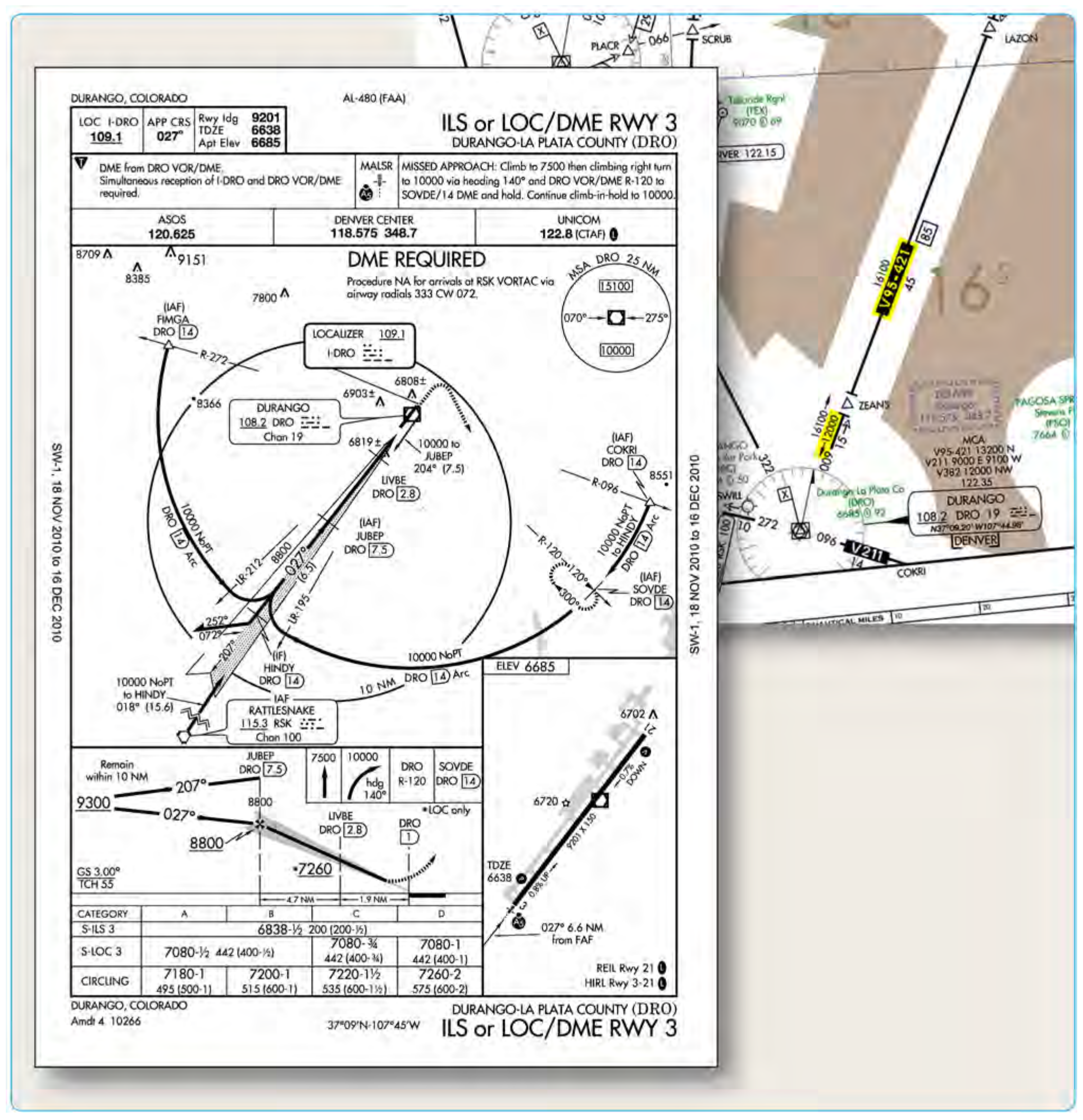
The extent of services provided by approach control varies greatly from location to location. The majority of Part 121 operations in the NAS use airports that have radar service and approach control facilities to assist in the safe arrival and departure of large numbers of aircraft. Many airports do not have approach control facilities. It is important for pilots to understand the differences between approaches with and without an approach control facility. For example, consider the Durango, Colorado, ILS DME RWY 2 and low altitude en route chart excerpt shown in Figure 4-7.